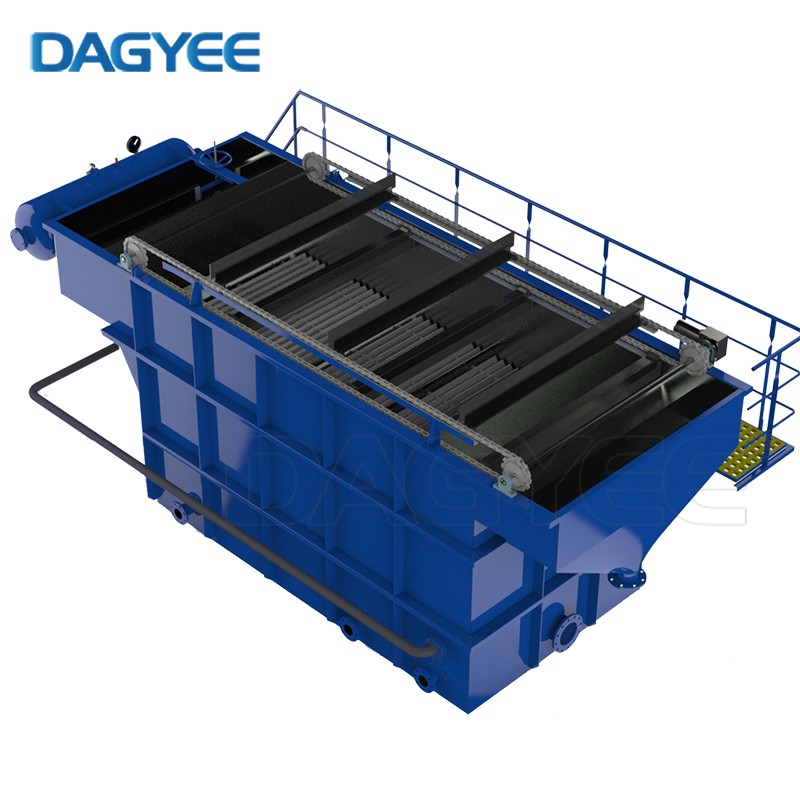
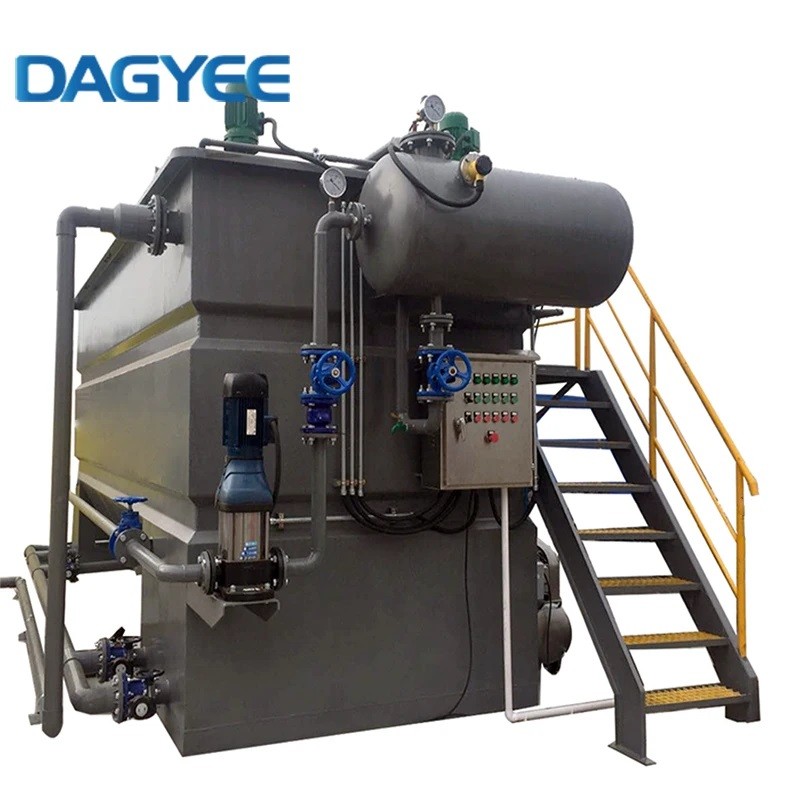
Industrial Dissolved air flotation (DAF) System – High-Efficiency Removal of TSS, FOG, and Emulsified Oils
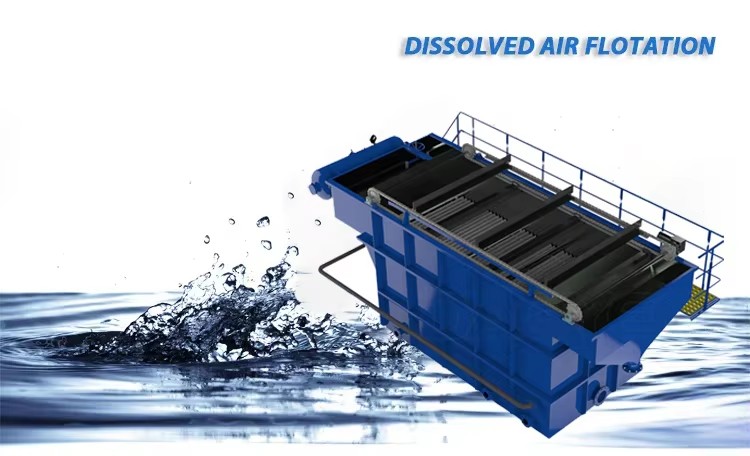
In many industrial and municipal wastewater applications, conventional gravity settling is simply not effective. Light suspended solids, emulsified oils, fats, grease, and biological flocs do not settle readily—they remain suspended and pass through clarifiers, fouling downstream equipment and violating discharge permits. This is where Dissolved air flotation (DAF) becomes the technology of choice.
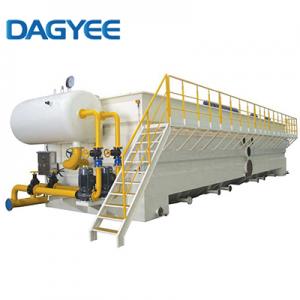
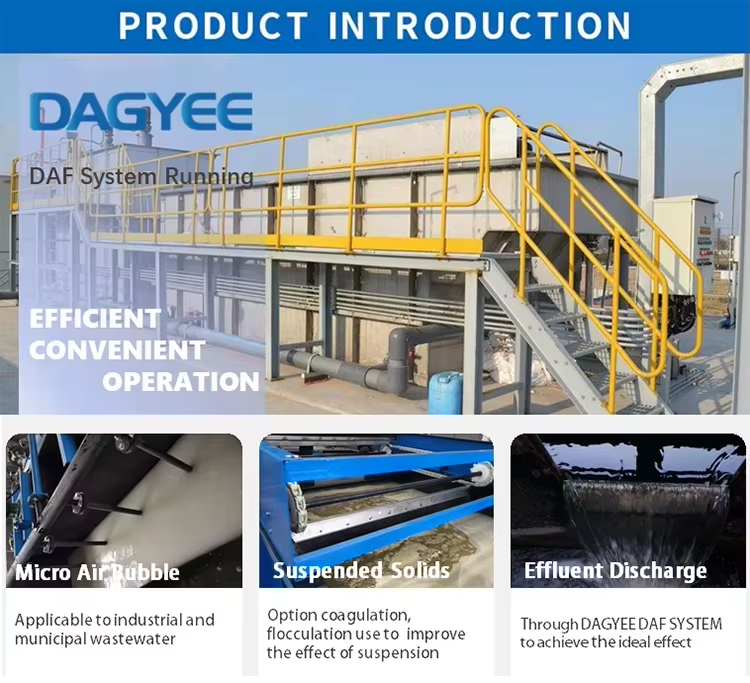
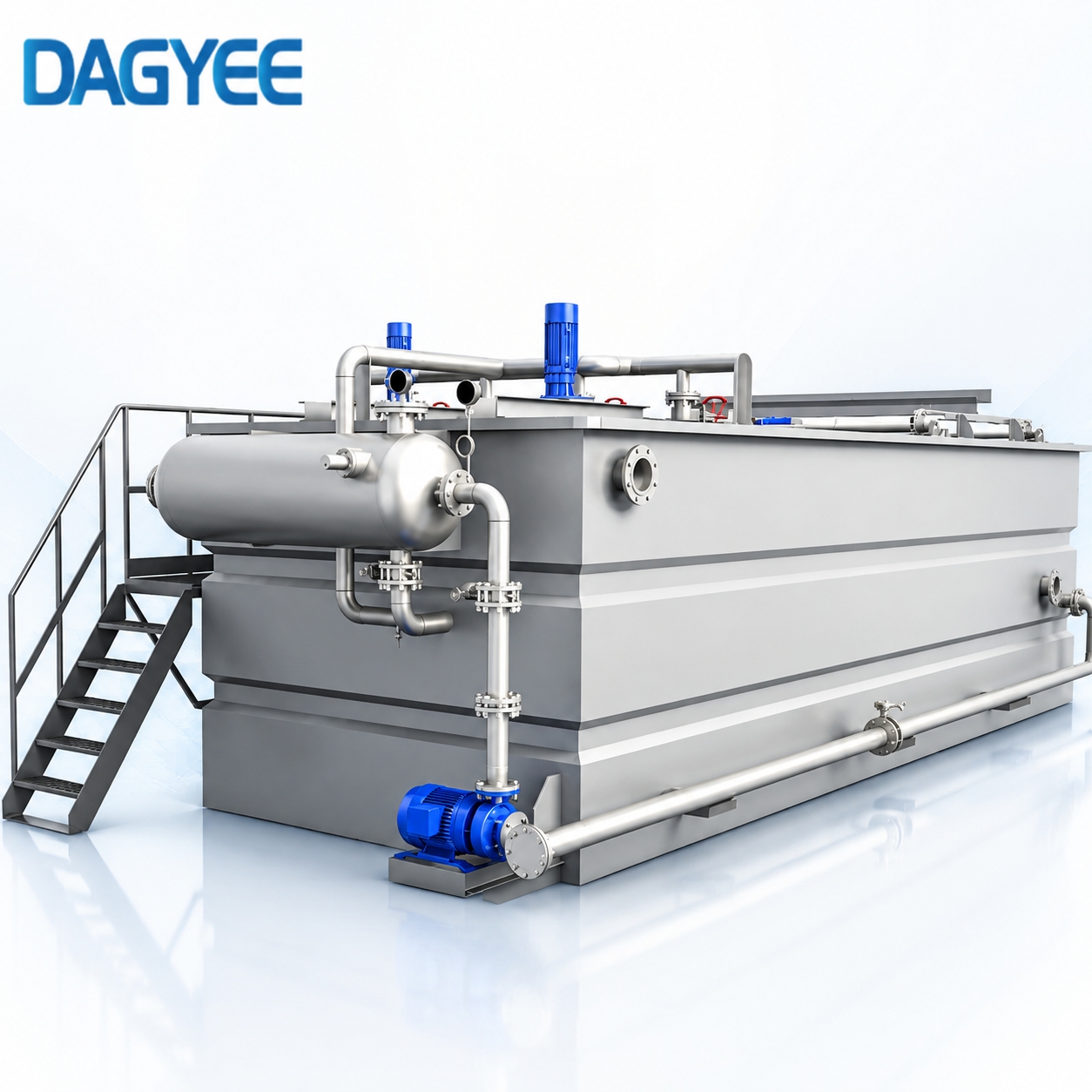
The DAGYEE Industrial DAF System is a highly efficient clarification solution that removes total suspended solids (TSS), fats, oils, and grease (FOG), and emulsified oils from wastewater streams. Unlike settling tanks that rely on gravity, DAF uses micro-bubbles to lift contaminants to the surface, where they are mechanically skimmed and removed. The result is clear, compliant effluent with removal efficiencies up to 95% for TSS and 99% for FOG.
This system is ideal for food processing plants, oil and gas facilities, chemical manufacturers, paper mills, and municipal treatment plants. It delivers reliable performance in a compact footprint, with automated operation and low maintenance requirements.
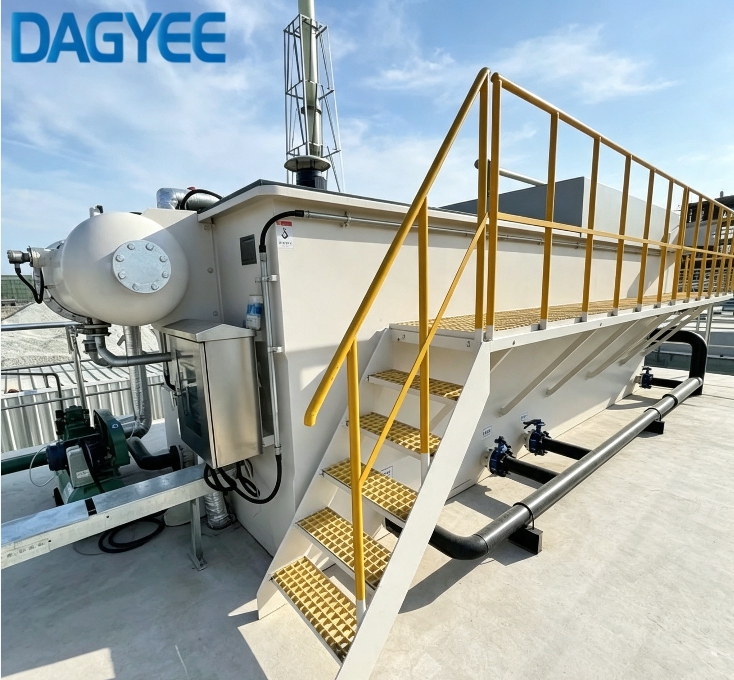
How the DAF System Works
The DAF process uses dissolved air flotation to separate suspended solids, oils, and grease from wastewater.
The Process Flow
Step 1: Influent Conditioning
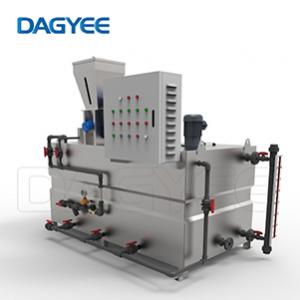
Wastewater enters the DAF system through an inlet chamber. Coagulants and flocculants are added to destabilize particles and form larger, more floatable flocs. The chemical conditioning stage is critical for achieving high removal efficiencies.
Step 2: Air Saturation
A portion of the clarified effluent is recycled and pumped into a pressure vessel called the saturator. Air is introduced under pressure, dissolving into the water.
Step 3: Micro-Bubble Generation
The pressurized, air-saturated water is released through specialized nozzles at the inlet of the flotation tank. The pressure drop causes the dissolved air to come out of solution, forming millions of micro-bubbles.
Step 4: Bubble Attachment
The micro-bubbles attach to the suspended solids, oil droplets, and flocs. The air-particle aggregates have a lower density than water and rapidly rise to the surface.
Step 5: Surface Skimming
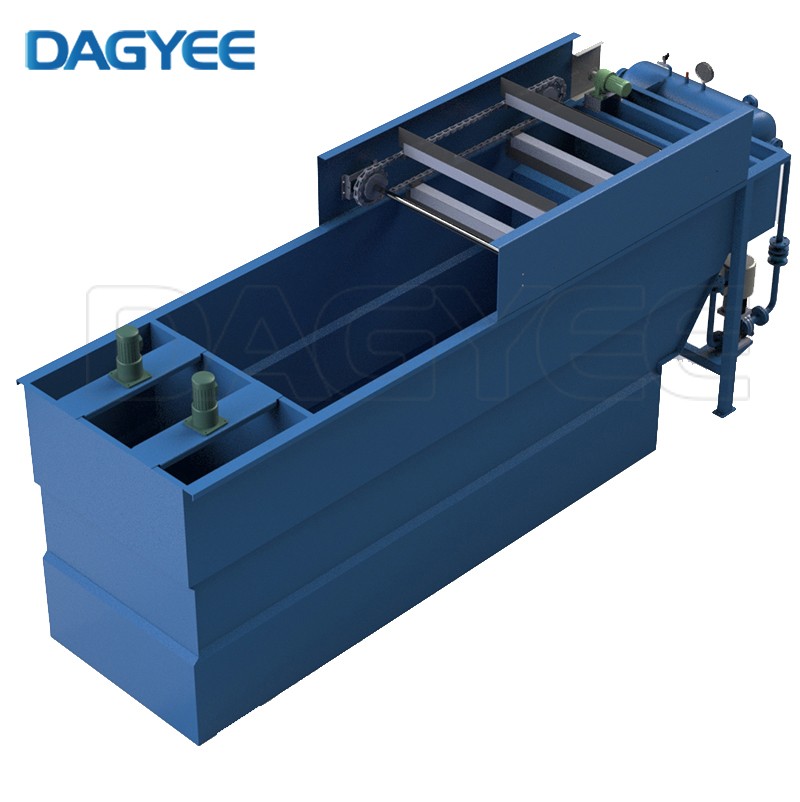
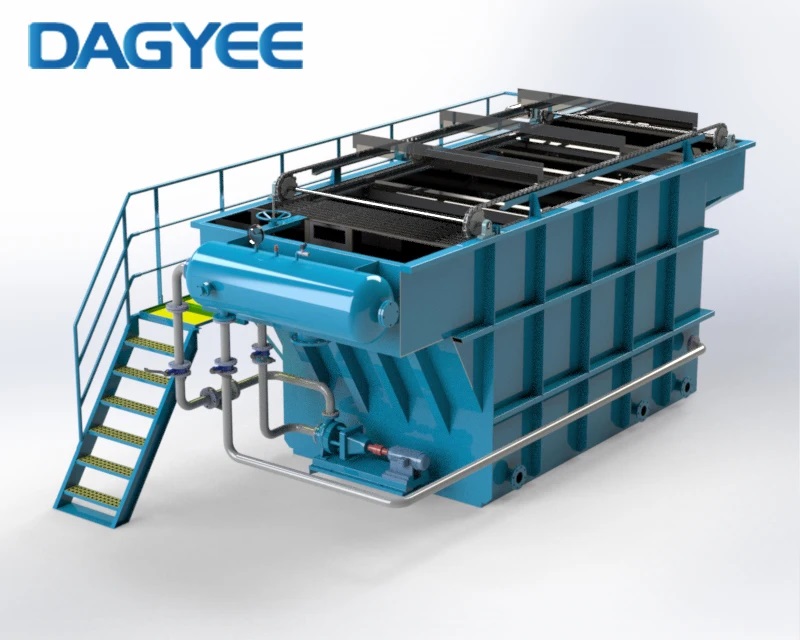
Floated solids form a stable sludge blanket on the water surface. A motorized scraper continuously removes the floated sludge into a collection hopper.
Step 6: Clarified Effluent
Clean water exits from the bottom of the flotation cell, ready for discharge or further treatment. The clarified effluent can be reused as recycle water for the saturator system or sent to downstream biological treatment.
Step 7: Sludge Handling
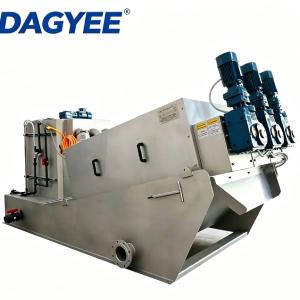
Concentrated sludge is pumped from the sludge hopper to dewatering equipment or disposal.
DAGYEE Technical Specifications
Model Number: DAGYEE-DAF
Flow Capacity: 3 – 200 m³/h (selectable)
Tank Configuration: Circular or Rectangular
Micro-Bubble Size: 20 – 100 microns
Saturator Pressure: 4 – 6 bar
Recycle Ratio: 10 – 30% of influent flow
Hydraulic Retention Time: 15 – 45 minutes
TSS Removal: Up to 95%
FOG Removal: Up to 99%
Sludge Concentration: 3 – 7% solids
Construction Materials: SS304 / SS316L / Carbon steel with epoxy coating
Power Supply: 380V ± 10%, 50/60Hz, 3 Phase
Control System: PLC with HMI touch screen
Certification: CE
Model Selection Guide
| DAF Model | Qm3/h | Piping Connections | Physical Dimensions(m) | Weight (Kg) | Operating Weight (Kg) |
|---|---|---|---|---|---|
| DAF-003 | 3 |
Inlet: DN50 Outlet: DN50 Sludge: DN100 Vent: DN100 |
L/L1: 3.7/2.8 W/W1: 2.4/1.16 H/H1: 2.2/1.7 |
1500 | 5000 |
| DAF-005 | 5 |
Inlet: DN80 Outlet: DN80 Sludge: DN100 Vent: DN80 |
L/L1: 4/3 W/W1: 2.4/1.16 H/H1: 2.2/1.7 |
1600 | 7000 |
| DAF-010 | 10 |
Inlet: DN100 Outlet: DN100 Sludge: DN100 Vent: DN100 |
L/L1: 4.65/3.8 W/W1: 2.7/1.36 H/H1: 2.4/1.9 |
2000 | 12000 |
| DAF-015 | 15 |
Inlet: DN125 Outlet: DN100 Sludge: DN150 Vent: DN100 |
L/L1: 5.6/4.5 W/W1: 2.9/1.66 H/H1: 2.5/2 |
2200 | 18000 |
| DAF-020 | 20 |
Inlet: DN150 Outlet: DN150 Sludge: DN150 Vent: DN100 |
L/L1: 5.9/4.8 W/W1: 3.2/1.96 H/H1: 2.5/2 |
3000 | 22000 |
| DAF-030 | 30 |
Inlet: DN150 Outlet: DN150 Sludge: DN150 Vent: DN100 |
L/L1: 6.8/5.5 W/W1: 3.2/2.16 H/H1: 2.7/2.2 |
3800 | 32000 |
| DAF-040 | 40 |
Inlet: DN200 Outlet: DN150 Sludge: DN150 Vent: DN100 |
L/L1: 8/6.7 W/W1: 3.6/2.6 H/H1: 2.7/2.2 |
5000 | 45000 |
| DAF-050 | 50 |
Inlet: DN200 Outlet: DN150 Sludge: DN150 Vent: DN100 |
L/L1: 8.4/7 W/W1: 3.6/2.6 H/H1: 2.7/2.2 |
5500 | 55000 |
| DAF-060 | 60 |
Inlet: DN250 Outlet: DN200 Sludge: DN150 Vent: DN100 |
L/L1: 9.9/8.4 W/W1: 3.8/2.8 H/H1: 2.9/2.4 |
6000 | 66000 |
| DAF-070 | 70 |
Inlet: DN250 Outlet: DN200 Sludge: DN150 Vent: DN100 |
L/L1: 10.4/9 W/W1: 3.8/2.8 H/H1: 2.9/2.4 |
6500 | 75000 |
| DAF-080 | 80 |
Inlet: DN250 Outlet: DN250 Sludge: DN150 Vent: DN100 |
L/L1: 10.8/9.4 W/W1: 4/3 H/H1: 2.9/2.4 |
7500 | 100000 |
| DAF-100 | 100 |
Inlet: DN300 Outlet: DN250 Sludge: DN150 Vent: DN100 |
L/L1: 12.1/10.6 W/W1: 4.2/3.2 H/H1: 2.9/2.4 |
9000 | 110000 |
| DAF-120 | 120 |
Inlet: DN300 Outlet: DN250 Sludge: DN150 Vent: DN100 |
L/L1: 12.5/11.4 W/W1: 4.4/3.4 H/H1: 2.9/2.4 |
10000 | 130000 |
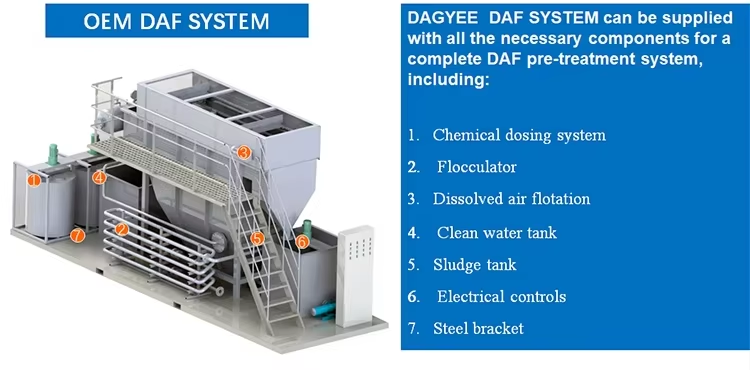
Dissolved air flotation process flow
Chemical Treatment: Wastewater is mixed with coagulants and flocculants to form larger particles ("flocs").
Air Injection & Contact: Pressurized, air-saturated water is released into the water stream, creating fine bubbles that attach to the flocs.
Separation: The air-floc aggregates float to the surface, forming a sludge layer.
Sludge Removal: A surface scraper removes the floating sludge.
Water Outlet: Clarified water is collected from the bottom of the tank and discharged. Part of it is often recycled to create the pressurized air stream.
DAF vs. Conventional Clarifiers
| Feature | DAF System | Gravity Settling Tank | Lamella Clarifier |
|---|---|---|---|
| Best at Removing | Light suspended solids, emulsified oils, FOG, biological flocs | Dense, fast-settling solids | Medium-density solids |
| Performance on FOG | Excellent — micro-bubbles lift oil to surface | Weak — FOG does not settle | Limited — plates do not address emulsified oil |
| Footprint | Compact — high hydraulic loading rate | Large — requires long residence time | Compact |
| Sludge Characteristics | Drier float sludge — easier to dewater | Wet settled sludge — higher disposal volume | Moderate |
| Chemical Usage | Moderate (coagulation/flocculation) | Low | Low to moderate |
| Space Savings | 30-50% less than conventional clarifiers | Baseline | Compact |
Food and Beverage Processing
Removes FOG, proteins, starches, and solids from wastewater. Typical capacities range from 10 to 100 m³/h for meat, poultry, dairy, and vegetable processing plants.
Oil and Gas / Refineries
Separates emulsified hydrocarbons and suspended solids from produced water and refinery effluent. Capacities typically range from 20 to 200 m³/h.
Chemical Processing
Removes solvents, pigments, surfactants, and suspended particles from chemical wastewater. Capacities range from 10 to 100 m³/h.
Pulp and Paper
Recovers fiber, fillers, and coating pigments from white water. Capacities range from 20 to 200 m³/h.
Municipal Wastewater
Handles primary clarification, phosphorus removal, and combined sewer overflow treatment. Capacities range from 50 to 500 m³/h.
Meat and Poultry Processing
Removes blood, animal fats, and protein solids from high-strength effluent. Capacities range from 10 to 80 m³/h.
Metalworking and Automotive
Removes coolants, cutting fluids, and paint shop wastewater. Capacities range from 5 to 50 m³/h.
Plastic Recycling
Removes fines, labels, oils, and microplastics from wash water. Capacities range from 10 to 50 m³/h.
Chemical Pre-Treatment Requirements
Effective DAF operation typically requires chemical conditioning to achieve high removal efficiencies.
Typical Chemical Addition:
Coagulant — aluminum sulfate (alum), ferric chloride, or polyaluminum chloride (PAC). Neutralizes particle charges to allow aggregation.
Flocculant — anionic or cationic polymer. Binds particles into larger, more floatable flocs.
pH Adjustment — acid or caustic to optimize coagulation chemistry.
Dosing Considerations:
Dosage depends on wastewater characteristics and is determined by jar testing.
Automated dosing systems ensure consistent chemical feed.
Chemical savings of up to 50% can be achieved compared to coagulation-settling systems.
Contact Us
The DAGYEE Industrial Dissolved Air Flotation (DAF) System provides reliable, high-efficiency removal of suspended solids, fats, oils, and grease from industrial and municipal wastewater. With up to 95% TSS removal, up to 99% FOG removal, and a compact footprint, it delivers consistent compliance and lower operating costs.
Contact our team for a free consultation and customized DAF system design for your application.