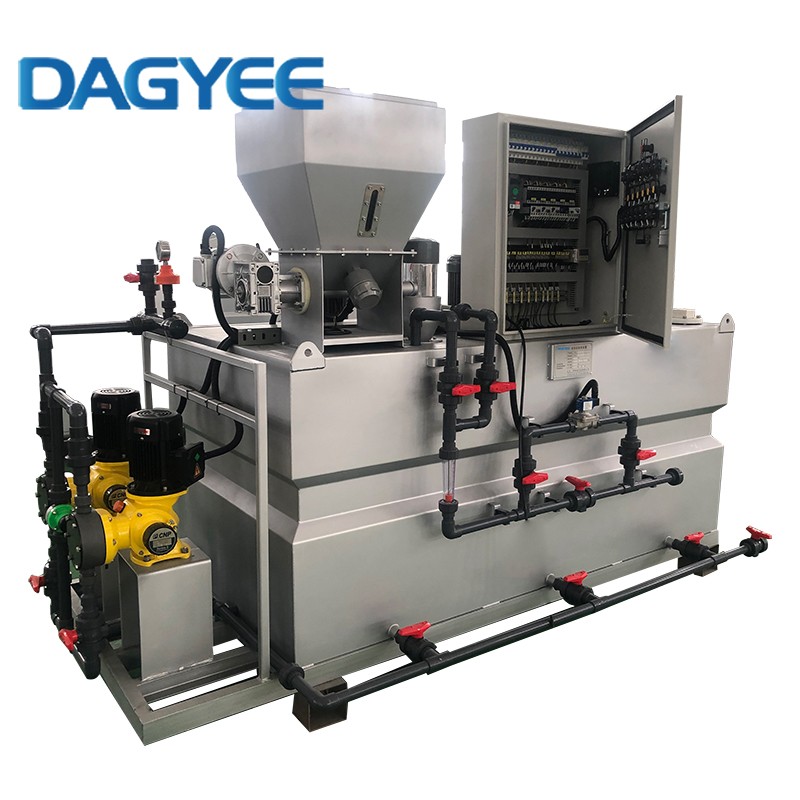
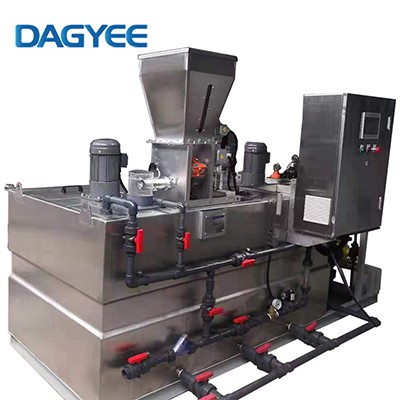
DAGYEE Complete Polymer Preparation Plant – Integrated Mixing, Maturation & Dosing System
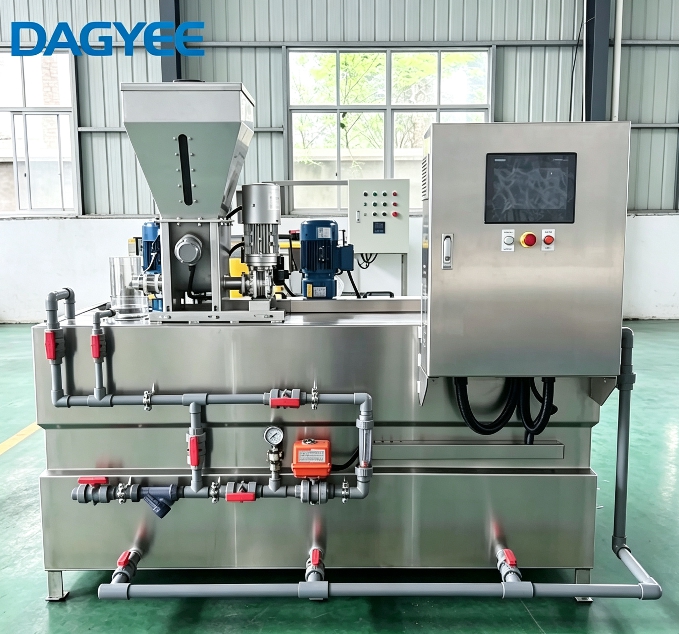
DAGYEE Polymer Unit
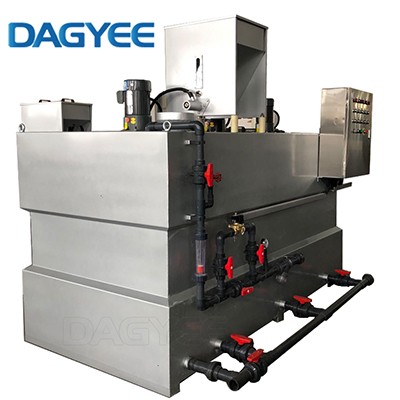
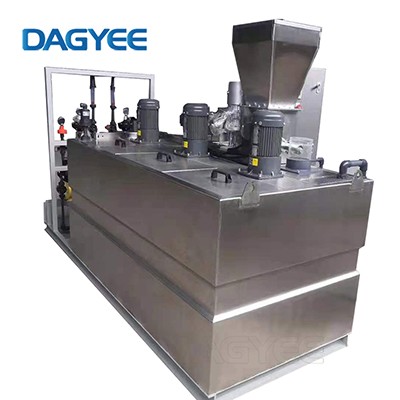
This is a complete, ready-to-run polymer preparation plant. It takes dry polymer powder or liquid polymer, mixes it with water, activates it, and delivers a fully matured solution to your dosing point. The whole process runs automatically, so your operators don't have to babysit it. They just load the hopper, set the concentration, and let the system do the work.
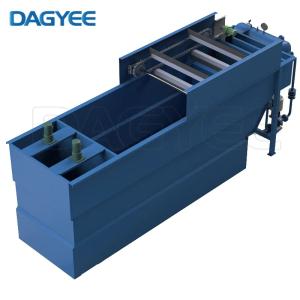
The plant uses a three-chamber design. The first chamber mixes the polymer with water. The second chamber gives it time to activate properly. The third chamber stores the ready-to-use solution until it's needed. This is the same basic approach used in large municipal treatment plants, but packaged into a compact, skid-mounted unit that fits into existing facilities without major civil works.
You can run it with dry powder or liquid polymers. The system adjusts automatically to maintain the concentration you set. If the storage tank gets low, it makes more. If the tank is full, it stops. It handles peak demand and low demand without operator intervention.
Product Overview
The DAGYEE polymer preparation unit is a fully automated system for continuous preparation of polymer solutions from dry powder or liquid polymers. The unit combines precise polymer metering, controlled wetting, gentle mixing, and age-dependent discharge to produce fully activated polymer solutions with consistent concentration and quality.
Key Components:
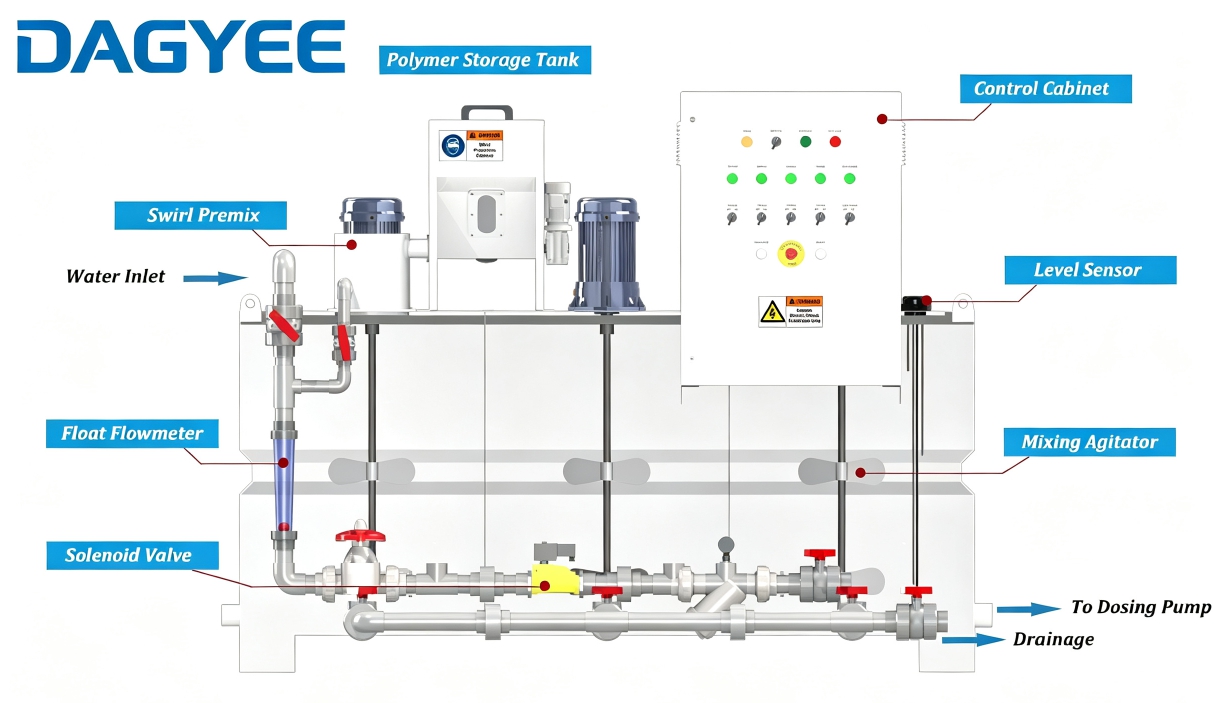
Polymer powder hopper with level sensor
Precision dosing screw feeder driven by VFD motor
Pre-wetting system to prevent agglomeration
Three-chamber tank (mixing + maturation + storage)
High-speed mixer in mixing chamber
Low-speed mixer in maturation chamber
Automatic water control with flow meter
PLC control panel with HMI touch screen
Complete piping and skid mounting
Core Function:
The system takes raw polymer powder or liquid, meters it accurately, mixes it with water, matures it to full activation, and stores the ready-to-use solution for dosing to the application point—all automatically and continuously. The PLC controls the entire sequence, from water filling to polymer feeding to solution transfer between chambers.
Step 1: Polymer Feeding
For dry polymers, the powder is stored in a hopper with a tapered bottom that stops bridging. A variable speed screw feeder pulls powder from the hopper and delivers it to the wetting zone. The screw speed is controlled by a VFD, so you can dial in exactly the feed rate you need. A heater at the feeder outlet stops moisture from clogging the screw—a common problem with PAM powders that most systems ignore.
For liquid polymers, a metering pump takes over the feeding duty. The pump draws emulsion or solution polymer from a drum or bulk tank and delivers it to the mixing zone at a controlled rate.
Step 2: Pre-Wetting
As soon as the polymer leaves the feeder, it hits a water spray that wets every particle. This is critical. If the powder hits water all at once, it forms lumps that never dissolve—they just float around in the solution, wasting polymer and clogging downstream equipment. The pre-wetting system separates the particles so they dissolve properly.
Step 3: Dissolution (Chamber One)
The wetted polymer enters the first chamber with more water. A high-speed mixer breaks up any remaining agglomerates and starts the dissolution process. This chamber is where the polymer begins to hydrate and uncoil.
Step 4: Maturation (Chamber Two)
The partially dissolved solution overflows into the second chamber. Here, a low-speed mixer keeps the solution moving without tearing the polymer chains apart. This gentle agitation is important because polymer chains are long and fragile. If you shear them too much, they lose their flocculation power. The solution stays here until it has reached the programmed maturation time—usually 30 to 60 minutes, depending on the polymer.
Step 5: Age-Dependent Transfer
This is a key detail. The system does not transfer solution to the storage chamber based only on level. It waits until the solution has been in the maturation chamber for the full programmed time. That way, you never dose partially activated polymer. You always get fully matured, fully effective solution.
Step 6: Storage and Dosing (Chamber Three)
The matured solution moves to the storage chamber. A gentle agitator keeps it uniform without damaging the polymer. When the dosing pumps call for solution, it's ready to go. When the storage level drops to a set point, the preparation cycle starts again. When the tank is full, the system stops.
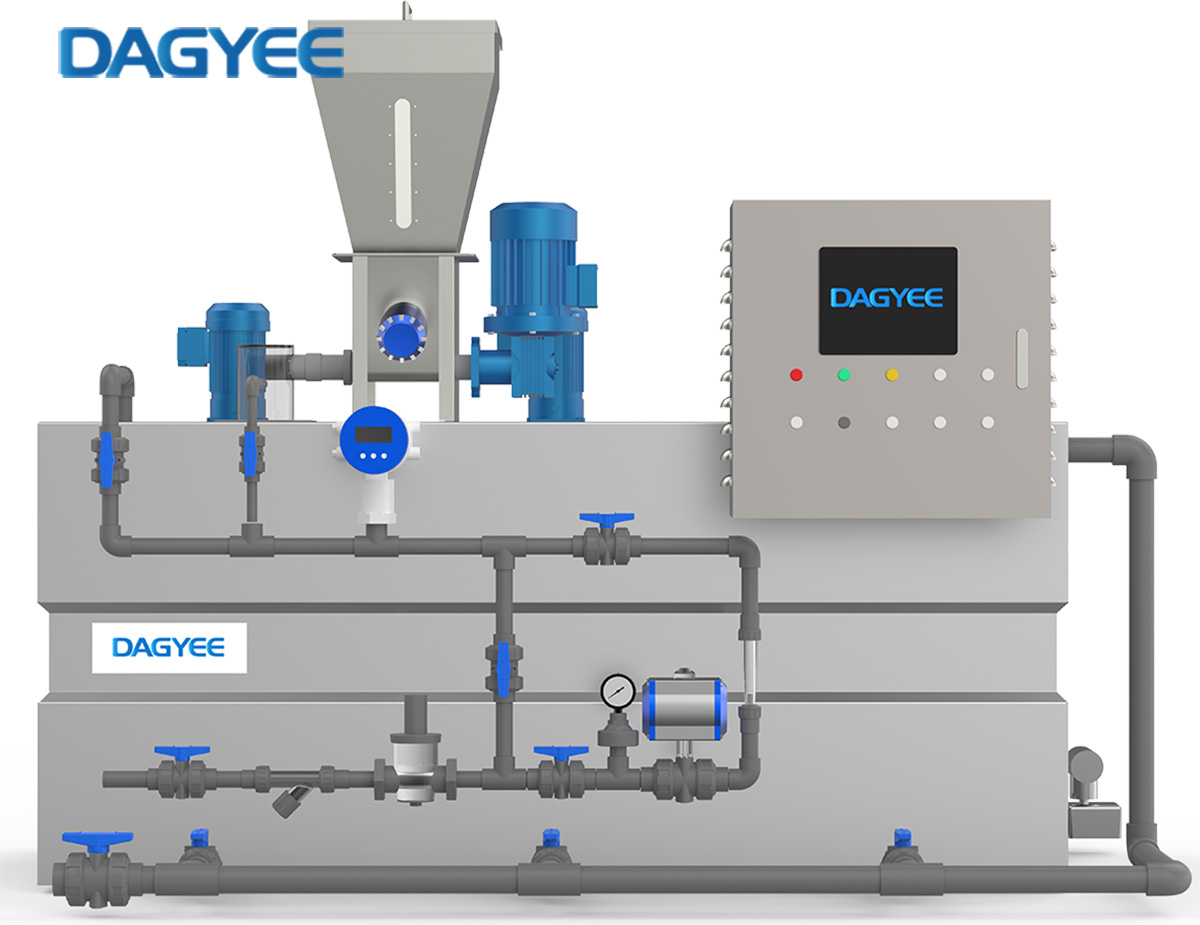
The system operates in two main modes: solution preparation and dosing.
1. Solution Preparation
For dry reagents (lime, powdered carbon, dry coagulants): reagent is fed from hopper via feeder into mixing device, mixed with water to specified concentration. Finished solution is stored in tank.
For liquid reagents (chlorine, hypochlorite, liquid coagulants): reagent is delivered from storage tank via dosing pump to dissolution tank (if dilution needed) or directly to dosing pump.
2. Dosing
Finished solution is delivered to the process via dosing pumps with adjustable capacity. Dosing is controlled by signals from process controllers (flow, pH, turbidity, ORP) or according to process specification.
Control Modes:
Automatic — from process controllers
Semi-automatic — from control panel
Manual — local pump and valve control
Polymer Preparation unit Model
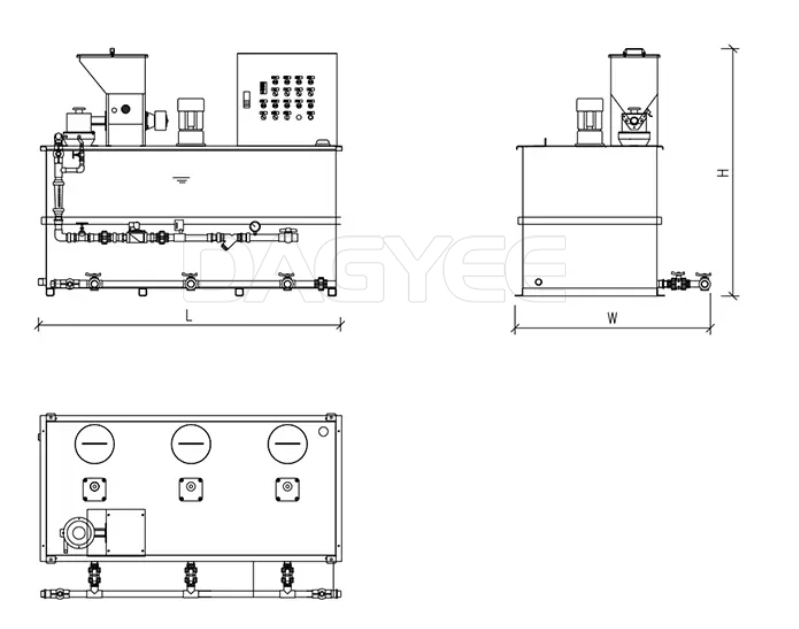
| Model | Capacity L/H | Volume L | Timing H | Dimensions MM | Weight KG | Power KW |
|---|---|---|---|---|---|---|
| DT300 | 300 | 450 | 0.6-1 | 1500*1000*500 | 300 | 1.8 |
| DT500 | 500 | 750 | 0.6-1 | 1500*1000*650 | 420 | 1.8 |
| DT1000 | 1000 | 1500 | 0.6-1 | 2000*1000*900 | 500 | 2.8 |
| DT1500 | 1500 | 2250 | 0.6-1 | 2000*1200*900 | 620 | 3 |
| DT2000 | 2000 | 3000 | 0.6-1 | 2500*1200*1000 | 800 | 3.9 |
| DT3000 | 3000 | 4500 | 0.6-1 | 3000*1500*1000 | 950 | 5.3 |
| DT5000 | 5000 | 7500 | 0.6-1 | 5000*1500*1000 | 1250 | 7 |
| DT10000 | 10000 | 15000 | 0.6-1 | 4800*1800*2000 | 3600 | 7 |
Reduced Chemical Consumption
Proper polymer activation significantly reduces chemical usage. Automated systems typically reduce polymer consumption by a substantial margin compared to manual batching, delivering significant cost savings over time.
Precision Preparation and Dosing
The use of variable frequency drive screw feeders and accurate water metering ensures consistent solution concentration. The ratio of water flow to powder feed rate determines concentration, and the automated system maintains this ratio precisely.
Considerable Savings in Running Costs
Precise polymer preparation reduces waste and optimises performance. Well-controlled hydraulic retention and contact times ensure the polymer reaches full activation before dosing, maximising its effectiveness.
Labour Saving and Easy Operation
The system is fully automated. Operators only need to spend a short time per day on refilling the hopper and visual inspection. No dedicated operator is required for continuous operation.
Space Saving and System Centralisation
The compact skid-mounted design integrates mixing, maturation, and storage in one unit. This saves valuable plant space and simplifies installation.
Optimised Mixing Properties
Separate high-speed and low-speed mixers in different chambers ensure proper dissolution without damaging polymer chains. This preserves flocculation performance and ensures complete polymer activation.
Zero Powder Loss
Enclosed systems eliminate dust exposure and ensure full utilisation of polymer without waste. This improves operator safety and reduces chemical costs.
Material: Stainless Steel, PP, or FRP
| Material | Pros | Cons | Best For |
|---|---|---|---|
| SS304 | Stands up to corrosion, strong, lasts a long time | Higher cost | Most projects |
| SS316 | Even better corrosion resistance | Costs more than 304 | High salt, very corrosive conditions |
| PP (Polypropylene) | Cheap, handles chemicals well | Low strength, ages faster | Small, low requirement projects |
| FRP (Fiberglass) | Handles chemicals, lightweight | Expensive, hard to fix | Chemical plants, special conditions |
I have seen too many plants buy a PP tank to save money. Three years later, the tank is cracked and leaking. The fittings are brittle. They end up buying a stainless steel unit anyway. The cheap one ends up being the expensive one.
The feeding screw is the heart of the dry polymer preparation system. Its design and operation directly impact solution quality and chemical consumption.
Precision Auger and VFD Control
The powder feeder uses a precision-machined screw auger driven by a variable frequency drive motor. The VFD allows the operator to control the exact RPM of the screw, ensuring accurate polymer feed regardless of powder characteristics or hopper level.
Heated Discharge Pipe
Polymer powders, especially polyacrylamide, are hygroscopic and can absorb moisture from the air, causing clogs at the feeder outlet. DAGYEE installs a heating element around the feeder discharge pipe to prevent this common issue, ensuring consistent powder flow and reducing maintenance.
Pre-Wetting System
To prevent agglomeration and ensure complete dissolution, dry polymer is wetted immediately after metering. The pre-wetting device uses a carefully designed water spray pattern to separate individual polymer particles before they enter the mixing chamber. This prevents the formation of undissolved lumps that waste chemical and can cause blockages downstream.
Tapered Hopper Design
The polymer hopper is designed with tapered geometry to promote consistent powder flow. A level sensor alerts operators when refilling is needed, ensuring uninterrupted operation. This design eliminates bridging and ensures the screw feeder receives a consistent supply of powder.
Anti-Caking Heater
Polymer powders can absorb moisture from the air and form lumps that prevent flow. DAGYEE units include a gentle heating element at the feeder discharge to prevent moisture from accumulating on the screw. This is essential for powder flow consistency, particularly with polyacrylamide powders that are prone to caking.
Direct Coupling
The screw feeder motor is directly coupled to the auger for precise speed control and reliable operation, eliminating belt slippage and ensuring consistent feed accuracy.
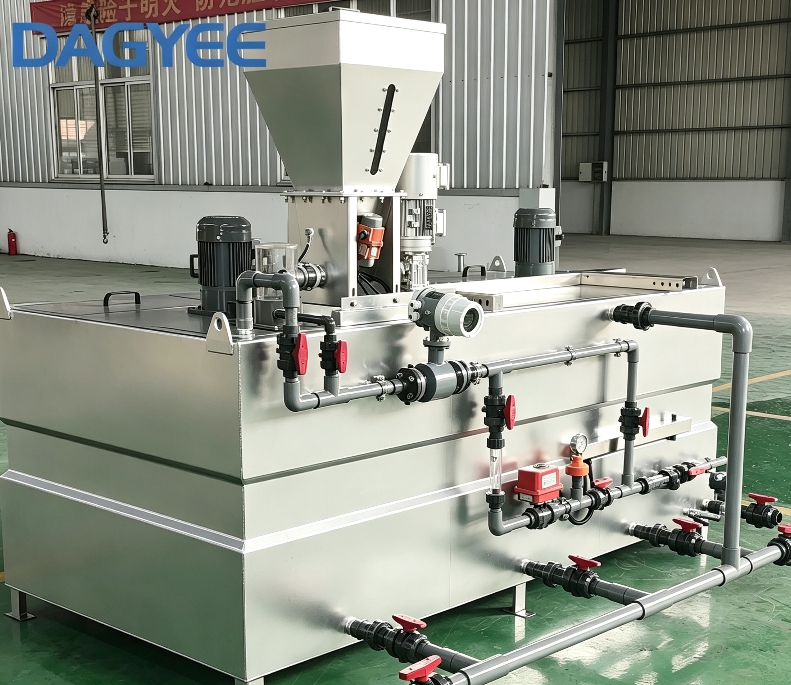
Polymer preparation Unit Feature
Three-Chamber SystemThe system includes safety interlocks that prevent operation if the hopper is empty, water supply is low, or any system fault is detected. This ensures reliable operation and protects equipment from damage.
Polymer preparation Unit Remark
♦ Model selection: Process capacity or flow volume is necessary
♦ Raw material: SS304 or SS316.
♦ Manufacturer: We have our own workshop so that best quality and loweat price can be provided for you.
♦ Customization: Custom-made is available.
Standard Inclusions:
Two-chamber tank (polypropylene)
Powder feeder with hopper and screw
2 mixers (dissolution + maturation)
Water supply system with filter and valves
Control unit (timer or PLC)
Wheeled skid
UPVC piping
Operation and maintenance manual

What Makes DAGYEE Units Different
| Feature | What It Means for You |
|---|---|
| Heated Feeder Discharge | Stops polymer powder from caking at the outlet. Keeps the feed consistent and cuts down on cleaning and maintenance time. |
| Age-Dependent Discharge Control | The polymer stays in the maturation chamber until it's fully activated. No chance of dosing under-matured solution that wastes chemical and underperforms. |
| Low-Shear Maturation | The maturation mixer runs gently enough to keep the solution mixed without breaking polymer chains. You get the full flocculation performance the polymer was designed to deliver. |
| Enclosed, Dust-Free Design | Powder stays in the system from hopper to storage outlet. No dust in the air, safer for operators, and less chemical waste from spillage or airborne loss. |
| Precision Screw Feeder | The stainless steel auger is machined to tight tolerances, so feed rates are accurate and repeatable. VFD control lets you fine-tune the speed to suit different polymers. |
| Pre-Wetting as Standard | Powder is wetted immediately after metering, preventing lumps from forming. This is standard on every unit, not an extra-cost option. Less waste, fewer blockages. |
| Robust, Long-Life Construction | Built with heavy-duty materials and reliable motors from established brands. Fewer breakdowns, longer service intervals, and lower total cost of ownership. |
| Material Options | Choose stainless steel or polypropylene to match your site's water chemistry and environmental conditions. Food-grade materials available for potable water applications. |
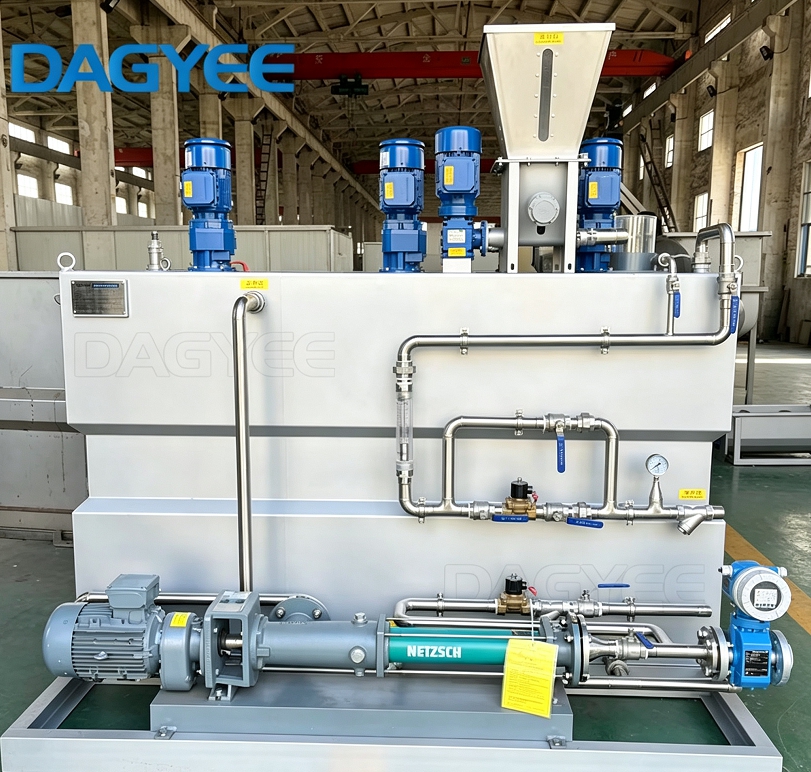
Summary
The DAGYEE Complete Polymer Preparation Plant is a ready-to-run system that takes dry or liquid polymer, prepares it properly, and delivers fully activated solution to your dosing point. It uses a three-chamber design with age-dependent discharge, so you get consistent solution quality and full flocculation performance. The heated feeder outlet, low-shear mixers, and pre-wetting system are features that many systems omit, but they make the difference between a system that works reliably and one that gives you trouble.
Whether you're treating municipal wastewater, dewatering sludge, or running a mining operation, this plant delivers the polymer solution you need, when you need it, without wasting chemical or operator time.
Contact Us
The DAGYEE Complete Polymer Preparation Plant delivers consistent, fully activated polymer solution for water and wastewater treatment. It's built to run reliably, waste less chemical, and require less operator attention than manual or poorly designed automated systems.
Contact our team for a free consultation and system sizing for your application.
Get in Touch:
Free Application Assessment – We'll look at your wastewater and suggest what fits
Customized Design – Built around your flow, space, and treatment goals
Fast Quotation – Detailed estimate within 48 hours
Project References – We'll share examples of similar installations
Factory Tour – Come see our facility