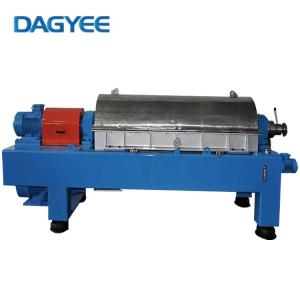
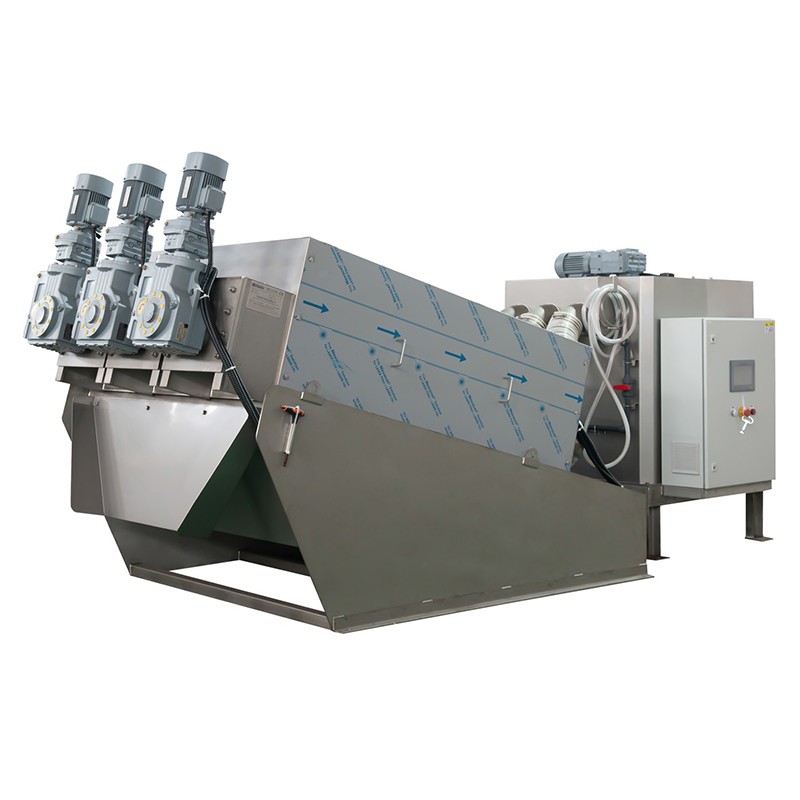
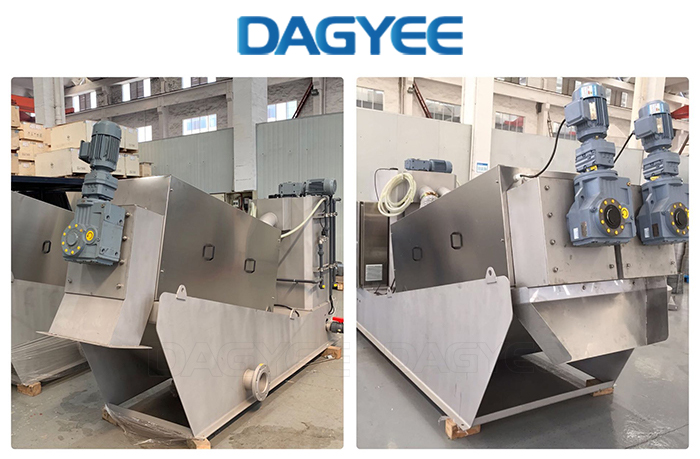
In wastewater treatment operations, dewatering equipment often becomes a major source of operational burden. Belt presses require constant monitoring and frequent cloth changes. Centrifuges consume high amounts of power and produce significant noise. Both options demand regular maintenance and skilled operator attention.
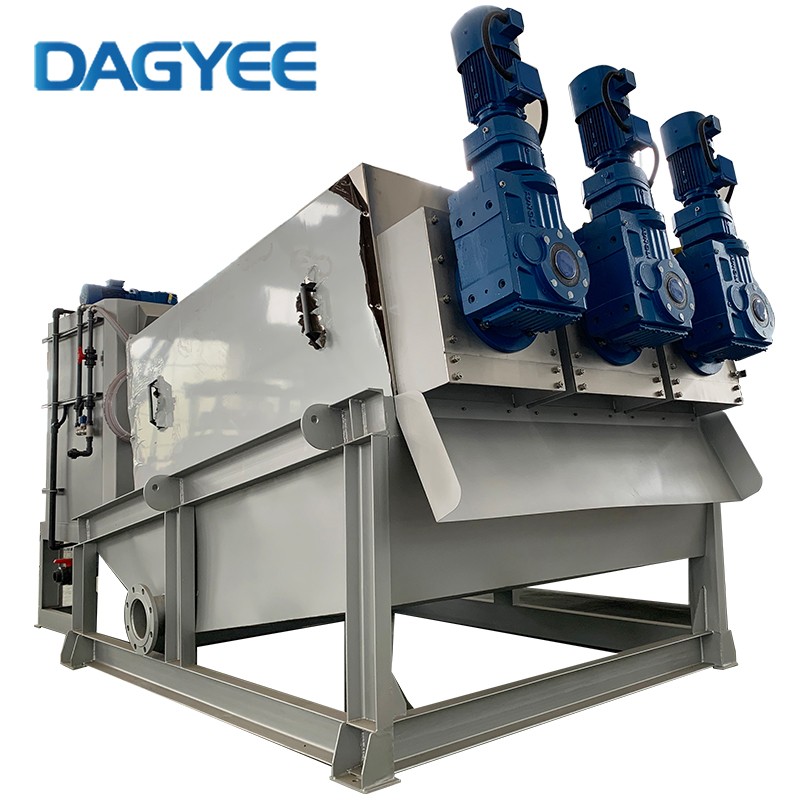
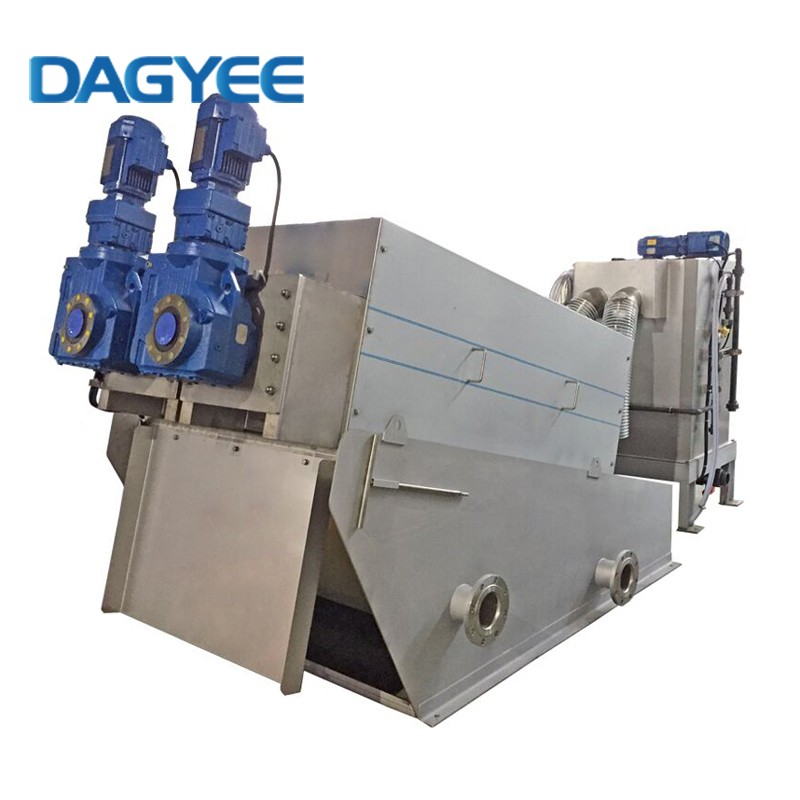
DAGYEE Screw Press was designed to address these challenges directly.
Our machine operates on a different principle. Slow rotation speed means minimal wear. Self-cleaning rings eliminate clogging issues. Low power consumption reduces operating costs significantly. The design allows for continuous, unattended operation.
For plant managers, this translates to fewer maintenance calls. For operators, less time spent on cleaning and troubleshooting. For financial officers, lower electricity bills and reduced spare parts expenses.
We have been manufacturing screw presses for over a decade. Our customers include municipal wastewater plants, food processing facilities, chemical factories, and livestock farms across multiple countries. Many have replaced existing belt presses or centrifuges after seeing the difference in total operating cost.
The machine works. The numbers add up. And we stand behind both claims.
2. Working Principle
Here's what happens inside.
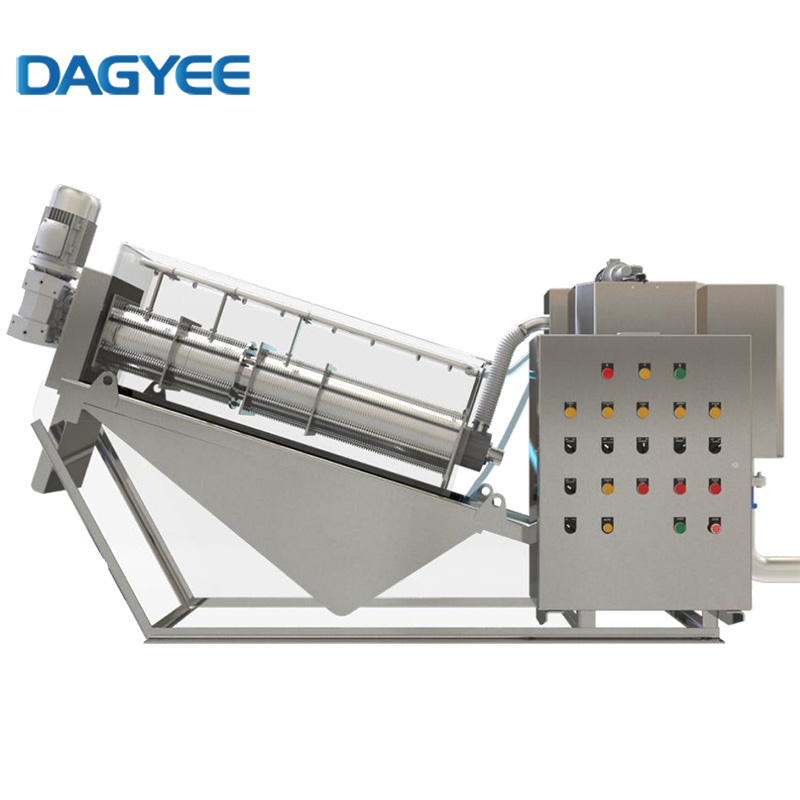
The DAGYEE Screw Press uses a mechanical dewatering process that requires no complex hydraulics or high-speed rotating parts.
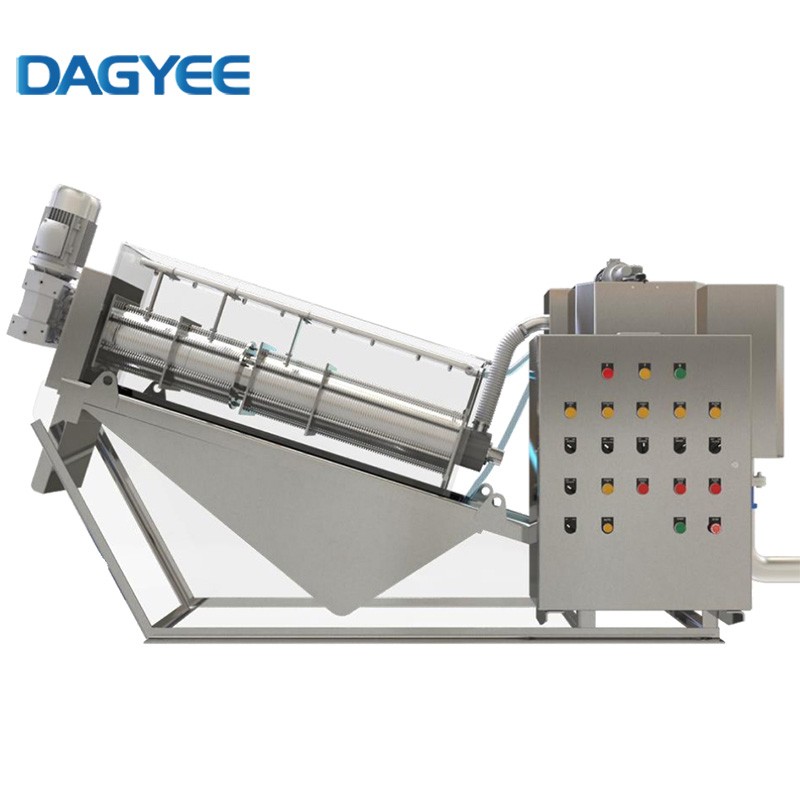
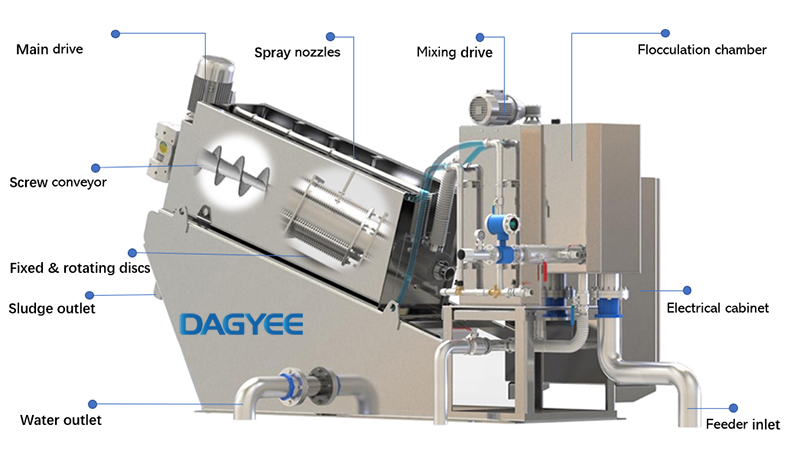
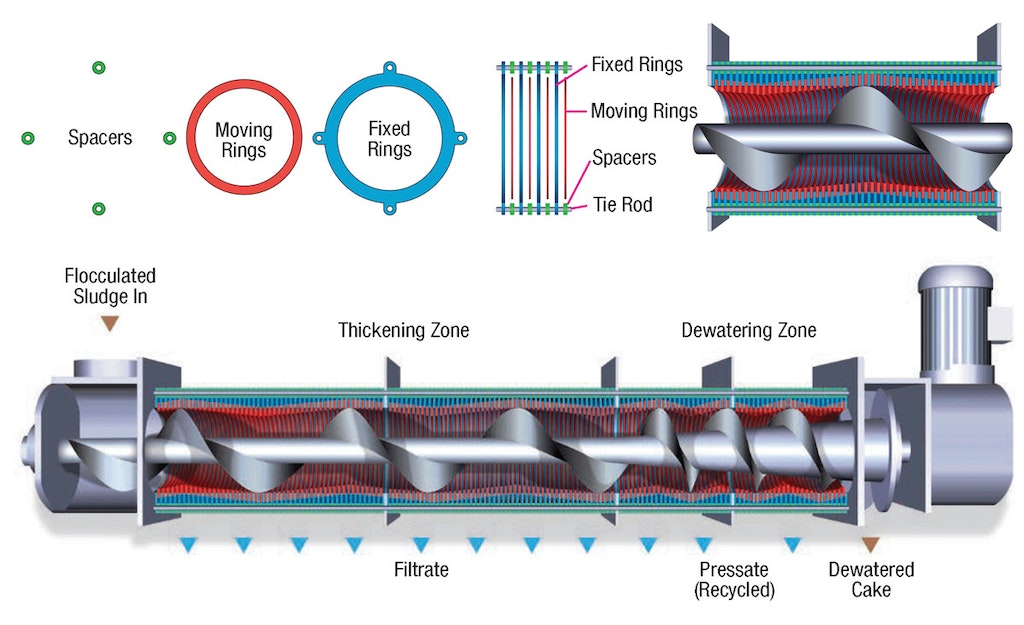
The main components are a spiral screw shaft and a cylindrical ring stack consisting of alternating fixed rings and moving rings.
As sludge enters the dewatering chamber, the rotating screw conveys it toward the discharge end. The screw pitch decreases gradually along the length, which reduces the available volume and creates compression. Water is squeezed out through the small gaps between the fixed and moving rings.
The moving rings shift slightly with each rotation of the screw. This continuous motion performs a self-cleaning function, preventing solids from accumulating in the gaps. No high-pressure water spray is needed during normal operation.
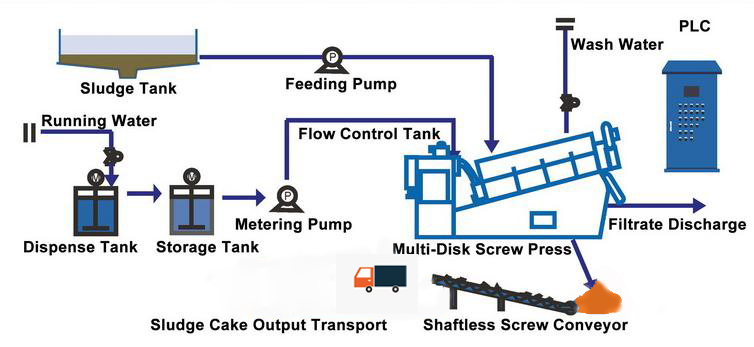
The dewatered sludge cake exits through an adjustable back-pressure plate, where the final compression occurs. The filtrate collects in a lower tray and can be directed to further treatment or discharged according to local requirements.
This simple, reliable design enables continuous operation with minimal supervision.
3. Key Advantages
The following advantages distinguish DAGYEE Screw Press from alternative dewatering technologies.
Self-Cleaning Ring Stack
The moving rings continuously clean the filtration gaps during operation. This eliminates clogging issues commonly experienced with belt presses, particularly when processing oily, greasy, or fibrous sludge.
Low Energy Consumption
The screw rotates at 2 to 5 RPM, requiring only 0.75 to 5.5 kW depending on the model. Typical energy consumption is approximately one tenth that of a comparably sized centrifuge.
Quiet Operation
Noise levels remain below 65 dB during normal operation. No hearing protection is required for nearby personnel.
Unattended Operation
The machine can operate continuously for extended periods without operator intervention. An automatic control system manages feed rate, compression, and alarms.
Minimal Wash Water Requirement
Unlike belt presses that require continuous high-pressure spray, the DAGYEE Screw Press only needs occasional rinsing. This reduces both water consumption and wastewater re-treatment volume.
Low Maintenance Design
The only regular maintenance tasks are annual gearbox oil changes and periodic bearing lubrication. There are no filter cloths, belts, or spray nozzles to replace.
Compact Footprint
The smallest model occupies approximately 2.5 meters by 0.85 meters of floor space. This allows installation in facilities where space is limited.
Operational Safety
Low rotational speed and the absence of exposed high-speed parts reduce workplace injury risks compared to centrifuges and belt presses.
Adaptability to Variable Sludge Conditions
The machine handles fluctuations in sludge concentration and composition without requiring recalibration or manual adjustment.
Comprehensive Technical Support
Every customer receives direct access to our technical team for installation guidance, troubleshooting, and spare parts supply.
4. Technical Specifications
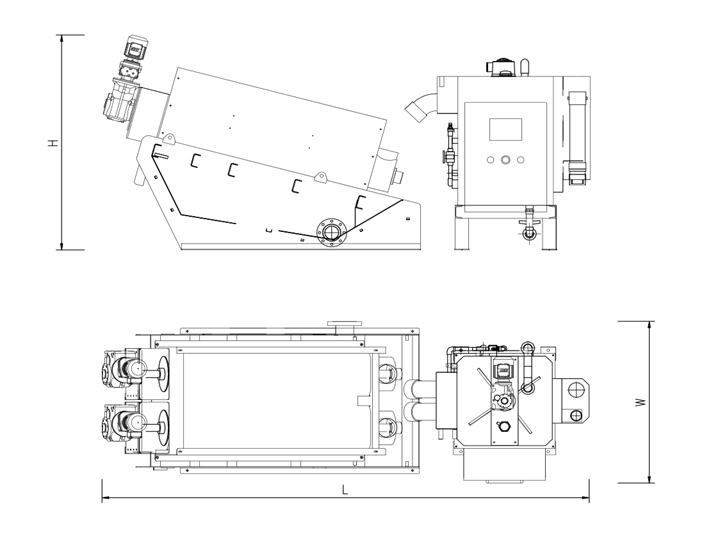
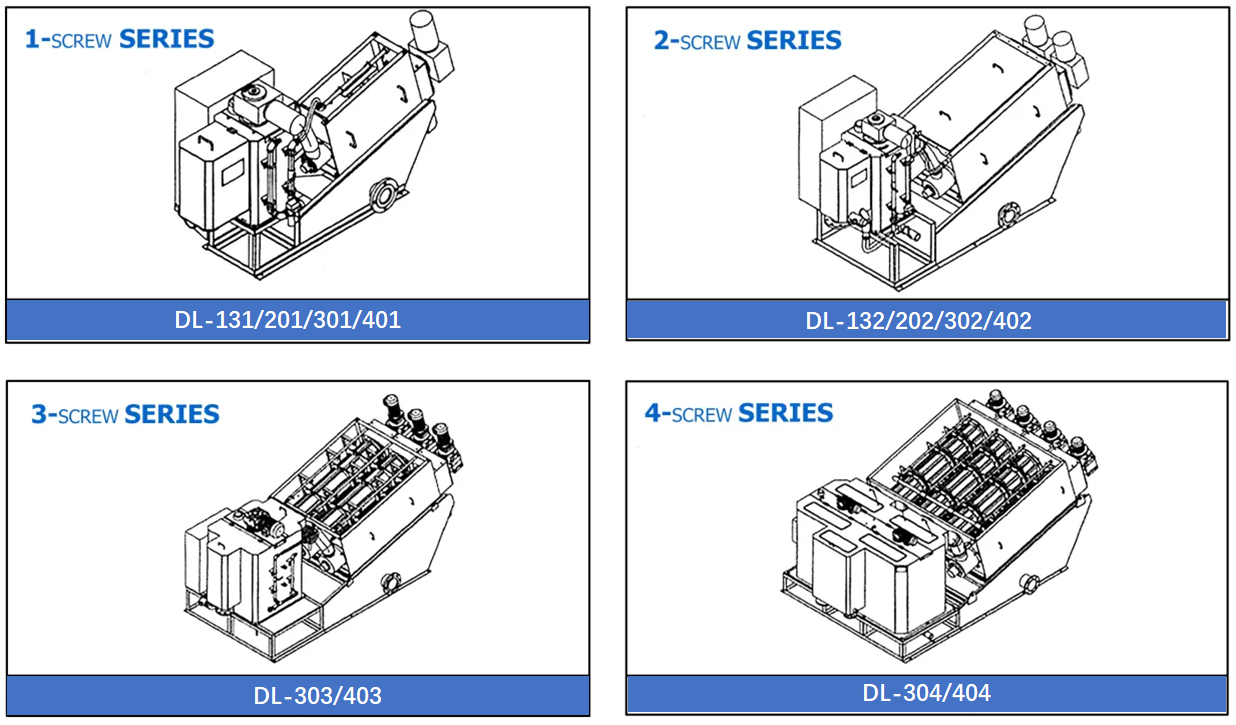
Standard models are listed below. Custom configurations are available upon request.
Note: Capacity and cake dryness depend on sludge characteristics, polymer type, and dosage. A sludge test is recommended for accurate sizing.
Materials:
Screw and rings – Stainless 304 (316L available for corrosive stuff)
Housing – Stainless 304
Frame – Carbon steel with epoxy coating
Cake solids: 15% to 30% depending on your sludge and chemical
Temperature range: 0°C to 60°C
Voltage: We match yours – 380V/50Hz, 460V/60Hz, or others
5. Comparison with Traditional Equipment
| Parameter | Belt filter press | Plate and Frame Press | Centrifuge | Screw Press |
|---|---|---|---|---|
| Energy Consumption | High | Higher | Highest | Lowest |
| Footprint | Large | Large | Medium | Small |
| Automation Level | Moderate | Low | High | High |
| Clogging Risk | High | High | Medium | Very Low |
| Wash Water Usage | High | Medium | Low | Very Low |
| Suitable Concentration | ≥5000 mg/L | ≥10000 mg/L | ≥3000 mg/L | ≥2000 mg/L |
| Continuous Operation | Yes | Intermittent | Yes | Yes |
Each technology has appropriate applications. The selection depends on specific site requirements including sludge characteristics, available labor, energy costs, and budget constraints.
What this means for you:
Want the driest cake possible? Get a centrifuge. But budget for power and repairs.
Have almost no budget upfront? Get a belt press. But plan for labor and water.
Want the lowest total cost and least headache? Get our screw press.
6. Selection & Maintenance
How to pick the right model – don't guess
Here's what we need to know:
What kind of sludge? (municipal, food, chemical, farm, etc.)
How much flow? (m³ per hour or gallons per minute)
How thick is it going in? (% solids or grams per liter)
Send us that info. Better yet – send us a sludge sample.
We'll run it on our test machine and tell you exactly which model works. Free. No obligation. No hidden "consulting fee".
We do this because we want you to buy the right machine the first time. Not upsell you on something too big. Not undersell you on something that won't work.
Quick sizing rule:
Take your dry solids per hour. Pick a model rated for at least 1.5 times that number.
Example: 200 kg/hour dry solids → DAG-401 or bigger.
Maintenance – what you actually have to do
Not much. Really.
Daily (5 minutes)
Walk by. Listen. Look for leaks.
Weekly (15 minutes)
Check chemical mix tank if you're using polymer.
Monthly (30 minutes)
Check gearbox oil.
Grease bearings (if they have fittings).
Yearly (2 hours)
Change gearbox oil.
Quick inspection of rings.
What wears out and when:
Seals – 2 to 3 years
Rings – 5 to 8 years
Bearings – 5 to 10 years
Screw shaft – 10+ years
Spare parts we suggest keeping:
One set of shaft seals
One relay for the control panel
That's it. No filter cloths to stock. No belts to keep. No spray nozzles to buy by the dozen.
7. Applications
| Industry | Applications |
|---|---|
| Municipal Wastewater | Municipal sludge dewatering |
| Food Processing | Soybean, starch, juice, brewery wastewater sludge |
| Slaughterhouse & Farming | Livestock and poultry slaughter, farming wastewater sludge |
| Textile & Dyeing | Printing and dyeing sludge, pulp recovery |
| Paper Industry | Paper sludge, fiber recovery |
| Chemical & Pharmaceutical | Chemical sludge, pharmaceutical wastewater sludge |
8. Service & Contact
Get in Touch:
Free Application Assessment – We'll look at your wastewater and suggest what fits
Customized Design – Built around your flow, space, and treatment goals
Fast Quotation – Detailed estimate within 48 hours
Project References – We'll share examples of similar installations
Factory Tour – Come see our facility