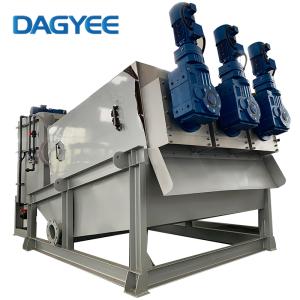
How to Choose the Right Polymer Preparation Unit for Your Plant Size Without Wasting Money
polymer preparation unit Sizing Guide: Get the Right Capacity and Save Thousands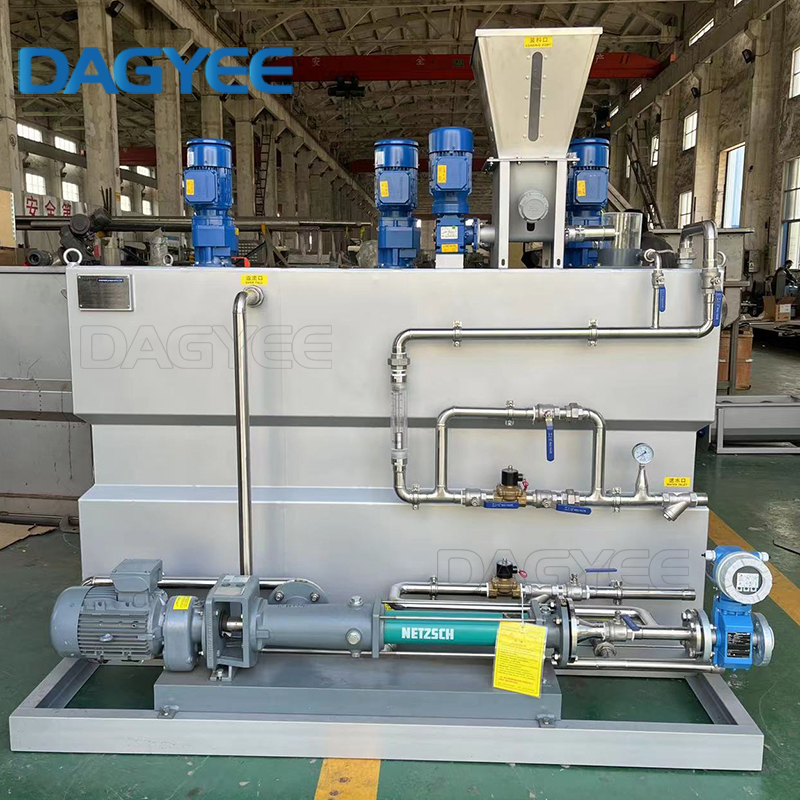
Introduction: Wrong Sizing Costs You a Fortune
The size of your wastewater treatment plant determines your sludge volume. Your sludge volume determines your polymer consumption. And your polymer consumption determines your operating costs. The polymer preparation unit is often overlooked by people, but it is the key to controlling costs.
If the size is set too small, then you won't be able to obtain enough flocculant.Your sludge will not dewater properly. Flocs will be loose, and cake moisture will stay high.
Size it too large, and you waste capital investment. The polymer sits in the aging tank too long, degrades, and loses effectiveness. You also waste electricity.
Not wasting money does not mean buying the cheapest unit. It means buying the one that is just right for your plant.
This article breaks down polymer preparation unit sizing by plant capacity. By the end, you will know exactly which size you need.
1. What Is a Polymer Preparation Unit?
A polymer preparation unit, also called a flocculant preparation system or powder dosing unit, automatically dissolves dry powder or emulsion PAM into a solution of precise concentration. This solution is then fed continuously to your sludge dewatering equipment, such as a screw press, Belt filter press, or centrifuge.
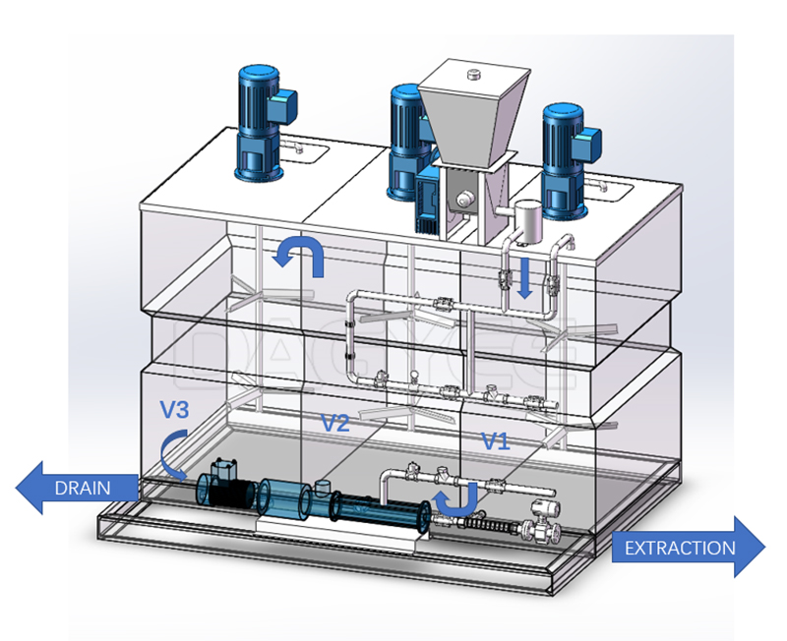
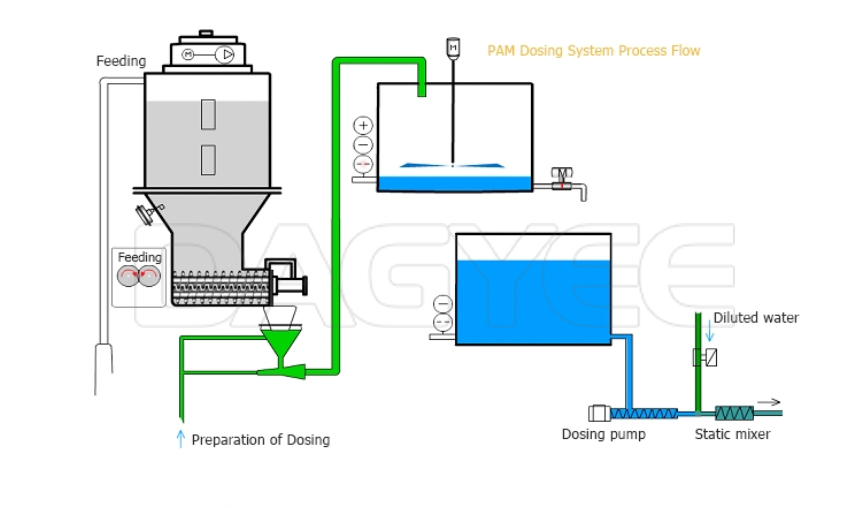
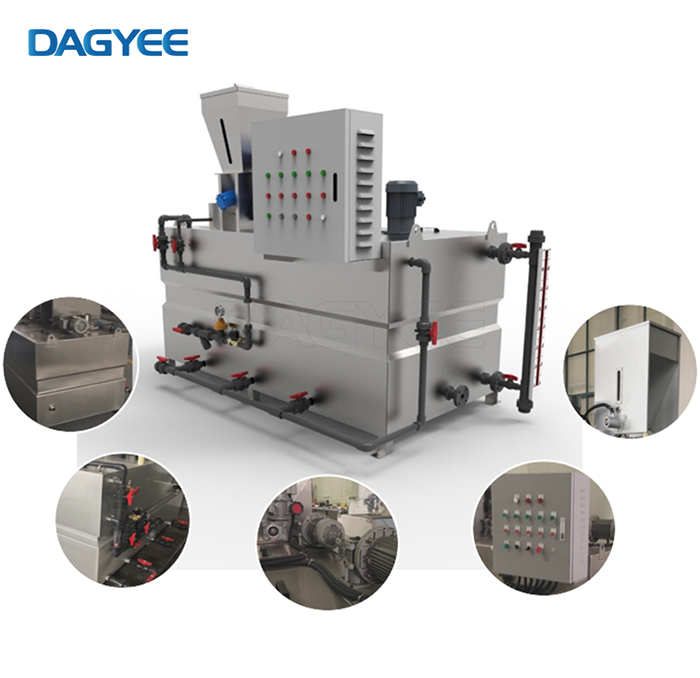
A complete polymer preparation unit typically includes:
- Powder feeding system: Hopper and metering screw for accurate powder delivery
- Wetting system: Venturi eductor or mixer for thorough powder water contact
- Preparation tank: Initial mixing of polymer and water
- Aging tank: Slow stirring to fully activate PAM molecular chains, which requires 45 to 60 minutes
- Storage tank: Holds the ready to use solution for continuous supply
- Control system: PLC and HMI for fully automatic operation
The core specification is preparation capacity, which means how many liters of polymer solution the unit can produce per hour, measured in L per hour.
2. Key Sizing Parameters
Before sizing, you need to understand a few key numbers.
2.1 How Much Capacity You Really Need (Liters per Hour)
This number matters most. Standard units run anywhere from 200 L/h up to 10,000 L/h.
Here is a quick way to figure out what you need. Three steps, that is all.
Step 1: Figure out your dry solids per hour
Take your sludge flow in cubic meters per hour. Multiply it by your sludge concentration in kilograms per cubic meter. That gives you kg of dry solids per hour.
Step 2: Figure out how much PAM you use per hour
Take your dry solids per hour from Step 1. Multiply it by your PAM dose per ton of dry solids. That gives you kg of PAM per hour.
Step 3: Figure out how much solution you need per hour
Take your PAM per hour from Step 2. Divide it by your target concentration percentage. That gives you liters of solution per hour.
Let me walk you through an example.
Say your sludge flow is 20 m³/h. Your sludge concentration is 20 g/L, which is the same as 20 kg/m³. Your PAM dose is 5 kg per ton of dry solids. You want to run at 0.2% concentration.
First, dry solids per hour = 20 × 20 = 400 kg/h.
Second, PAM per hour = 400 × 5 ÷ 1000 = 2 kg/h.
Third, solution per hour = 2 ÷ 0.2% = 1000 L/h.
So you would look at a DT1000. That size fits.
2.2 Preparation Concentration
The typical preparation concentration for PAM is 0.1 percent to 0.5 percent. Most municipal plants use 0.2 percent to 0.3 percent.
If the concentration is too low, you have high dilution water consumption and require a larger storage tank.
If the concentration is too high, you have high viscosity, poor mixing, and risk of line blockage.
Start with 0.2 percent and adjust based on flocculation performance and cake moisture.
2.3 Aging Time
PAM powder requires proper aging to fully activate, typically 45 to 60 minutes.
If aging time is too short, polymer chains have not fully uncoiled, leading to poor flocculation.
If aging time is too long, continuous shearing breaks down polymer chains, reducing effectiveness.
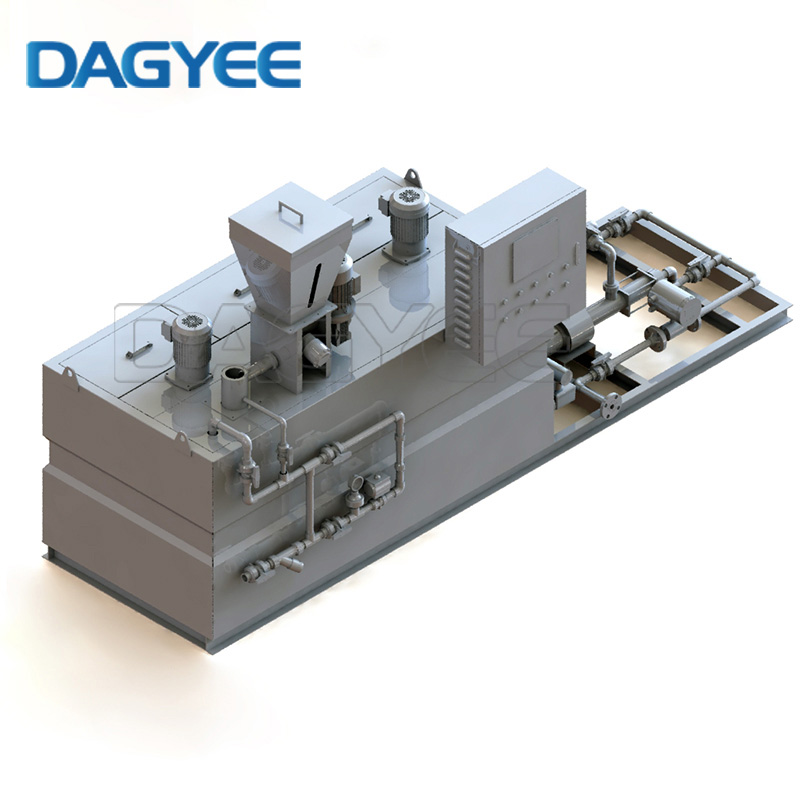
Three tank designs with preparation, aging, and storage tanks are specifically engineered to meet this aging time requirement.
2.4 Dry Powder vs. Emulsion
Dry powder PAM has advantages of lower transport cost and longer shelf life, but disadvantages of requiring aging and being sensitive to moisture. It is best for most municipal and industrial plants.
Emulsion PAM has advantages of being ready to use with no aging needed, but disadvantages of higher transport cost and shorter shelf life. It is best for small flows and emergency use.
Make sure your unit is compatible with the polymer form you use. Three tank dry powder units typically also handle emulsion with minor adjustments.
3. DAGYEE Polymer Preparation Unit Specifications
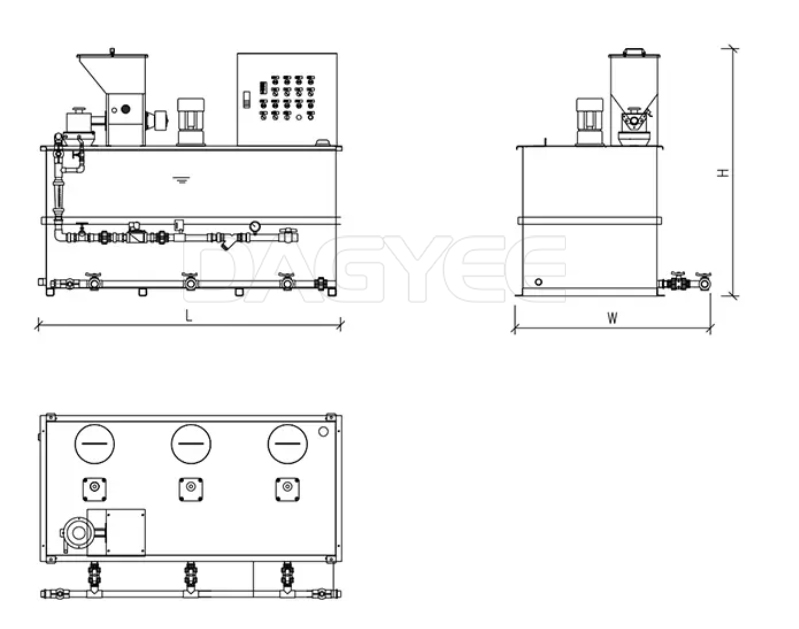
| Model | Capacity (L/h) | Dimensions (mm) | Weight (kg) | Power (kW) | Plant Size |
|---|---|---|---|---|---|
| DT300 | 300 | 1370×730×1450 | 350 | 0.92 | Lab, pilot trials |
| DT500 | 500 | 1370×730×1450 | 350 | 0.92 | Small WWTPs, small industrial parks |
| DT1000 | 1000 | 1800×950×1620 | 480 | 1.3 | County WWTPs, medium industrial parks |
| DT2000 | 2000 | 2130×1120×1620 | 560 | 1.7 | Medium WWTPs, large industrial parks |
| DT3000 | 3000 | 2450×1270×2000 | 790 | 2.4 | City WWTPs, large industrial parks |
| DT4000 | 4000 | 2780×1440×2250 | 1050 | 3.2 | Large city WWTPs |
| DT6000 | 6000 | 3100×1600×2650 | 1200 | 4.8 | Large city WWTPs with duty and standby |
| DT10000 | 10000 | 3970×2040×2650 | 1450 | 6.4 | Mega scale WWTPs, watershed projects |
4. Sizing Guide by Plant Size
4.1 Small Plants (Capacity Less Than 5,000 Cubic Meters per Day)
Typical applications include township WWTPs, small industrial parks, and on site industrial pretreatment.
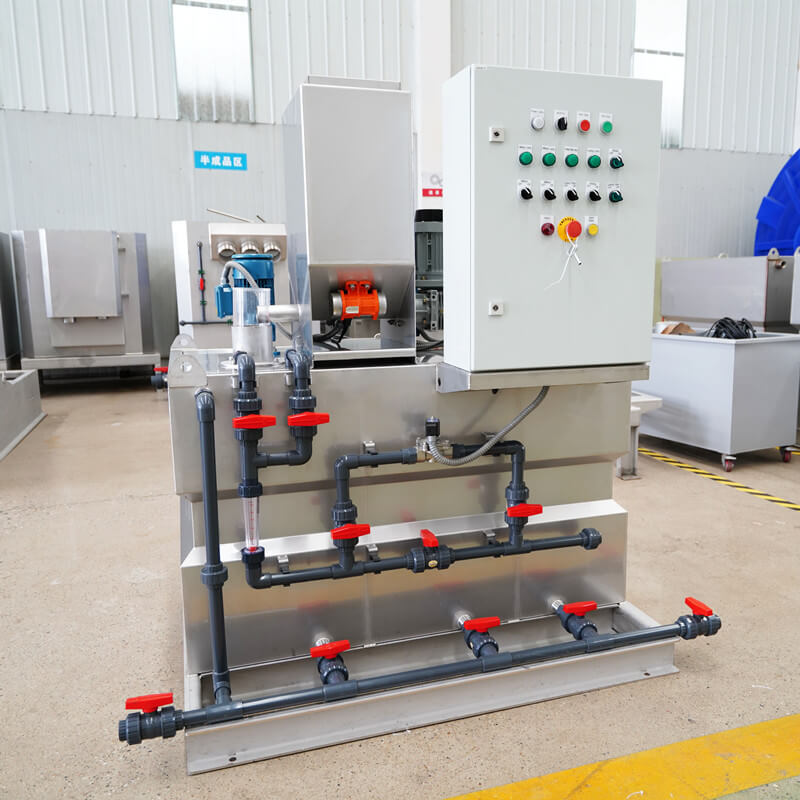
Recommended models are DT300 or DT500.
| Parameter | DT300 | DT500 |
|---|---|---|
| Capacity | 300 L/h | 500 L/h |
| Dimensions | 1370×730×1450 mm | 1370×730×1450 mm |
| Power | 0.92 kW | 0.92 kW |
| Weight | 350 kg | 350 kg |
- Small plants have low polymer consumption, so 300 to 500 L per hour is usually sufficient
- Compact footprint fits tight spaces
- Choose skid mounted design for quick installation
Common mistake: Some plants oversize to be safe, selecting a 1000 L per hour unit when they only need 300 L per hour. The polymer sits in the storage tank too long, degrades, and flocculation suffers.
4.2 Medium Plants (Capacity 5,000 to 20,000 Cubic Meters per Day)
Typical applications include county WWTPs, medium industrial parks, and large slaughterhouse or food processing plants.
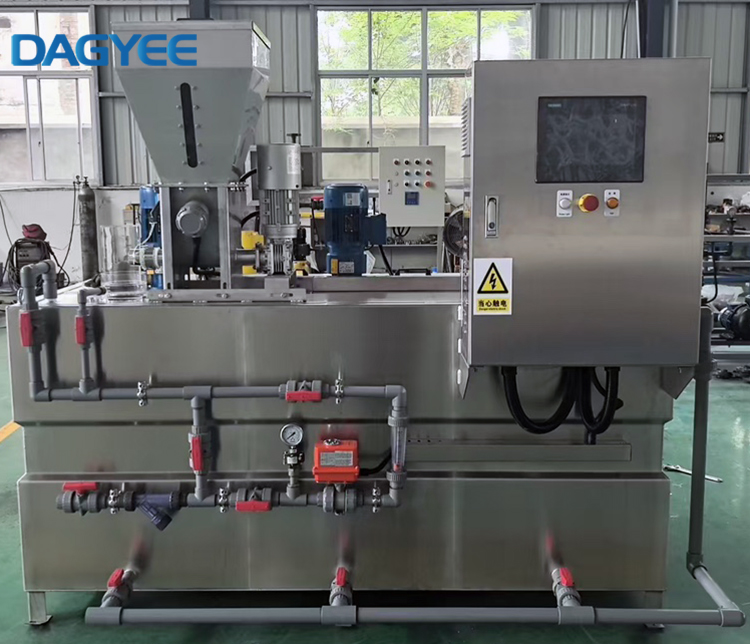
| Parameter | DT1000 | DT2000 |
|---|---|---|
| Capacity | 1000 L/h | 2000 L/h |
| Dimensions | 1800×950×1620 mm | 2130×1120×1620 mm |
| Power | 1.3 kW | 1.7 kW |
| Weight | 480 kg | 560 kg |
Sizing tips:
- 1000 L per hour meets most medium plant needs
- Choose 2000 L per hour if you have high sludge solids or large dewatering equipment
- Three tank design ensures proper aging of 45 to 60 minutes for maximum polymer activity
Real case: A county WWTP processing 12,000 cubic meters per day was using a 500 L per hour unit. During peak hours, they had to prepare batches in advance. After upgrading to DT1000, they met peak demand easily and reduced polymer consumption by 15 percent because the polymer was properly aged.
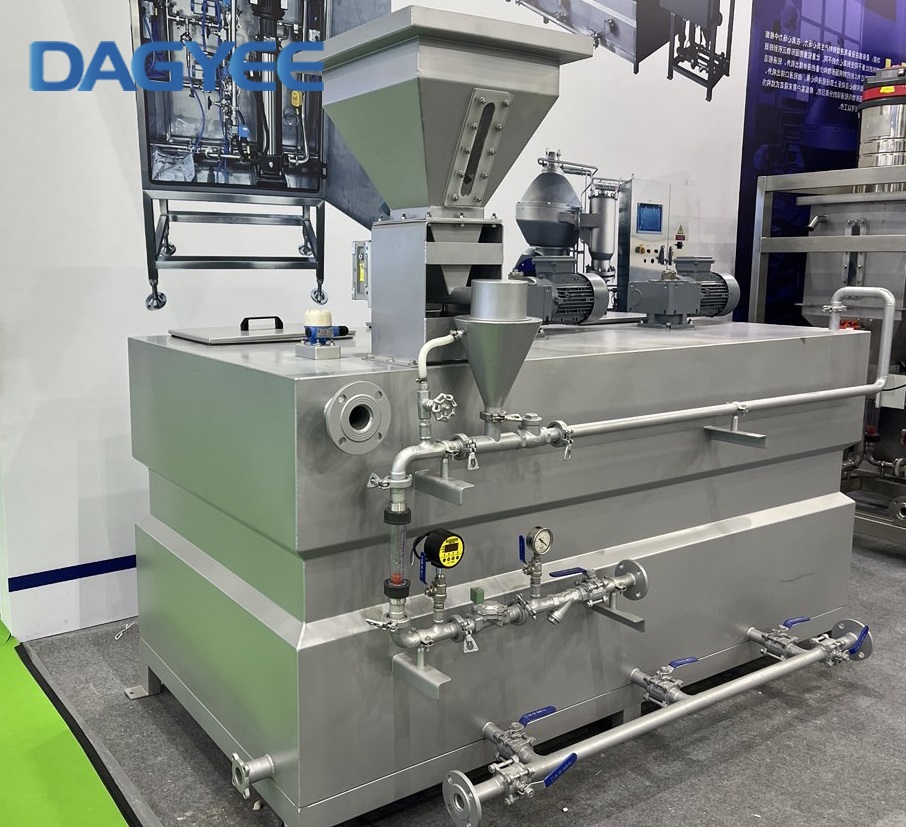
4.3 Large Plants (Capacity 20,000 to 50,000 Cubic Meters per Day)
Typical applications include city WWTPs and large industrial park central treatment facilities.
| Parameter | DT3000 | DT4000 |
|---|---|---|
| Capacity | 3000 L/h | 4000 L/h |
| Dimensions | 2450×1270×2000 mm | 2780×1440×2250 mm |
| Power | 2.4 kW | 3.2 kW |
| Weight | 790 kg | 1050 kg |
- High daily flow requires 3000 L per hour or higher for continuous supply
- PLC and HMI automatic control enables unattended operation
- Consider duty and standby configuration for 100 percent uptime
4.4 Extra Large Plants (Capacity More Than 50,000 Cubic Meters per Day)
Typical applications include provincial capital WWTPs, mega industrial parks, and watershed treatment projects.
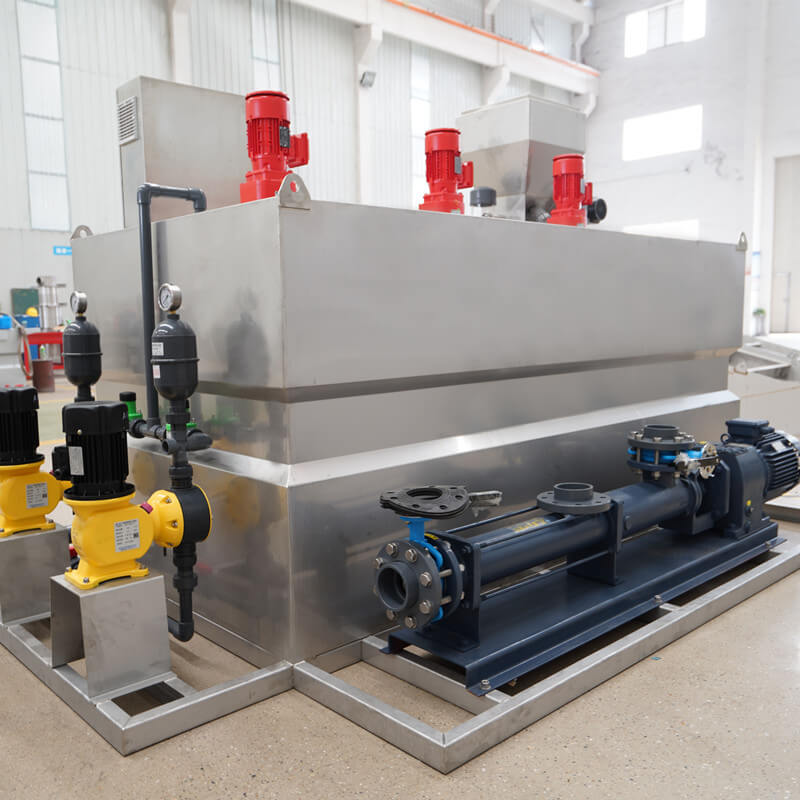
Recommended models are DT6000, DT10000, or multiple units in parallel.
| Parameter | DT6000 | DT10000 |
|---|---|---|
| Capacity | 6000 L/h | 10000 L/h |
| Dimensions | 3100×1600×2650 mm | 3970×2040×2650 mm |
| Power | 4.8 kW | 6.4 kW |
| Weight | 1200 kg | 1450 kg |
- Above 6000 L per hour, consider multiple units in parallel rather than one oversized unit
- Parallel configuration provides redundancy and easier maintenance
- Control system must support remote monitoring and SCADA integration
- Automatic cleaning feature is recommended to reduce manual maintenance
5. Sizing Summary Table
| Plant Size | Daily Capacity | Recommended Model | Preparation Capacity | Typical Applications |
|---|---|---|---|---|
| Small | Less than 5,000 m³/d | DT300 or DT500 | 300 to 500 L/h | Township WWTPs, small industrial parks |
| Medium | 5,000 to 20,000 m³/d | DT1000 or DT2000 | 1000 to 2000 L/h | County WWTPs, medium industrial parks |
| Large | 20,000 to 50,000 m³/d | DT3000 or DT4000 | 3000 to 4000 L/h | City WWTPs, large industrial parks |
| Extra Large | More than 50,000 m³/d | DT6000 or DT10000 | 6000 to 10000 L/h | Mega WWTPs, watershed projects |
Mistake 1: Only looking at capacity and ignoring aging time
Some units claim high output, but their tanks are tiny. PAM needs 45 to 60 minutes to age properly. If the tank is too small, the solution moves through too fast. The polymer chains never fully open up, and your flocs end up weak.
DAGYEE uses three separate tanks. One for mixing, one for aging, and one for storage. Each stage does its own job. The aging tank gives the polymer the time it needs. That is how you get good flocculation.
A lot of people pick a bigger unit than they need because they worry about not having enough. That extra capacity sounds safe, but it comes with problems. The solution sits in the storage tank for hours. The agitator keeps running. The polymer chains slowly break down.
You end up paying more for the equipment and getting worse performance from your polymer.
Leave yourself 20% to 30% margin. That is enough. Bigger is not always better. The right size is what matters.
Dry powder and emulsion look similar, but they behave differently. Dry powder needs more time to wet out and age. Emulsion is faster. Before you buy a unit, know which type you will use. Not every unit handles both.
DAGYEE three tank dry powder units work with both dry powder and emulsion. Just change a few settings when you switch. No need for a different machine.
devices are suitable for both dry powder and emulsion. Just adjust the settings.
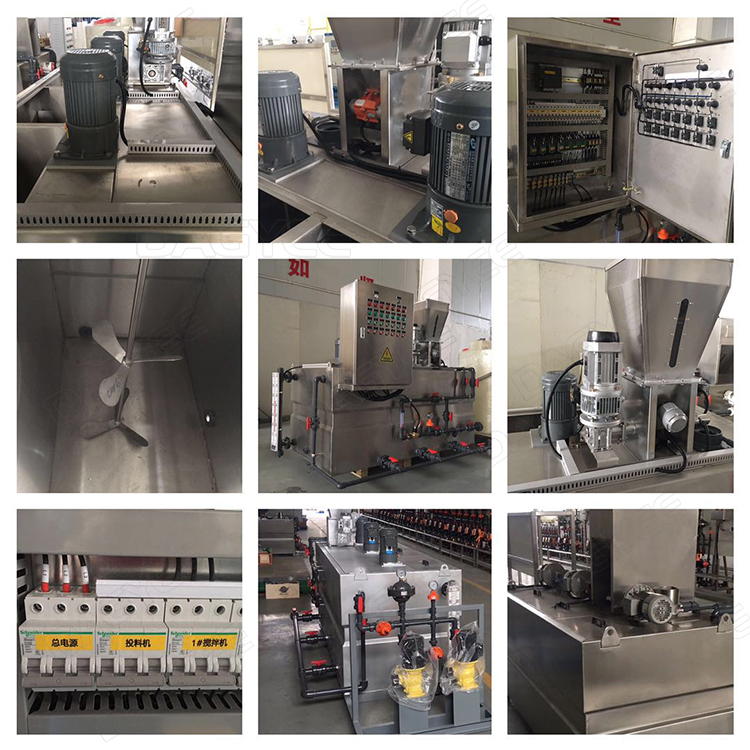
7. DAGYEE Polymer Preparation Unit Core Advantages
| Feature | Benefit |
|---|---|
| Three tank design | Preparation, aging, and storage ensures 45 to 60 minutes of aging time for maximum polymer activity |
| Anti caking design | Heated screw end prevents moisture caking; tapered hopper with smooth walls prevents bridging |
| Fully automatic | PLC and HMI control handles feeding, water addition, mixing, and transfer automatically |
| Precise concentration | Feed rate and water flow are interlocked; concentration stays within plus or minus 5 percent |
| Durable construction | HDPE or SS304 tanks, SS316 agitator shafts, stainless steel feeding screw |
| Dry powder and emulsion compatible | One unit handles both polymer forms with simple adjustments |
| Remote control ready | 4 to 20 mA remote control supports SCADA integration |
| Low level alarm | Storage tank low level alarm prevents polymer starvation |
8. Daily Maintenance Checklist
| Task | Frequency | Action |
|---|---|---|
| Check hopper | Daily | Look for caking; clean interior walls |
| Inspect feeder | Weekly | Disassemble and clean screw; remove residue |
| Inspect mixer | Weekly | Check spray nozzles and mixing chamber; clear blockages |
| Check seals | Monthly | Inspect hopper lid seals for aging |
| Full service | Quarterly | Disassemble feeder, mixer, piping and valves |
| Empty on shutdown | If offline more than 3 days | Empty all powder from hopper |
9. Conclusion: Size It Right, Save Money
Sizing a polymer preparation unit is about doing the math.
Size too small means not enough polymer, poor dewatering, fines, and high cake moisture.
Size too large means higher capital cost, polymer degradation, and higher operating cost.
| Daily Capacity | Recommended Model |
|---|---|
| Less than 5,000 m³/d | DT300 or DT500 |
| 5,000 to 20,000 m³/d | DT1000 or DT2000 |
| 20,000 to 50,000 m³/d | DT3000 or DT4000 |
| More than 50,000 m³/d | DT6000 or DT10000 or multiple units |
Still not sure which size you need?
DAGYEE offers free sizing consultation. Tell us your plant capacity, sludge characteristics, and dewatering equipment type. We will calculate exactly what you need.
Note: The above size recommendations are based on general circumstances. The final choice should take into account your specific wastewater characteristics, sludge properties, as well as the characteristics of the dewatering equipment, etc.
Related News