Submersible Mixer Sizing: 4 Things You Must Know Before Buying
Submersible Mixer Selection Guide: Tank Type, Media, and Flow Velocity — Missing Any One Can Lead to the Wrong ChoiceAnyone who has worked in wastewater treatment knows that a submersible mixer may seem like a small piece of equipment, but choosing the wrong one is a real headache. You install it and find that mixing is poor, sludge settles at the bottom, the motor trips on overload, or thrust is insufficient. You end up swapping equipment or modifying the installation — wasting time, money, and effort.
The problem often starts at the selection stage — focusing only on power and price while ignoring the factors that truly matter.
1. First, Understand What Your Tank Actually Needs
The first step in selection isn't flipping through spec sheets. It's understanding what your tank is designed to do. Different tank types have completely different mixing requirements.
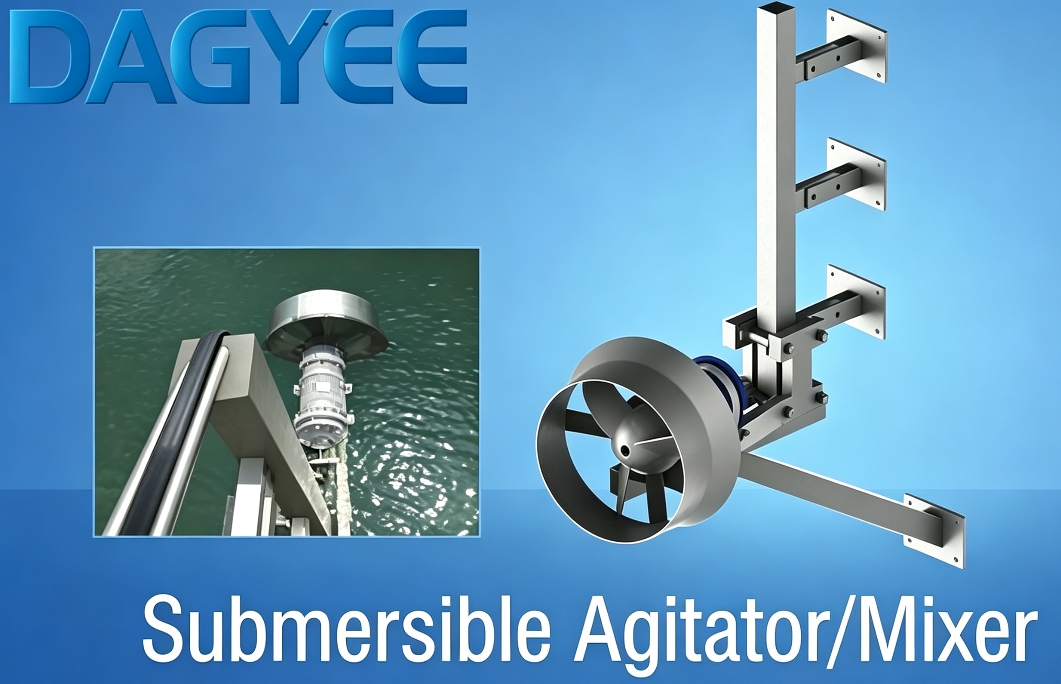
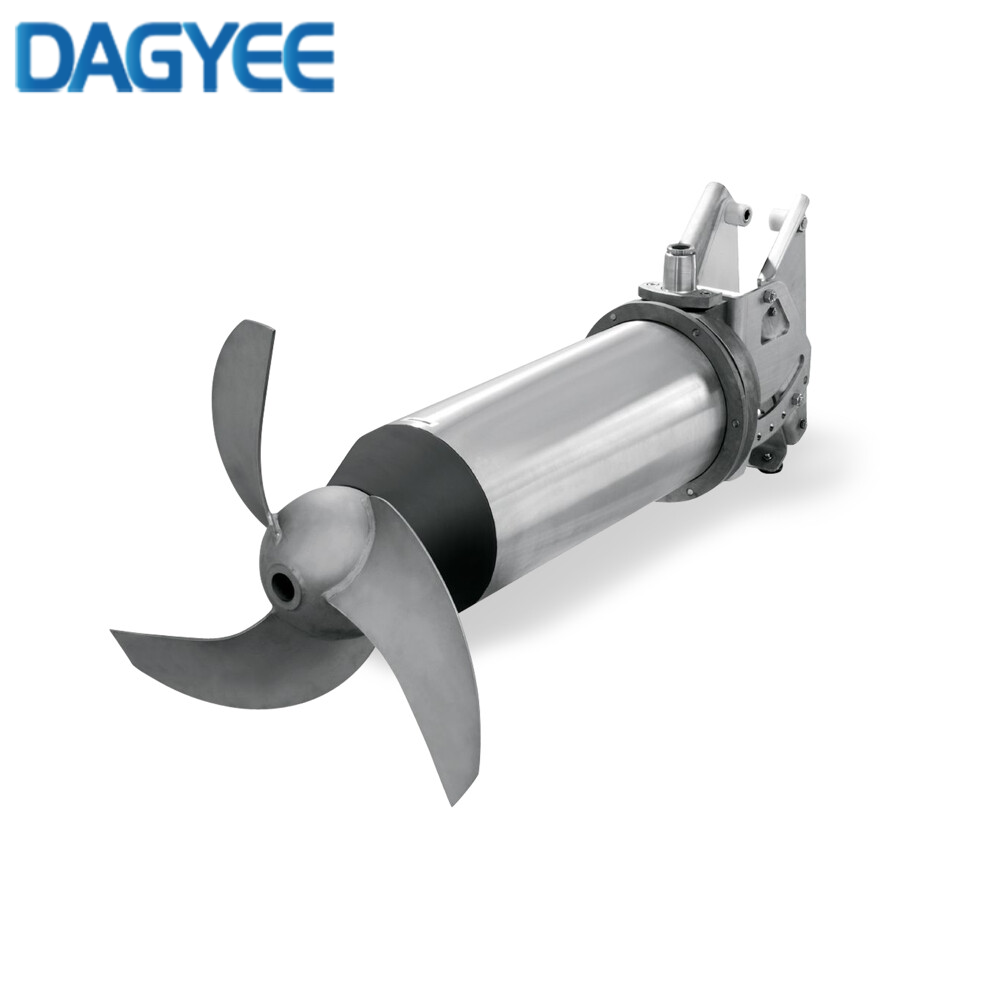
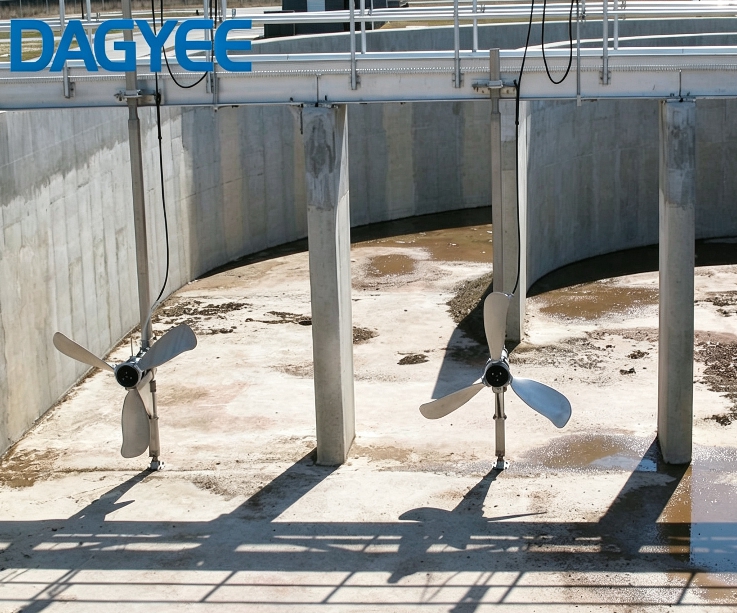
Submersible mixers come in two main series: mixing series and low-speed flow series. The mixing series uses multi-pole motors with direct-coupled design — low energy consumption, high efficiency, high-precision impeller, and strong thrust. It's suitable for mixing liquids containing suspended solids. The low-speed flow series uses cycloidal pinwheel reducers — low power, low speed, large impeller diameter, and wide coverage. It's suitable for aeration tanks and can create flow for nitrification, denitrification, and phosphorus removal stages.
Different tank types have very different mixing needs:
Match your tank type to the right mixer configuration
| Tank Type | Mixing Requirement | Recommended Configuration |
|---|---|---|
| Equalization tank, hydrolysis tank | High flow, low shear — avoid damaging sludge flocs | Large impeller, low speed |
| Anaerobic/anoxic tank | Maintain sludge suspension, uniform thrust, prevent settling | Medium impeller, moderate speed |
| Reaction tank (chemical mixing) | Fast, uniform mixing | Small impeller, high speed |
| Sludge storage tank, homogenization tank | High solids content, strong mixing required | Large impeller, high thrust |
| Aerobic tank, oxidation ditch | Flow generation, circulate water | Large impeller, low speed |
Selection Tip: Always match the mixer type and configuration to your specific tank application. The same mixer may perform differently in different tank types — choose based on the primary function your tank serves.
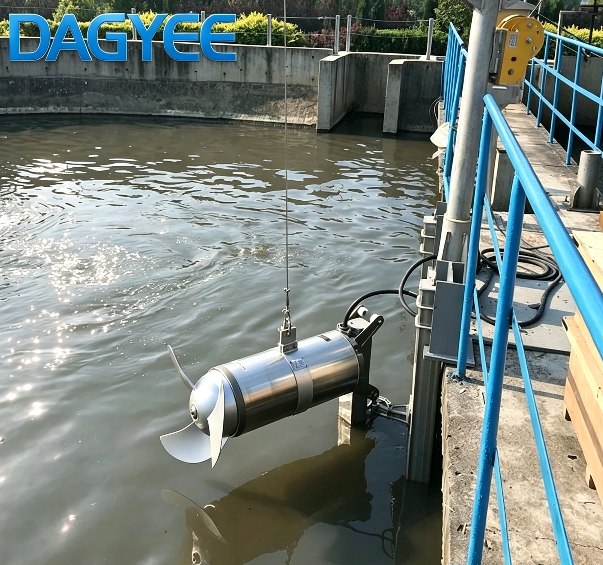
Before selecting, you need to know: tank length, width, effective water depth, tank volume (V = L × W × H), and mixer installation position (wall-mounted, corner-mounted, or bridge-mounted).
2. Know Your Media — What Are You Actually Mixing?
The same mixer can have completely different service life and performance in domestic sewage versus industrial wastewater.
Municipal wastewater has relatively stable composition — mainly organics and suspended solids, with low corrosivity. A standard cast iron body with stainless steel impeller is sufficient and cost-effective.
Industrial wastewater is more complex. It may contain acids, alkalis, heavy metals, high salts, or oils, with wide fluctuations in water quality. In these cases, 316L stainless steel or duplex stainless steel is essential — maximum corrosion protection.
Beyond that, several parameters must be determined: suspended solids content, viscosity, temperature, and pH. According to DAGYEE product standards, normal continuous operation conditions are: media temperature ≤40°C, pH 5-9, liquid density ≤1150 kg/m³, and submergence depth generally ≤20m.
Other selection considerations: higher media density → greater thrust required → either more power or larger impeller diameter needed. Selection should be based on the worst-case operating conditions (highest solids content, highest density) with adequate margin.
3. Flow Velocity — The Most Overlooked Yet Critical Parameter
This is the most frequently overlooked parameter in selection — but also the most important.
The basic selection principle is to ensure the mixer achieves effective mixing within the tank volume. The standard for this is generally determined by flow velocity. Based on different treatment process requirements, the optimal flow velocity range is 0.15–0.3 m/s:
Below 0.15 m/s → insufficient mixing and flow, sludge will settle
Above 0.3 m/s → process disruption and energy waste
When selecting, don't just look at power. Calculate flow velocity. Tank size, number of units, and placement must all be designed to keep the final water velocity within this range.
Before selecting, you need to determine: the purpose (preventing settling, chemical dispersion, or oxidation ditch circulation). Wide tanks need large diameter, low speed. Narrow, long tanks need small diameter, high speed. The power required is determined by tank volume, liquid density, and mixing depth — one or multiple mixers may be needed depending on the specific conditions.
4. Thrust — A More Important Selection Metric Than Power
Many people select mixers based solely on power (kW). In reality, thrust (N) is the core indicator of mixing effectiveness.
ISO 21630 recognizes thrust as the fundamental output performance parameter for submersible mixers. Using required thrust as the basis for mixer selection has been widely adopted in China, with over 1,000 mixers successfully selected using this method across municipal wastewater, chemical, pharmaceutical, brewery, and other applications.
Same power, different thrust. In the DAGYEE SMB series, the SMB4/6-400 (4kW) delivers 1010N thrust, while the SMB4/12-620 (4kW) delivers 1230N. Same 4kW, but over 20% difference in thrust.
So the recommended selection approach is: first calculate the thrust required to overcome system losses and achieve the target average flow velocity, then match the required thrust to a model with adequate rated thrust, and only then check power consumption.
5. Decoding the Model Code — What Does SMB0.85/8-260/3-740/C/S Actually Mean?
Many customers look at model codes and have no idea what they mean. But when broken down, each part has a clear meaning:
Submersible Mixer Model Code Breakdown
What does SMB0.85/8-260/3-740/C/S actually mean?
| Code Part | Meaning | Example |
|---|---|---|
| SMB / QJB | Submersible mixer | SMB = DAGYEE submersible mixer series |
| 0.85 | Motor power (kW) | 0.85 = 0.85 kilowatts |
| 8 | Number of motor poles | 8 = 8-pole motor |
| 260 | Impeller diameter (mm) | 260 = 260mm diameter |
| 3 | Number of blades | 3 = 3 blades |
| 740 | Rated speed (r/min) | 740 = 740 rpm |
| C / S | Material code | C=Cast iron, S=Stainless steel, P=Polyurethane, AL=Aluminum |
Example: SMB0.85/8-260/3-740/C/S means — 0.85kW, 8-pole motor, 260mm impeller, 3 blades, 740 rpm, available in cast iron or stainless steel.
6. DAGYEE SMB Series Technical Specifications
The table below shows DAGYEE SMB Series submersible mixers, covering commonly used models from 0.85kW to 10kW:
SMB Series — Technical Specifications
DAGYEE submersible mixers — performance data for selection
| Model | Power (kW) | Current (A) | Speed (rpm) | Impeller (mm) | Thrust (N) | Weight (kg) |
|---|---|---|---|---|---|---|
| SMB0.85/8-260/3-740/C/S | 0.85 | 3.4 | 740 | 260 | 163 | 55/58 |
| SMB1.5/6-260/3-980/C/S | 1.5 | 4.4 | 980 | 260 | 290 | 55/58 |
| SMB2.2/8-320/3-740/C/S | 2.2 | 5.9 | 740 | 320 | 582 | 74/77 |
| SMB4/6-320/3-980/C/S | 4 | 10.8 | 980 | 320 | 609 | 74/77 |
| SMB1.5/8-400/3-740/S | 1.5 | 5.6 | 740 | 400 | 382 | 76/80 |
| SMB2.5/8-400/3-740/S | 2.5 | 7.3 | 740 | 400 | 575 | 76/80 |
| SMB3/8-400/3-740/S | 3 | 8.6 | 740 | 400 | 642 | 78/82 |
| SMB4/6-400/3-980/S | 4 | 10.3 | 980 | 400 | 1010 | 80/84 |
| SMB4/12-620/3-480/S | 4 | 14 | 480 | 620 | 1230 | 240/245 |
| SMB5/12-620/3-480/S | 5 | 18.2 | 480 | 620 | 1420 | 240/245 |
| SMB7.5/12-620/3-480/S | 7.5 | 28 | 480 | 620 | 1963 | 255/270 |
| SMB10/12-620/3-480/S | 10 | 32 | 480 | 620 | 2361 | 255/270 |
How to read: Small tanks / low concentration → lower thrust models (e.g. SMB0.85/8-260, 163N). Large tanks / high concentration / flow applications → higher thrust models (e.g. SMB10/12-620, 2361N). 6-pole motors (980 rpm) for mixing; 8-pole (740 rpm) for balanced performance; 12-pole (480 rpm) for high torque, wide-area flow.
Look at thrust first. Small tanks and low-concentration media → smaller thrust models (e.g., SMB0.85/8-260 with 163N thrust). Large tanks, high-concentration media, or flow applications → higher thrust models (e.g., SMB10/12-620 with 2361N thrust).
Look at speed. 6-pole motors (980 rpm) run faster — suitable for mixing. 8-pole motors (740 rpm) balance thrust and energy — most commonly used. 12-pole motors (480 rpm) run slow with high torque — suitable for large-area flow generation.
7. Key Features of DAGYEE Submersible Mixers
The DAGYEE SMB Series has several noteworthy design features:
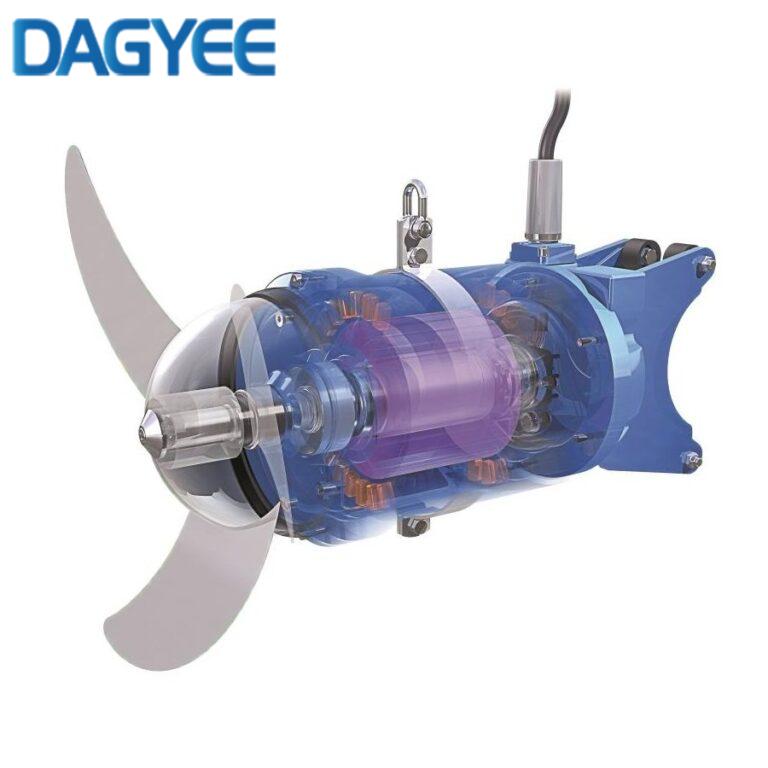
Reliable materials. Housing available in stainless steel (SUS304) or cast iron. Impeller available in stainless steel or fiberglass-reinforced polyurethane. Shaft made of ASTM431 or 420 stainless steel. Mechanical seals use corrosion-resistant sintered tungsten carbide or silicon carbide.
Double mechanical seals. This is the most critical protection for submersible mixers. Two seals in series — even if the first seal fails, the second still protects the motor from water ingress.
Motor protection IP68, insulation Class F. Can operate continuously underwater at depths up to 20 meters. Motor windings withstand 155°C, providing high reliability for long-term continuous operation.
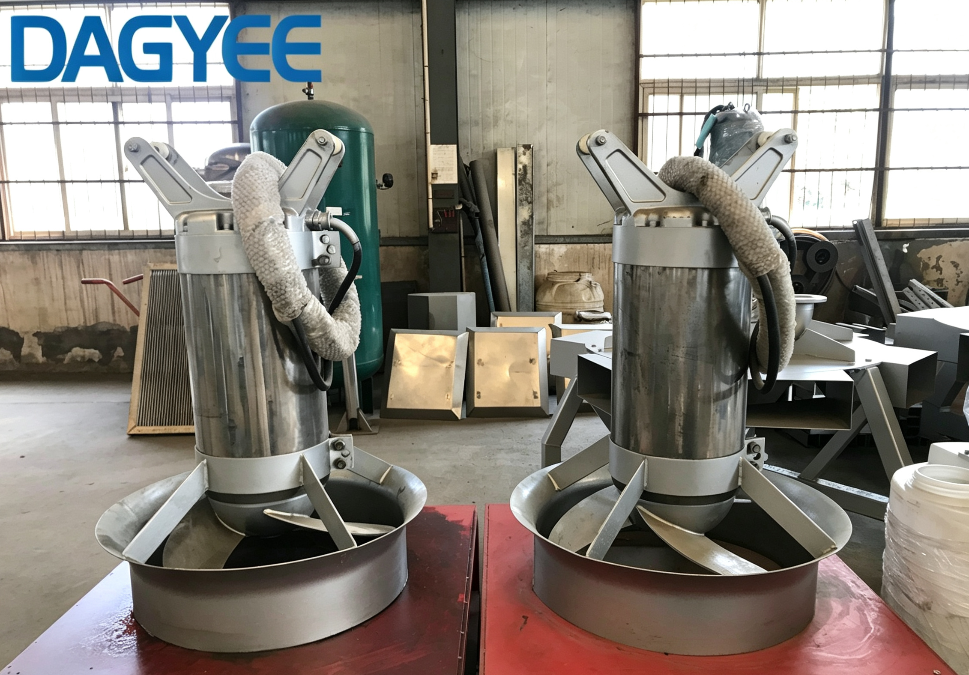
Flexible mounting systems. The mixer should be liftable for inspection and maintenance without personnel entering the tank. The mixer is mounted on a sliding guide rail system with all weight supported on a single bracket capable of withstanding all thrust forces. A guide-rail lifting system allows the unit to be pulled up for maintenance without draining the tank or sending personnel down.
8. Common Selection Mistakes
Based on industry experience, these are the most common mistakes:
Looking at power only, not thrust. The same 4kW mixer with a large, slow impeller may deliver far more thrust than a small, fast one. Select by thrust, then check power.
Placing a single mixer in the center of a large tank. This often creates dead zones in the corners. Multiple units or manufacturer-recommended layouts are better.
Focusing only on initial investment, ignoring lifecycle costs. Power consumption is a major cost factor over the equipment's lifetime. An extra 1kW of power adds thousands of yuan in electricity costs per year — over several years, this may exceed the equipment price itself.
Not reserving maintenance space. Guide rail foundations, lifting points, and cable clamps must be embedded during civil construction. Otherwise, later maintenance becomes difficult.
9. Summary
Selecting a submersible mixer isn't just about comparing power and price. You need to understand four things: "what the tank needs, what the media is like, whether flow velocity is adequate, and whether thrust is sufficient" — only then can you choose the right equipment.
DAGYEE SMB Series covers models from 0.85kW to 10kW, with materials available in cast iron, stainless steel, or polyurethane — matching the right configuration to your tank type, media characteristics, and mixing requirements.
DAGYEE — Submersible Mixer Solutions
Need help selecting a submersible mixer? Tell us your tank dimensions, media parameters, and mixing requirements. We'll recommend the right model for your application.

Related News