Polymer Preparation Unit Maintenance: A Complete Daily/Weekly/Monthly/Quarterly Guide
The Ultimate polymer preparation unit Maintenance Checklist: Don't Wait Until It BreaksBy DAGYEE – Water Treatment Specialist
Introduction
Have you noticed this pattern?
For the first three months after buying a new unit, everything runs perfectly. Operators think the equipment is fantastic. The boss thinks the money was well spent.Six months later, small problems start appearing. The wetting cone gets a little clogged. The dosing accuracy drifts. The pump doesn't sound quite right.
One year later, those small problems become big ones. Pipes are completely blocked. The pump has stopped working. Production is down. The maintenance technician arrives, takes one look, and asks: "Has this unit ever been maintained?"
You pause. Maintenance? Not really.
This is not an isolated case. At DAGYEE, we receive calls like this every year. Some units are only two years old but look worse than units that have been running for eight. Others have been running for eight years and still look like new.
What's the difference? It's not equipment quality. It's maintenance.
This blog is a complete maintenance checklist. Follow it, and your DAGYEE polymer preparation unit will run reliably for years to come.
Why Maintenance Matters More Than Repair
Let's do a quick cost comparison.
| Item | Cost | Time |
|---|---|---|
| Daily maintenance (15 minutes/week) | Nearly zero | 15 min/week |
| Replace pump balls and seats | $50-100 | 30 minutes |
| Clear a full system blockage | $500-1,000 + downtime | Half to full day |
| Replace a pump destroyed by dry running | $1,500-3,000 | Half day |
| Fines for discharge violations due to polymer failure | $10,000+ | — |
Preventive maintenance costs pennies compared to reactive repairs and compliance penalties.
Maintenance costs minutes. Repair costs hours and money. Fines cost your company's reputation.
The choice is clear.
DAGYEE's Design Philosophy: Maintenance Should Be Easy
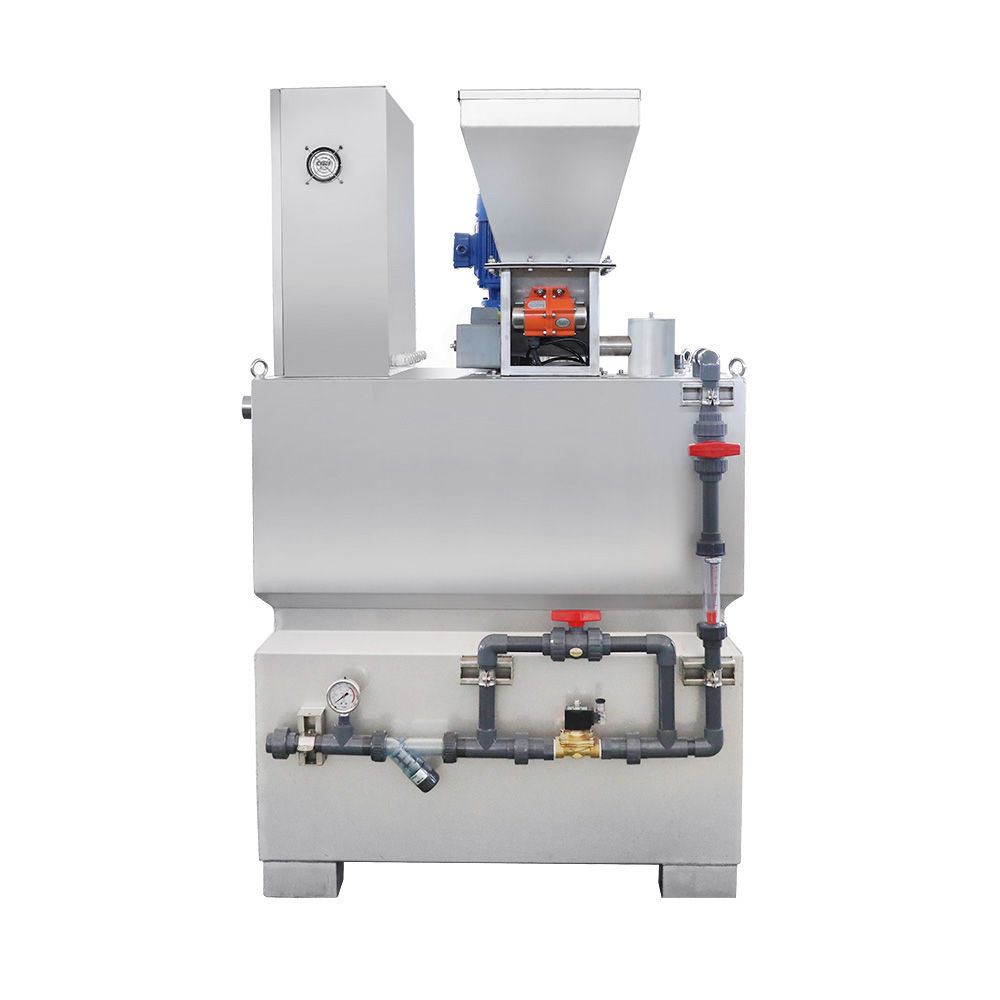
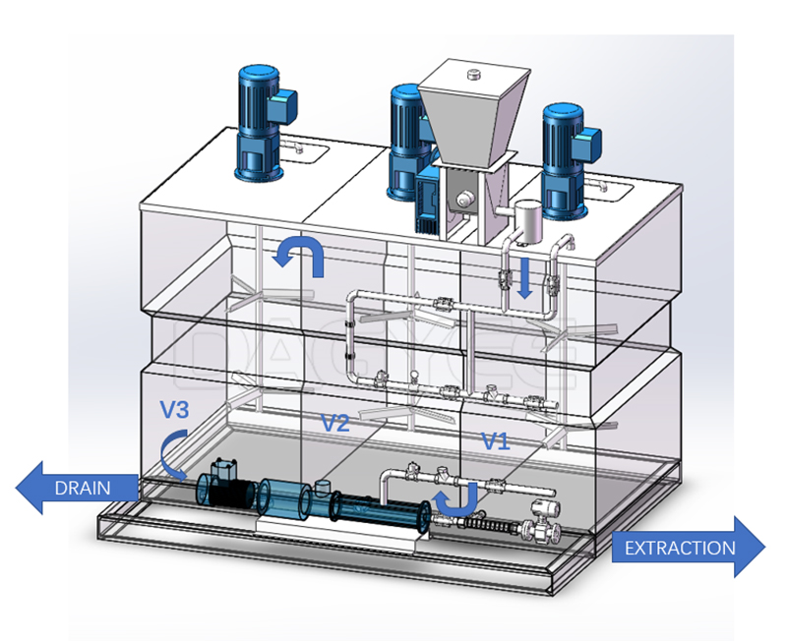
Before we dive into the specific procedures, here's an important fact:DAGYEE polymer preparation units are designed with "maintenance-friendly" as a priority from the very beginning.
What does this mean?
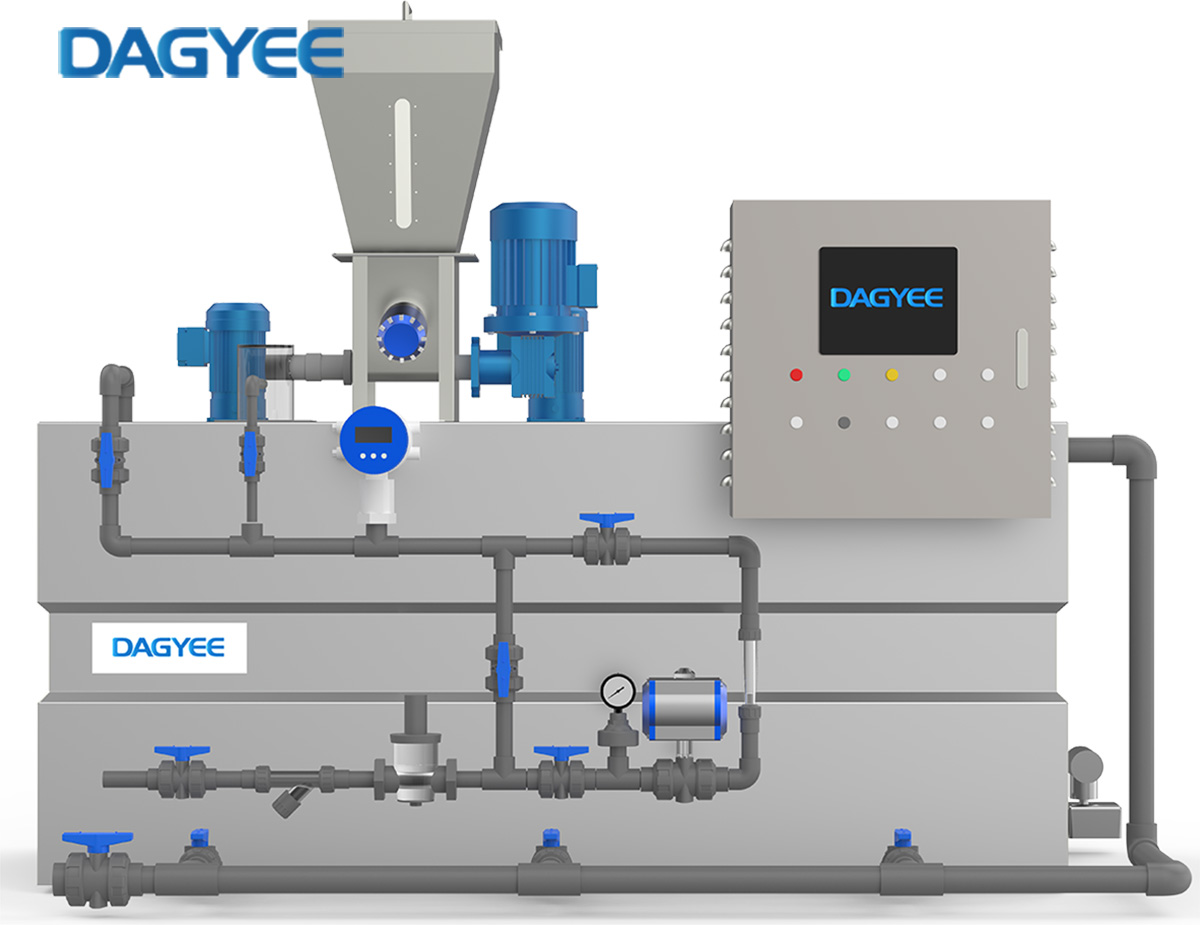
• The wetting cone can be quickly removed for cleaning — no tools required
• The hopper has an access door so you can reach in and clean wall buildup
• The electrical control panel is clearly labeled — you can see which sensor does what
• Every component that needs regular inspection or replacement is within easy reach
We call this "maintenance-friendly design."
But no matter how friendly the design, it doesn't work if you don't execute. Here is the maintenance checklist you need to follow.
Maintenance Overview
DAGYEE Polymer Preparation System
| Frequency | Activities | Time | Responsible |
|---|---|---|---|
| Daily | Basic checks | 5-10 minutes | Shift operator |
| Weekly | Routine maintenance | 15-20 minutes | Shift operator |
| Monthly | In-depth inspection | 30-45 minutes | Team leader or technician |
| Quarterly | Complete maintenance | 2-3 hours | Technician |
| Annually | Major overhaul | 1 day | Technician + DAGYEE support |
Daily Maintenance (5-10 minutes)
These are the basic checks you should do before startup or during operation each day. They don't take much time, but they prevent most sudden failures.1. Check Water Pressure
Look at the pressure gauge. The reading should be between 2-3 bar (30-45 psi).
• Too low: Check if the water supply valve is fully open, if the inlet strainer is clogged, or if the feed pump is working properly
• Too high: Check if the outlet valve is too far closed or if there's a restriction in the line
DAGYEE Tip: Every DT series polymer preparation unit should have a pressure gauge installed on the water inlet line. If yours doesn't, add one. This is one of the most important monitoring points in the entire system.
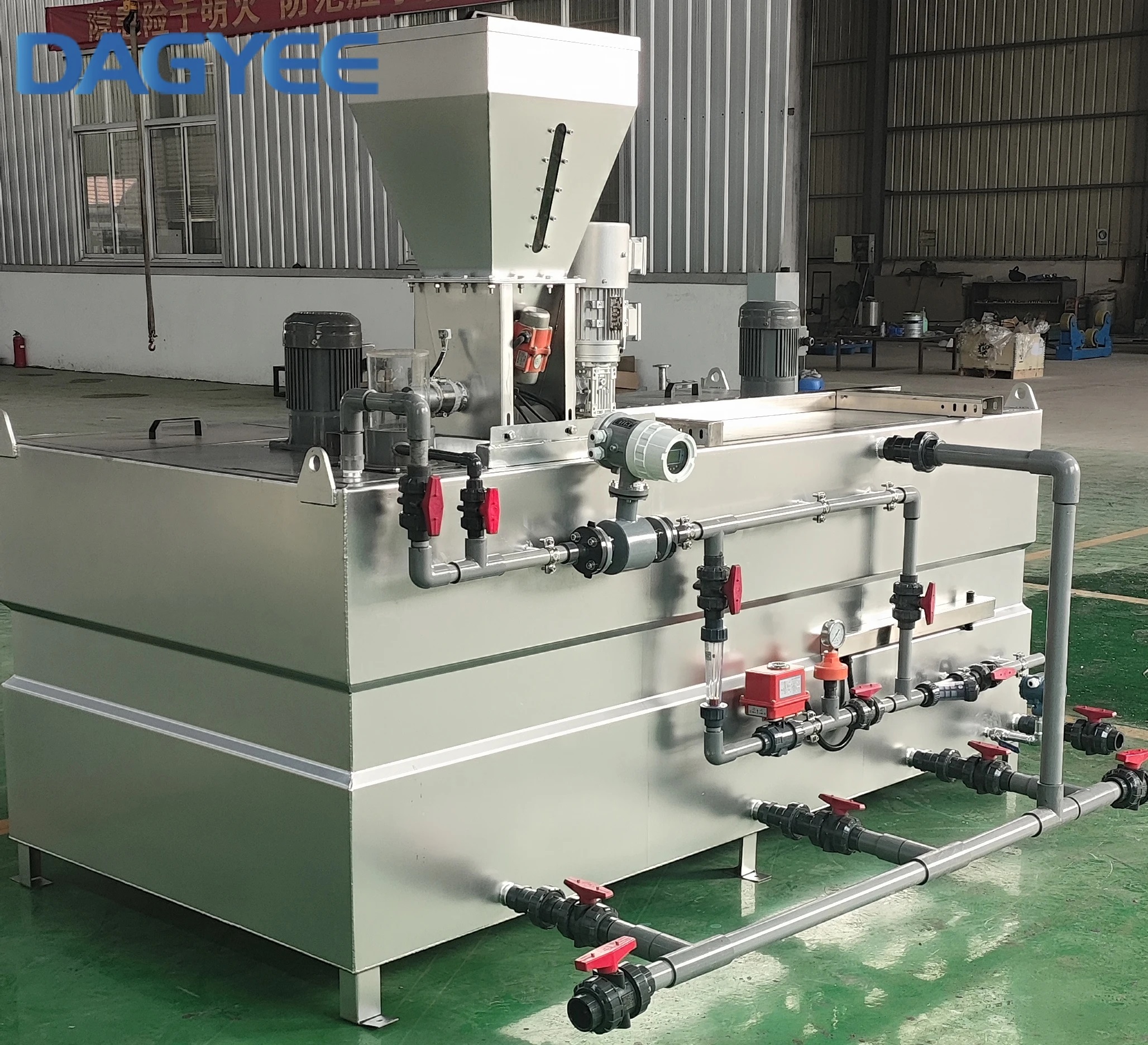
Look through the inspection window. You should see a uniform mixture of water and powder flowing down inside the wetting cone.
• Dry powder falling straight through: Water pressure is too low or feeder speed is too high
• Visible buildup on the inner walls: Time to clean
• Intermittent water flow: The inlet strainer may be clogged
3. Listen to the Equipment
Use your ears — this is the simplest and most overlooked inspection method.
• Pump sound: Normal operation is smooth and steady. Grinding, knocking, or irregular surging sounds are not normal.
• Agitator sound: Should be a low, steady hum. A sharp metallic sound means bearings may be dry.
• Feeder sound: The screw should turn quietly. Clicking or scraping sounds may mean the screw is rubbing against the hopper wall.
4. Check Liquid Level
Look at the solution storage tank level. Do not run for extended periods with low level (below 30%).
Running at low level causes:
• Vortexing that pulls air into the pump suction
• Dry running that damages the diaphragm and valves
• Concentration fluctuations that affect downstream performance
5. Inspect the Final Solution
Take a sample from the outlet. Hold it up to the light.
• Clear and uniform: Normal
• Fish eyes (gel-like particles): Check the wetting cone and water pressure
• Settled solids: Check if the agitator is turning and at the right speed
Weekly Maintenance (15-20 minutes)
Weekly maintenance focuses on areas where material accumulates and parts wear.1. Clean the Wetting Cone
This is the single most important step for preventing fish eyes and clogs.
Procedure:
1. Stop the unit and close the water supply valve
2. Remove the inspection cover or the entire wetting cone (DAGYEE units allow tool-free removal)
3. Use a brush or high-pressure water to clean polymer residue from the inner walls
4. Check the jet nozzle for any blockage
5. Reinstall and resume operation
If cleaning is difficult: This means buildup has been accumulating for too long. Shorten your cleaning interval.
DAGYEE Tip: Some customers keep two wetting cones — one in use and one cleaned and ready as a spare. They rotate them so the unit never has to stop for cleaning.
2. Inspect the Hopper Interior
Open the hopper access door (standard on DAGYEE units). Use a flashlight to look at the inner walls.
• Sticking powder: Use a brush or scraper to clean it off
• Visible wear on the walls: Check if any foreign objects have entered the hopper
• Damp clumps: The storage environment is too humid — consider dehumidification
3. Clean the Y-Strainer
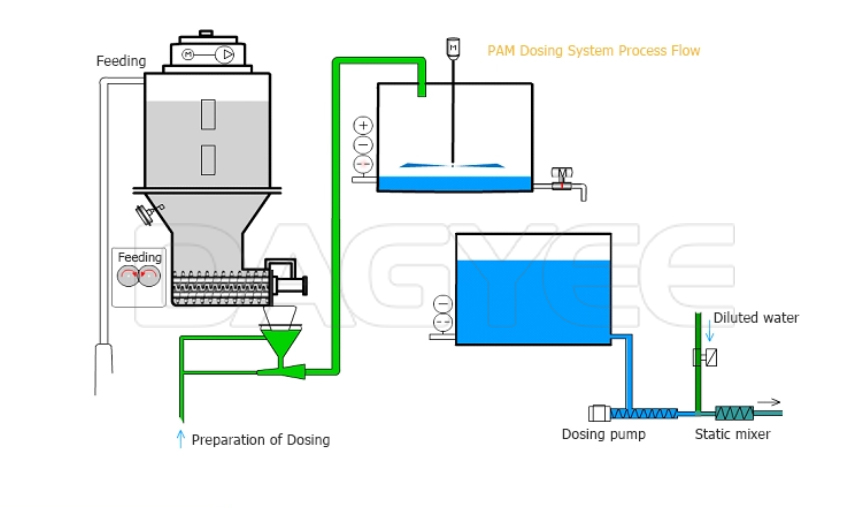
The Y-strainer is installed on the pump suction line. Its job is to catch undissolved particles before they reach the pump.
Procedure:
1. Close the valves before and after the pump
2. Unscrew the strainer cap
3. Remove the screen and rinse it thoroughly with water
4. Reinstall, open the valves, and check for leaks
Why clean it even if it's not fully blocked? Fine residue builds up slowly. It won't completely block the strainer, but it will gradually reduce flow. You think the pump is working normally, but output has already dropped.
4. Check the Feeder Discharge
Moisture can travel back up the discharge opening and cause powder to cake.
Look at the discharge opening. Is there wet powder caked there? If yes, clean it and check:
• Is the powder in the hopper too damp?
• Is moisture traveling backward from the wetting cone? (Check the non-return device)
Monthly Maintenance (30-45 minutes)
Monthly maintenance focuses on calibration and verification.1. Recalibrate the Dry Feeder
Feeders drift over time. Without calibration, concentration accuracy suffers.
Procedure:
1. Stop the unit and turn off the water
2. Place a container under the feeder discharge
3. Run the feeder for exactly 3 minutes
4. Weigh the collected powder
5. Calculate the output per minute
6. Compare to the setpoint and adjust screw speed or calibration factor
7. Repeat until deviation is within ±5%
Record it: Write down each calibration result. If you see drift getting larger over time, the feed screw or barrel is wearing out and needs replacement.
2. Verify the Water Flow Meter
An inaccurate flow meter means inaccurate concentration.
Procedure:
1. Turn off the feeder
2. Run only water through the unit
3. Use a stopwatch and a graduated bucket to measure actual water flow for 1 minute
4. Compare to the flow meter reading
5. If deviation exceeds 5%, clean the flow meter or recalibrate it
3. Inspect Pump Balls and Seats
These are the most wear-prone parts in a dosing pump.
Procedure:
1. Disconnect the pump inlet and outlet lines
2. Open the pump head
3. Remove the balls and seats
4. Inspect the surfaces for scratches, pitting, or deformation
5. Replace if there is visible wear (replace as a set)
6. Reassemble and test
Spare parts recommendation: Keep 2-3 sets of balls and seats on hand. They are consumables and will eventually need replacement. If you wait until they fail to order parts, your downtime will be much longer.
4. Check All Sensors
Failed sensors cause false alarms or complete shutdowns.
Sensors to check:
• Low level switch: Manually trigger it. Does the control panel show an alarm?
• High level switch: Manually trigger it. Does the unit stop filling?
• Flow switch: Shut off the water supply. Does the unit trigger a water failure alarm?
• Powder level sensor (if equipped): Does it alarm when the hopper is empty?
Quarterly Maintenance (2-3 hours)
Quarterly maintenance is deep cleaning and inspection. Schedule it during planned downtime.1. Complete Drain and Flush
Drain the entire system and flush everything thoroughly with clean water.
Includes:
• Mixing tank, maturation tank, and storage tank
• All piping
• Pump head interior
• Wetting cone
Why do this: Polymer residue accumulates where you can't see it. Over time, it hardens into a plastic-like substance that is extremely difficult to remove. A quarterly flush prevents this from ever happening.
2. Inspect Agitator Bearings
Bearings wear out over time.
Procedure:
1. Stop the unit and disconnect power
2. Turn the agitator shaft by hand. Feel for resistance or excessive play.
3. Listen to the bearing as you turn it. A quiet bearing is normal. Grinding or clicking means it's dry or worn.
4. Check for oil leaks around the bearing housing.
Grease: Follow the motor and bearing manufacturer's instructions. Don't over-grease, but don't under-grease either.
3. Check Electrical Connections
Vibration loosens terminal screws over time.
Procedure:
1. Disconnect power
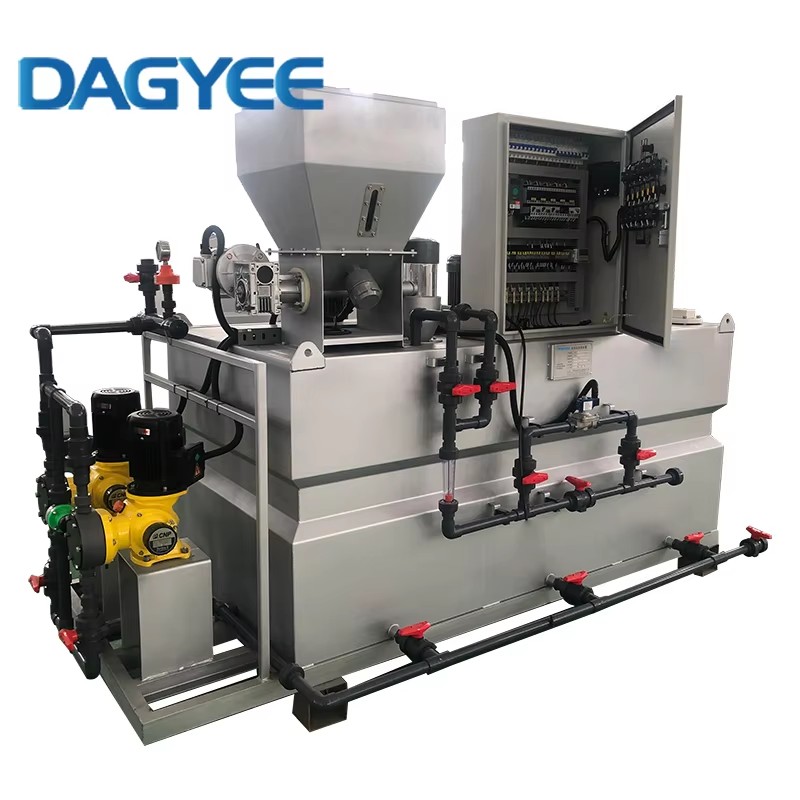
2. Open the control panel
3. Use a screwdriver to tighten every terminal (pay special attention to main power and motor circuits)
4. Look for any melted insulation or burn marks
5. Remove dust from inside the panel
4. Test Emergency Stops and Interlocks
Safety functions must be tested regularly.
Procedure:
1. With the unit running, press the emergency stop button
2. Confirm that all moving parts stop immediately
3. Reset the emergency stop. Confirm that the unit requires a manual restart.
4. Test each interlock condition one by one (no water, low level, over-temperature, etc.)
Annual Maintenance (1 day)
Annual maintenance is a major overhaul. We recommend doing this with DAGYEE technical support.1. Replace Worn Parts
Depending on usage, you may need to replace:
• Feed screw and barrel
• Pump diaphragm
• All seals and gaskets
• Agitator bearings
2. Complete Structural Inspection
• Check tanks for rust or cracks (stainless steel is durable, but check welds)
• Check the frame and anchor bolts for looseness
• Check all pipe connections for leaks
3. Control Panel Upgrades (if needed)
• Check for updated PLC programs
• Verify touchscreen calibration
• Replace aging relays
4. Performance Test• Run at rated capacity for 2 hours
• Record all parameters: water pressure, flow rate, concentration, power consumption
• Compare to factory data. If there are deviations, find the cause.
DAGYEE DT Series Technical Specifications (Maintenance Reference)
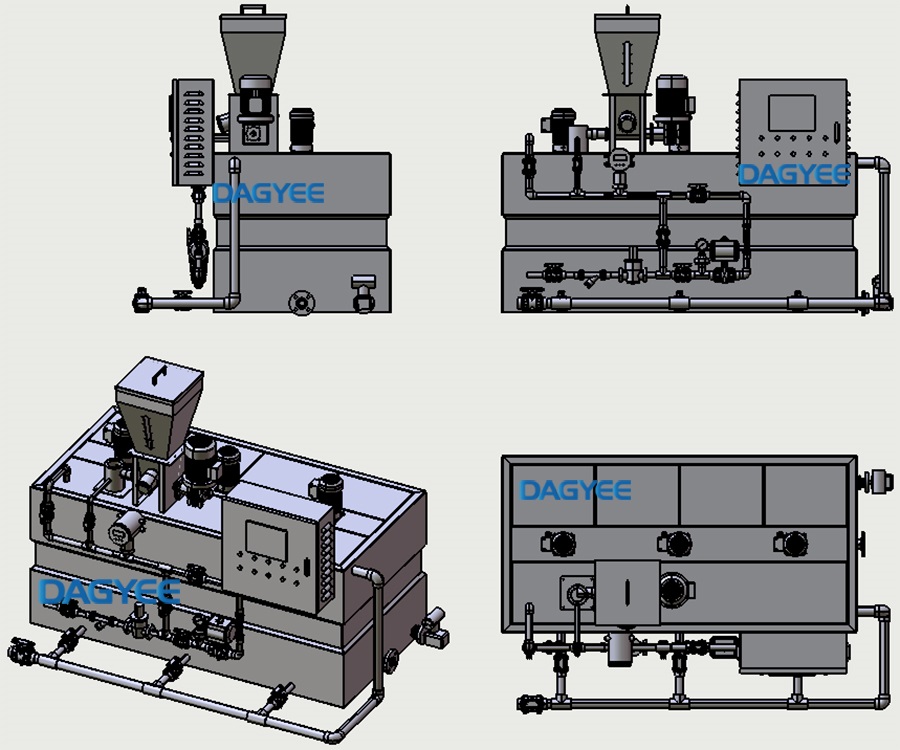
DT Series · Technical Specifications
Capacity, dimensions, weight and power data
| Model | Capacity (L/h) | Dimensions L×W×H (mm) | Weight (kg) | Power (kW) |
|---|---|---|---|---|
| DT200 | 200 | 940×520×1450 | 250 | 0.54 |
| DT500 | 500 | 1370×730×1450 | 350 | 0.92 |
| DT1000 | 1000 | 1800×950×1620 | 480 | 1.3 |
| DT1500 | 1500 | 2130×1120×1620 | 560 | 1.7 |
| DT3000 | 3000 | 2450×1270×2000 | 790 | 2.4 |
| DT4000 | 4000 | 2780×1440×2250 | 1050 | 3.2 |
| DT6000 | 6000 | 3100×1600×2650 | 1200 | 4.8 |
| DT10000 | 10000 | 3970×2040×2650 | 1450 | 6.4 |
Wear Part Replacement Intervals
Typical replacement intervals and early warning signs
| Component | Typical Replacement Interval | Signs It Needs Early Replacement |
|---|---|---|
| Pump balls and seats | 6-12 months | Decreasing flow, unstable dosing |
| Pump diaphragm | 12-24 months | Leaking pump head, abnormal flow |
| Feed screw and barrel | 2-3 years | Calibration drift keeps getting worse |
| Seals and gaskets | 2-3 years | Visible leaks |
| Agitator bearings | 3-5 years | Increasing noise during operation |
| Sensors | 3-5 years | False alarms or no alarms |
Frequently Asked Questions About Maintenance
Q1: I don't have a DAGYEE unit. Can I still use this checklist?Mostly, yes. The basic principles are the same across all polymer preparation units. However, for specific disassembly procedures and calibration steps, refer to your equipment's manual.
If your current unit gives you constant problems, maybe it's time to consider a DAGYEE.
Q2: My unit has been running for years with no maintenance. Is it too late to start?
It's not too late. But be prepared: the first time you do a quarterly maintenance, you may find many unexpected problems. The buildup may be hard as plastic. The pump valves may be severely worn.
That's okay. Starting today is better than never starting at all.
Q3: We can't stop production for maintenance. What do we do?
Two options:
• Schedule maintenance during planned downtime (shift changes, weekends, end of month)
• If your process allows it, install two units and rotate their use
DAGYEE's DT series has a modular design. Some maintenance tasks (like cleaning the wetting cone) take only minutes and can be done without a full shutdown.
Q4: Our operators have high turnover. How do we make sure maintenance doesn't get forgotten?
A few suggestions:
• Print the maintenance checklist and post it next to the unit
• Add maintenance tasks to the shift handover log
• Set phone reminders or alarms
• Assign one specific person to be responsible (don't rotate)
Conclusion
We wrote this blog for a simple reason: we've seen too many units retired early simply because they weren't maintained.Some units are only two years old but look worse than units that have been running for eight. Open them up and you find a clogged wetting cone, worn-out pump valves, and a hard layer of crust on the hopper walls. The operator says: "We didn't know we needed to maintain it."
That's a shame. Because the equipment itself is well designed and well built. With just a little time spent on maintenance, it could run reliably for years.
DAGYEE polymer preparation units are designed from the ground up to be maintenance-friendly.
Removable wetting cone. Hopper access door. Clearly labeled control panel. All of these features make it easy for you to do the maintenance.
But no matter how friendly the design, it ultimately comes down to people.Spend 15 minutes today. Spend 15 minutes tomorrow. Keep at it.
Your equipment will reward you with longer life, fewer failures, and lower operating costs.
If you're not sure where to start with maintenance, or if you do a deep inspection and find problems you can't solve — call DAGYEE. We don't just sell equipment. We help you keep it running.
Want your polymer preparation unit to last for years? Start maintenance today. Need help? Contact DAGYEE.

Related News