Chemical, Farm, or Municipal? How to Choose the Right Submersible Mixer for Your Application
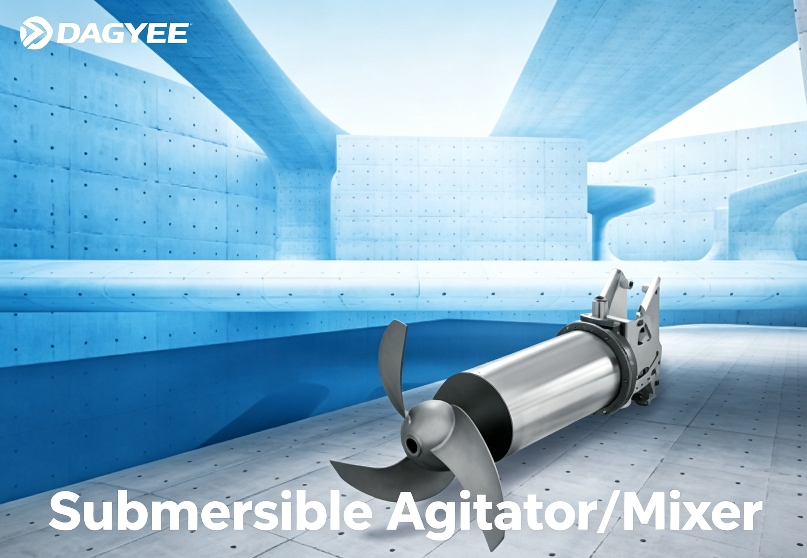
Chemical Plant, Livestock Farm, Municipal WWTP — Submersible Mixer Selection Guide for 3 Key Application ScenariosSubmersible mixers may look similar, but in the right application they perform well, and in the wrong one they become a problem. Chemical plants, livestock farms, and municipal wastewater treatment plants have completely different wastewater characteristics, and the selection logic for each is entirely different.
This article covers each scenario separately — what to watch for and what DAGYEE SMB Series models to recommend.
1. Chemical Plant: Wrong Material Choice Will Shorten Equipment Life Dramatically
Chemical wastewater has one defining characteristic — complexity.
Acids, alkalis, heavy metals, high salts, oils, and organic solvents — any one of these can shorten the life of a standard mixer. Some chemical plant wastewater has pH as low as 2-3, and some has salt content high enough to crystallize. Standard 304 stainless steel won't last long in these environments.
Chemical plant selection core: materials must resist corrosion, seals must hold.
How to choose materials?
According to industry standards for submersible mixers, the media pH should be between 5 and 9. Outside this range requires special customization. Chemical wastewater often falls outside this range, requiring 316L or even duplex stainless steel. All wetted parts (impeller, shaft, bolts) must be made of corrosion-resistant materials, with seals made of fluorine rubber. In one project, a mixer with 304 stainless steel was installed in a chemical park's high-salt wastewater. After some time, surface corrosion appeared and seals failed, requiring early replacement. After switching to 316L, the system stabilized.
Why are seals critical?
Submersible mixers operate underwater continuously. If a seal fails, the motor floods and the unit is scrap. Chemical wastewater is highly corrosive, and seals age faster. DAGYEE submersible mixers come standard with double mechanical seals, with seal faces made of corrosion-resistant tungsten carbide or silicon carbide, with a service life of no less than 25,000 hours. Prioritize models with double mechanical seals plus lip seals for dual protection.
Explosion-proof requirements matter.
If treating flammable or explosive chemical wastewater (containing solvents, oils, or gases), the equipment requires explosion-proof certification, typically ExdⅡBT4 or higher. Under normal conditions, the mixer must operate fully submerged and cannot be used in flammable or explosive environments unless specially customized.
Operating conditions: Media temperature ≤40°C, submergence depth generally ≤20m, media density ≤1150 kg/m³.
DAGYEE chemical plant recommended models:
Material and model selection based on operating conditions
| Application | Recommended Material | Recommended Model | Notes |
|---|---|---|---|
| High corrosion, high salt, acids/alkalis | 316L stainless steel | SMB4/6-400/S or SMB10/12-620/S | Full stainless steel, high thrust |
| Oily, solvent-containing | 304 stainless steel + fluorine rubber seals | SMB2.2/8-320/S | Upgraded seals, corrosion-resistant |
Selection tip: For chemical plants with aggressive media, choose material based on water analysis. For high chloride and acid content, 316L is essential. For media with organic solvents and oils, 304 with upgraded seals is sufficient.
Livestock farm wastewater is the opposite of chemical plant wastewater — composition is less complex, but there is one special requirement: don't mix too aggressively.
Whether it's pig farm or chicken farm manure wastewater, or aquaculture ponds, the core requirement is to keep manure and uneaten feed from settling while avoiding strong currents that could harm aquatic life.
Livestock farm selection core: low power, multiple placements, gentle flow.
Don't oversize power.
A 500 m³ shrimp pond needs only 1.5-2.2 kW of mixing power. The principle for aquaculture ponds is "low power, multiple placements" — better to install several small units than one large one. High-power mixing creates strong currents that stress fry and affect growth.
Control speed.
For aquaculture, speed should be controlled at 150-300 rpm, with guide cones to create gentle circulating flow. According to mixer selection standards, the mixing series typically uses multi-pole motors with direct-coupled design — low energy consumption, high efficiency, high-precision impeller, and strong thrust. For aquaculture, speed should be kept in an appropriate range — too fast and fish become stressed, too slow and circulation is insufficient.
Noise matters.
Aquatic life is sensitive to sound. Equipment noise should be kept below 60 dB to avoid startling the animals and affecting growth. DAGYEE submersible mixers feature low-speed design with low vibration and low noise.
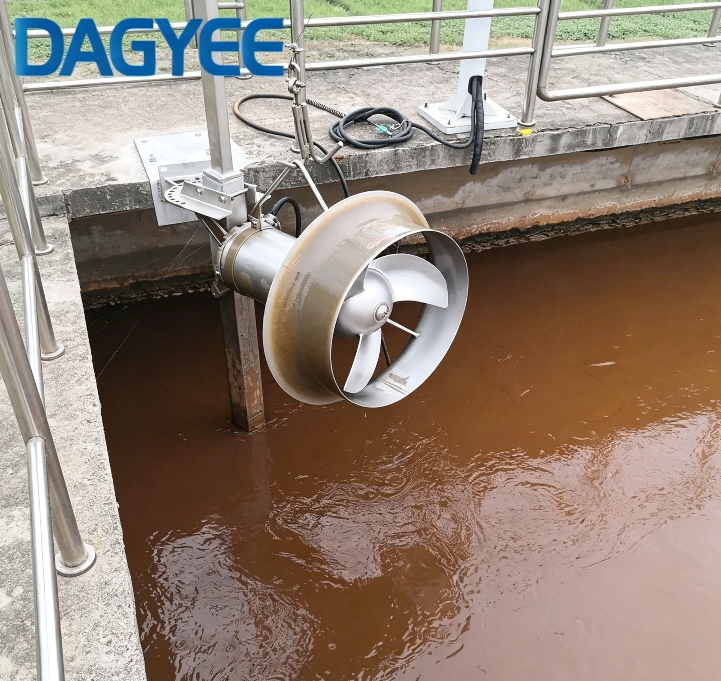
Manure wastewater treatment applications
Pig, cattle, and chicken farm manure wastewater has high solids content and contains fibers, making it prone to clogging. The impeller should have anti-winding capability. The three-blade swept-back impeller design has self-cleaning and anti-winding features, effectively preventing debris from wrapping around and clogging.
Operating conditions: Media temperature ≤40°C, pH 5-9, submergence depth ≤20m.
DAGYEE livestock farm recommended models:
Selection guide for aquaculture and manure wastewater treatment
| Farm Type | Recommended Model | Power | Features |
|---|---|---|---|
| Fish/shrimp pond (small volume) | SMB0.85/8-260 | 0.85 kW | Low power, low speed |
| Fish/shrimp pond (medium volume) | SMB1.5/6-260 | 1.5 kW | Moderate speed, gentle thrust |
| Manure wastewater treatment | SMB2.2/8-320 | 2.2 kW | 582 N thrust, handles high solids |
Selection tip: For aquaculture ponds, use multiple small units rather than one large unit to create gentle circulation without stressing aquatic life. For manure wastewater, choose higher thrust models to handle high solids content and prevent settling.
Municipal wastewater treatment plants are the most common application for submersible mixers, and the most prone to selection errors. A single WWTP has equalization tanks, hydrolysis tanks, anaerobic tanks, anoxic tanks, aerobic tanks, and sludge tanks — each with different mixing requirements.
Municipal WWTP selection core: tank type determines configuration, flow velocity determines success.
First, understand what your tank is designed to do.
Equalization tanks and hydrolysis tanks require high flow, low shear mixing to avoid damaging sludge flocs — choose large impeller, low speed.
Anaerobic and anoxic tanks mainly maintain sludge suspension and prevent settling — choose medium impeller, moderate speed.
Aerobic tanks and oxidation ditches need flow generation and water circulation — choose large impeller, low speed flow generators.
Reaction tanks for chemical mixing need fast, uniform mixing — choose small impeller, high speed.
According to industry standards, submersible mixers are divided into two main series: mixing series for liquids containing suspended solids, and low-speed flow series for aeration tanks, creating flow for nitrification, denitrification, and phosphorus removal stages.
Flow velocity is the hard selection criteria.
The basic selection principle is to ensure the mixer achieves effective mixing within the tank volume, generally determined by flow velocity. Based on different treatment process requirements, the mixer flow velocity should be maintained at 0.15-0.3 m/s — below 0.15 m/s fails to achieve mixing and flow, above 0.3 m/s disrupts the process and wastes energy.
For tanks with volume of 1000-3000 m³, media viscosity can reach 50 cP; for 500-700 m³, viscosity can reach 1000 cP. These parameters also affect mixer selection.
Installation depth affects selection.
For every 1 meter increase in water depth, the required thrust does not increase linearly — it rises exponentially. For tank depth H < 4m, a guide rail mounting system is recommended; for H > 4m, a cable suspension system is recommended to avoid guide rail bending and deformation.
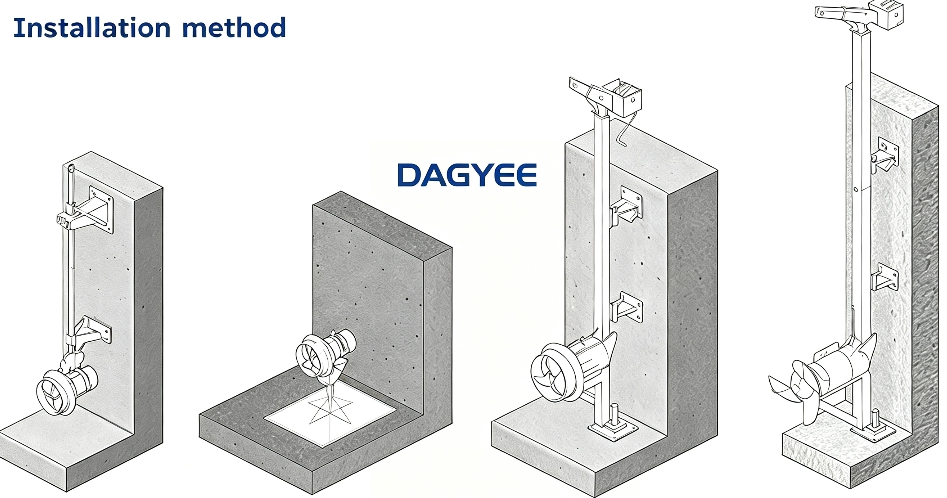
According to installation standards, the submersible mixer should be liftable for inspection and maintenance without personnel entering the tank. The mixer is mounted on a sliding guide rail bracket that supports all weight and must withstand all thrust forces.
Operating conditions: Media temperature ≤40°C, pH 5-9, density ≤1150 kg/m³, submergence depth ≤20m, motor capable of continuous or intermittent 24-hour operation.
DAGYEE municipal WWTP recommended models:
Selection guide for different tank types
| Tank Type | Recommended Model | Power | Thrust | Features |
|---|---|---|---|---|
| Equalization/hydrolysis tank | SMB2.2/8-320 | 2.2 kW | 582 N | Large impeller, low speed |
| Anaerobic/anoxic tank | SMB1.5/6-260 | 1.5 kW | 290 N | Moderate configuration |
| Aerobic tank/oxidation ditch | SMB4/12-620 | 4 kW | 1230 N | Large impeller, low speed flow |
| Reaction tank (chemical dosing) | SMB1.5/6-260 | 1.5 kW | 290 N | High speed mixing |
Selection tip: Match the mixer to the tank's primary function — equalization and hydrolysis need low shear, anaerobic/anoxic need suspension, aerobic tanks need flow generation, and reaction tanks need fast mixing. One size does not fit all in municipal WWTP applications.
DAGYEE SMB Series submersible mixers cover models from 0.85kW to 10kW, suitable for various operating conditions. Housing material available in stainless steel SUS304 or GG25 cast iron. Impeller available in stainless steel or fiberglass-reinforced polyurethane. Shaft made of ASTM431 or 420 stainless steel. Mechanical seals use corrosion-resistant tungsten carbide or silicon carbide.
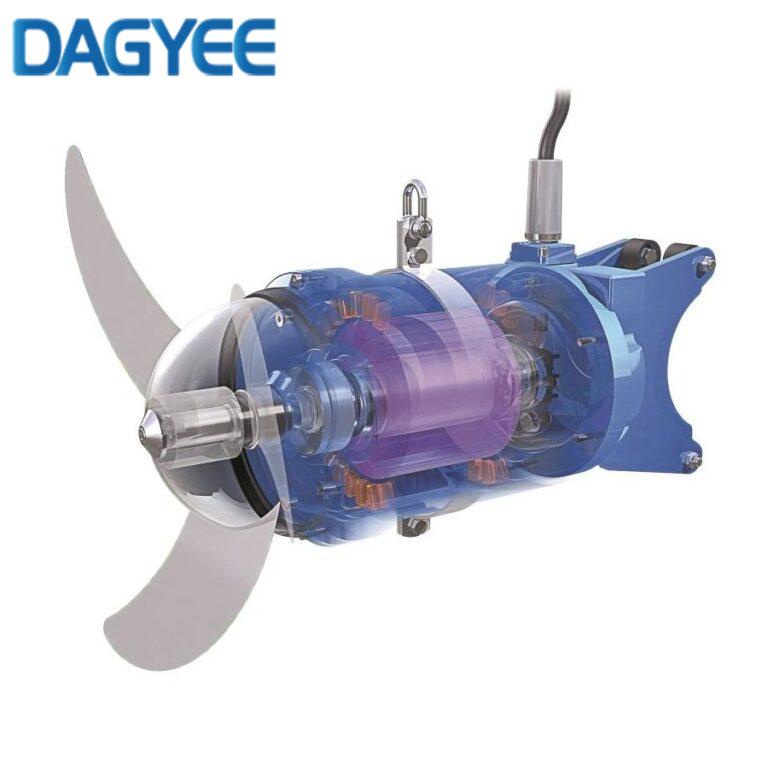
SMB Series — Technical Specifications
DAGYEE submersible mixers — performance data for selection
| Model | Power (kW) | Current (A) | Speed (rpm) | Impeller (mm) | Thrust (N) | Weight (kg) |
|---|---|---|---|---|---|---|
| SMB0.85/8-260/3-740/C/S | 0.85 | 3.4 | 740 | 260 | 163 | 55/58 |
| SMB1.5/6-260/3-980/C/S | 1.5 | 4.4 | 980 | 260 | 290 | 55/58 |
| SMB2.2/8-320/3-740/C/S | 2.2 | 5.9 | 740 | 320 | 582 | 74/77 |
| SMB4/6-320/3-980/C/S | 4 | 10.8 | 980 | 320 | 609 | 74/77 |
| SMB1.5/8-400/3-740/S | 1.5 | 5.6 | 740 | 400 | 382 | 76/80 |
| SMB2.5/8-400/3-740/S | 2.5 | 7.3 | 740 | 400 | 575 | 76/80 |
| SMB3/8-400/3-740/S | 3 | 8.6 | 740 | 400 | 642 | 78/82 |
| SMB4/6-400/3-980/S | 4 | 10.3 | 980 | 400 | 1010 | 80/84 |
| SMB4/12-620/3-480/S | 4 | 14 | 480 | 620 | 1230 | 240/245 |
| SMB5/12-620/3-480/S | 5 | 18.2 | 480 | 620 | 1420 | 240/245 |
| SMB7.5/12-620/3-480/S | 7.5 | 28 | 480 | 620 | 1963 | 255/270 |
| SMB10/12-620/3-480/S | 10 | 32 | 480 | 620 | 2361 | 255/270 |
Note: C/S indicates material options — C for Cast Iron, S for Stainless Steel. Small tanks / low concentration → lower thrust models. Large tanks / high concentration / flow applications → higher thrust models.
5. At a Glance — Selection Differences Across Three Scenarios
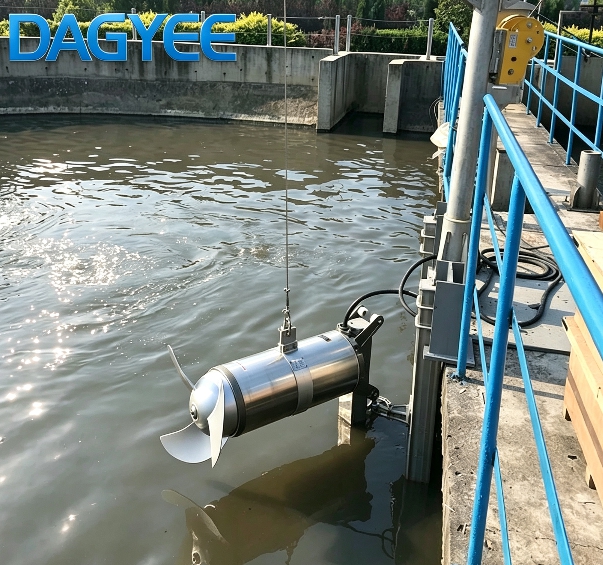
Chemical Plant · Livestock Farm · Municipal WWTP
| Comparison | Chemical Plant | Livestock Farm | Municipal WWTP |
|---|---|---|---|
| Core challenge | High corrosivity | Gentle flow required | Multiple tank types, complex conditions |
| Material requirement | 316L / Duplex stainless steel | 304 stainless steel sufficient | 304 stainless steel (standard conditions) |
| Seal grade | Double mechanical + lip seals | Standard mechanical seals | Double mechanical seals |
| Speed selection | Based on tank type | 150-300 rpm | Based on tank type |
| Suitable pH | Custom required | 5-9 | 5-9 |
| Suitable temperature | Custom required | ≤40°C | ≤40°C |
| Submergence depth | ≤20m | ≤20m | ≤20m |
| Protection class | IP68 | IP68 | IP68 |
| Insulation class | Class F | Class F | Class F |
| Special requirements | Explosion-proof | Low noise <60dB | Flow velocity 0.15-0.3 m/s |
Key takeaway: Each scenario has distinct requirements — chemical plants need corrosion-resistant materials and explosion-proof design; livestock farms need gentle flow and low noise; municipal WWTPs need flexibility for multiple tank types with flow velocity control.
Submersible mixer selection has no one-size-fits-all approach. Chemical, livestock, and municipal — each scenario has its own pitfalls. Wrong material, wrong power, or wrong mounting will all cause problems over time — problems that get more expensive the longer they go unaddressed.
Before selecting, get three things right: what your tank does, what your water quality is like, and whether flow velocity meets standards. Answer these three questions, and your selection direction won't be far off.
DAGYEE SMB Series covers models from 0.85kW to 10kW, with materials available in cast iron, stainless steel, or polyurethane. Protection class IP68, insulation class F — matching the right configuration to your specific application.
DAGYEE — Submersible Mixer Solutions
Need help selecting a submersible mixer? Tell us your application, tank dimensions, and water quality parameters. We'll recommend the right model for your needs.