Plate Clarifier vs. Tube Settler: A Technical Deep Dive for Wastewater Professionals
DAGYEE Lamella Plate Clarifier vs. Tube Settler: Why Plates Are the Better Choice for Industrial Applications
By DAGYEE Company - Water Treatment Specialist
Introduction
If you're specifying a clarifier for an industrial wastewater treatment project, you've likely encountered two similar-sounding technologies: plate settlers and tube settlers. Both are often referred to as "lamella" technologies, and both are designed to increase settling capacity within a smaller footprint.
But they are not the same.
While tube settlers (also called tube modules) are popular in municipal applications and some industrial settings, plate settlers offer distinct advantages for industrial wastewater treatment---particularly when dealing with high suspended solids, aggressive water chemistry, or projects requiring durable, long-term installations.
This article explains the key differences between plate and tube settlers, and why lamella plate clarifiers are often the superior choice for demanding industrial applications.
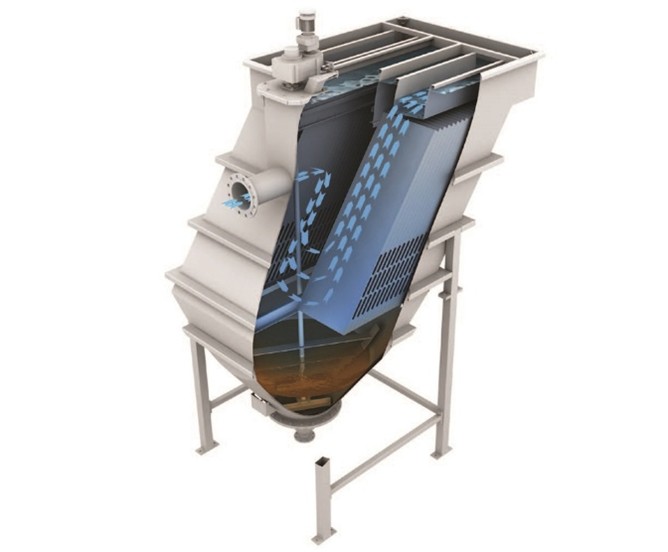
The Common Principle: Shallow Depth Settling
Before comparing the two technologies, it's important to understand what they share.
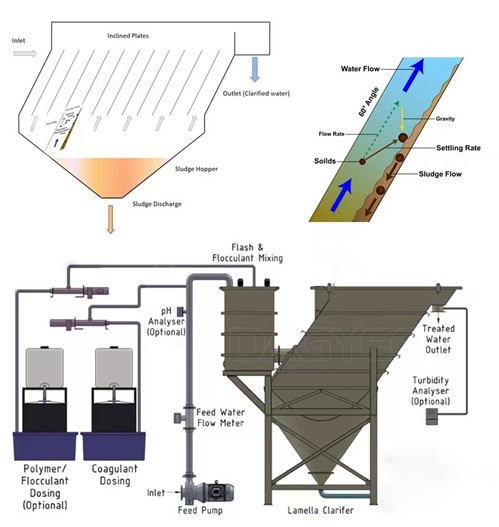
Both plate settlers and tube settlers are based on Hazen's sedimentation theory (1904), which states that particle settling efficiency depends on the surface area available for settling, not detention time.
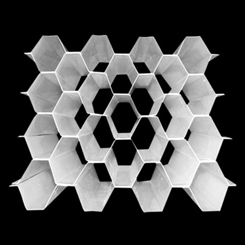
By installing inclined surfaces (plates or tubes) at a 55-60° angle, both technologies:
-
Reduce the vertical distance particles must fall (from meters to centimeters)
-
Increase the effective settling area by 5-10 times compared to conventional tanks
-
Enable counter-current flow: water rises while sludge slides down
However, the geometry of these surfaces creates significant differences in performance, maintenance, and cost.
Critical Quality Factors: What Separates Superior Equipment
Before diving into the plate vs. tube comparison, it's essential to understand what separates high-quality, long-lasting clarifiers from equipment that may fail prematurely. Based on our experience manufacturing and installing industrial clarifiers worldwide, these are the key factors we recommend evaluating:
Surface Treatment Process
Our Approach: We consistently apply passivation treatment to 304 stainless steel, forming a stable protective film that enhances corrosion resistance and extends equipment life.
The Risk of Inferior Alternatives: Some suppliers may use anti-rust paint spraying to reduce costs. In long-term water immersion environments, paint carries a significant risk of peeling and delamination, leading to localized corrosion of the base material. Once moisture penetrates beneath the paint film, corrosion accelerates rapidly---often hidden from view until structural damage occurs.
Key Insight: Passivation is a chemical process that enhances the natural oxide layer on stainless steel, creating a surface that is integral to the metal itself. Paint is merely a coating that can fail over time.
Core Settling Components
Our Approach: We use stainless steel lamella plates with a thickness of 6mm, offering high structural strength and a service life aligned with the main equipment (20-30+ years).
The Risk of Inferior Alternatives: Common plastic tube settlers are prone to aging, deformation, and embrittlement in complex water quality environments---particularly those with temperature variations, UV exposure, or aggressive chemistry. These typically require replacement every 1-2 years, adding significant maintenance costs and unplanned downtime.
Warning: We do not recommend using inclined tubes with a thickness of less than 1mm. Such thin-walled tubes lack adequate structural support and face the risk of collapse or deformation during normal operation. Field experience shows these require frequent replacement, negating any initial cost savings.
Structural Design and Material Quality
Our Approach: Our equipment features scientifically arranged reinforcement ribs and ensures all plate thicknesses comply with standard requirements. Structural rigidity is engineered for the specific hydraulic and solids loading conditions.
What to Look For: We recommend carefully evaluating the structural rigidity and material thickness of any clarifier you consider. Insufficient reinforcement can lead to plate deflection, uneven flow distribution, and reduced settling efficiency---even if the material grade is correct.
Drive Unit Configuration
Our Approach: We standardize with top-tier German brands such as SEW and NORD for reducers and drive components.
Why It Matters: High-quality drives significantly outperform common domestic alternatives in operational precision, energy efficiency, and service life. While the upfront cost is higher, the total cost of ownership is lower due to reduced maintenance, fewer failures, and longer operational life. This is particularly important for remote or unattended installations where breakdowns are costly.
Core Performance Assurance
Our Approach: We advise paying close attention to whether the effective settling area provided by the supplier accurately matches your treatment requirements---this is fundamental to ensuring effluent quality.
The Risk: Some suppliers may oversimplify sizing calculations, providing equipment with insufficient settling area for the actual flow rate and solids loading. This results in poor effluent quality, frequent upsets, and the need for costly retrofits or replacement.
Key Differences: Plate vs. Tube Settlers
Design and Geometry
|
Feature |
Plate Settler |
Tube Settler |
|
Structure |
Flat plates spaced 2-3 inches apart |
Tubular channels (hexagonal, circular, or trapezoidal) |
|
Material |
Stainless steel, FRP, or polypropylene |
PVC or polypropylene (typically) |
|
Typical Thickness |
2-6mm (stainless steel) |
<1mm (plastic) |
|
Angle |
55-60° |
60° (nominal) |
|
Flow Path |
Parallel plates create open channels |
Individual tubes create enclosed channels |
|
Hydraulic Radius |
Larger |
Smaller |
Hydraulic Performance
The most significant technical difference lies in hydraulics. Tube settlers, with their enclosed channels, achieve a smaller hydraulic radius, which can help maintain laminar flow (Reynolds number <500). However, this comes with trade-offs:
|
Parameter |
Plate Settler |
Tube Settler |
Advantage |
|
Flow Regime |
Laminar to transitional |
Laminar (Re 150-400) |
Tube (more stable) |
|
Velocity Gradients |
Lower near walls |
Higher near walls |
Plate (less floc shear) |
|
Head Loss |
30-50 Pa |
15-30 Pa |
Tube (lower energy) |
|
Effective Area per Volume |
100-150 m²/m³ |
200-250 m²/m³ |
Tube (more area) |
Table data compiled from industry sources
The Critical Issue: Floc Roll-Up and Solids Handling
Plate Settlers: Built for Solids
In plate settlers, solids settle onto flat surfaces and slide down by gravity. The open channel design allows for:
-
Unobstructed sludge flow - No corners or joints where solids can accumulate
-
Lower velocity gradients - Cornell University research shows that velocity gradients near walls can cause "floc roll-up," where settled particles are re-suspended. Plate settlers, with their larger hydraulic radius, create lower velocity gradients, reducing this risk.
-
Better handling of high solids loads - When influent suspended solids exceed 200 mg/L, plates provide a more reliable sludge removal path.
-
Stainless steel durability - 6mm thick plates resist bending, corrosion, and wear for decades
Tube Settlers: The Blockage Risk
Tube settlers, while offering more surface area per volume, have fundamental weaknesses:
-
The Geometry Problem: As one industry expert notes: "Tube settlers have dead area because any tubes near the wall are dead ends... very small diameter tube settlers won't work." In circular or rectangular tanks, tubes near the walls are partially blocked, reducing effective area.
-
The Clogging Risk: Tubes can become clogged with sludge, algae, or debris. Once a tube blocks, it's difficult to clean without removing the entire module.
-
The Material Limitation: Thin-walled plastic tubes (<1mm) are prone to:
-
Aging and embrittlement from UV exposure and temperature cycling
-
Deformation under load, especially in warm water
-
Frequent replacement (typically every 1-2 years in demanding applications)
|
Solids Handling Issue |
Plate Settler |
Tube Settler |
|
Clogging Risk |
Low (open channel) |
Moderate to High (enclosed tubes) |
|
Cleaning Access |
Plates can be removed individually |
Tubes difficult to clean; often replaced |
|
Sludge Slide Angle |
55-60° (optimized) |
60° (fixed) |
|
High SS Handling |
Excellent |
Good, but risk of bridging |
|
Typical Service Life |
20-30 years (stainless steel) |
1-5 years (plastic tubes) |
Material and Durability Comparison
This is where plate settlers have a significant advantage for industrial applications.
Plate Settler Materials
Stainless Steel (304/316) - Our Recommendation:
-
Thickness: 6mm (or as specified for structural requirements)
-
Surface Treatment: Passivation creates an integral protective layer---no paint to peel
-
Lifespan: 20-30+ years
-
Advantages: Maximum durability, corrosion resistance, and temperature tolerance. Ideal for aggressive industrial wastewater, high temperatures, or coastal installations.
-
Structural Integrity: Reinforcement ribs ensure plates maintain position under hydraulic load
Other Plate Options:
-
FRP (Fiberglass Reinforced Plastic): Good chemical resistance, lighter than steel, 15-25 year lifespan
-
Polypropylene: Chemical resistant, lower cost, but temperature-limited (<60°C)
Tube Settler Materials
Tubes are almost always PVC or polypropylene, typically with wall thicknesses less than 1mm. While these materials are chemically resistant, they have significant limitations:
|
Limitation |
Consequence |
|
UV Sensitivity |
PVC degrades in sunlight; must be protected |
|
Temperature Limits |
Typically <60°C; deformation risk above this |
|
Mechanical Strength |
Thin walls lack rigidity; can collapse under load |
|
Aging |
Becomes brittle over time, especially in variable temperatures |
|
Replacement Frequency |
1-2 years in demanding applications; 5-10 years in ideal conditions |
Lifespan Comparison
|
Material |
Expected Lifespan |
Applications |
|
Stainless Steel Plates (6mm) |
20-30+ years |
Industrial, corrosive environments, high-temperature, coastal |
|
FRP Plates |
15-25 years |
Municipal, some industrial |
|
PVC Tube Modules |
5-10 years (ideal conditions); 1-2 years (demanding) |
Municipal, low-temperature industrial |
|
Polypropylene Tubes |
Similar to PVC |
Similar to PVC |
The Hidden Cost of Frequent Replacement
Many buyers focus on initial cost when comparing plate and tube settlers. But the total cost of ownership tells a different story.
Tube Settler Replacement Scenario
Consider a 20 m³/h industrial clarifier with plastic tube modules:
|
Cost Factor |
Year 1 |
Year 2 |
Year 3 |
Year 4 |
Year 5 |
10-Year Total |
|
Initial Tube Cost |
$3,000 |
$0 |
$3,000 |
$0 |
$3,000 |
$9,000 |
|
Installation Labor |
$1,500 |
$0 |
$1,500 |
$0 |
$1,500 |
$4,500 |
|
Downtime Cost (lost production) |
$0 |
$0 |
$5,000 |
$0 |
$5,000 |
$10,000 |
|
Cumulative |
$4,500 |
$4,500 |
$14,000 |
$14,000 |
$23,500 |
$23,500 |
Stainless Steel Plate Scenario
|
Cost Factor |
Year 1 |
Year 2-10 |
10-Year Total |
|
Initial Plate Cost |
$12,000 |
$0 |
$12,000 |
|
Replacement Cost |
$0 |
$0 |
$0 |
|
Downtime Cost |
$0 |
$0 |
$0 |
|
Cumulative |
$12,000 |
$12,000 |
$12,000 |
Result: Despite higher initial cost, stainless steel plates save $11,500 over 10 years---and they're still going strong while the tube settler has been replaced three times.

Related News