Cut Footprint by 60% and Energy by 42%: The Integrated DAF and Sedimentation Unit
DAF and Sedimentation in One Unit: Less Space, Less Cost, Less Energy
By DAGYEE – Water Treatment Specialist
Introduction: Three Problems with the Old Way
If you have been around wastewater treatment for a while, you know how things are usually done. You build a DAF tank for the light stuff. You build a separate sedimentation tank for the heavy stuff. You connect them with pipes. It works. People have been doing it this way for decades.
But there are three problems.
First, it takes up too much room. A DAF unit plus a sedimentation tank can eat up 200 to 300 square meters. If your plant is tight on space, that is a real headache.
Second, it costs a lot to build. Two tanks. Two sets of piping. Two control panels. Plus the civil work. You are looking at 80,000to120,000 easily. A lot of small and medium plants see that number and walk away.
Third, it uses a lot of electricity. The DAF needs pressurized air. The sedimentation tank needs sludge pumps. Running two independent systems typically burns 0.8 to 1.2 kWh for every cubic meter of water. That adds up fast.
So what if you could put both functions into one piece of equipment? What if you could get the same result — or better — with half the space, less money, and lower energy bills?
That is exactly what the integrated DAF and sedimentation unit does.
1. How Does It Work?
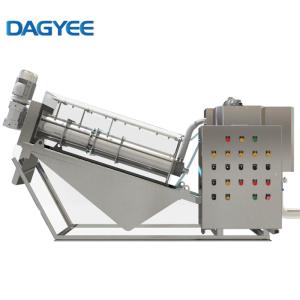
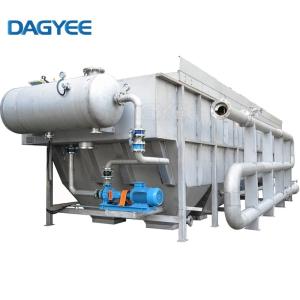
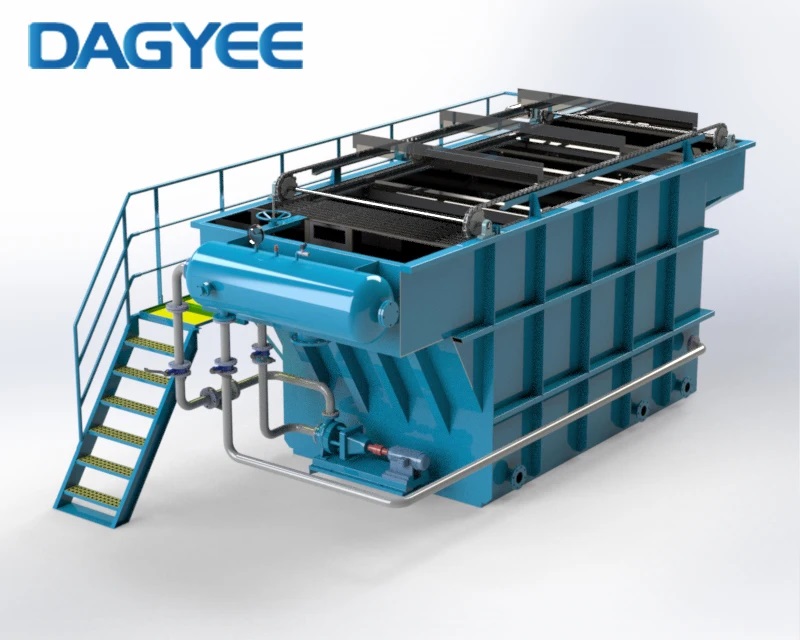
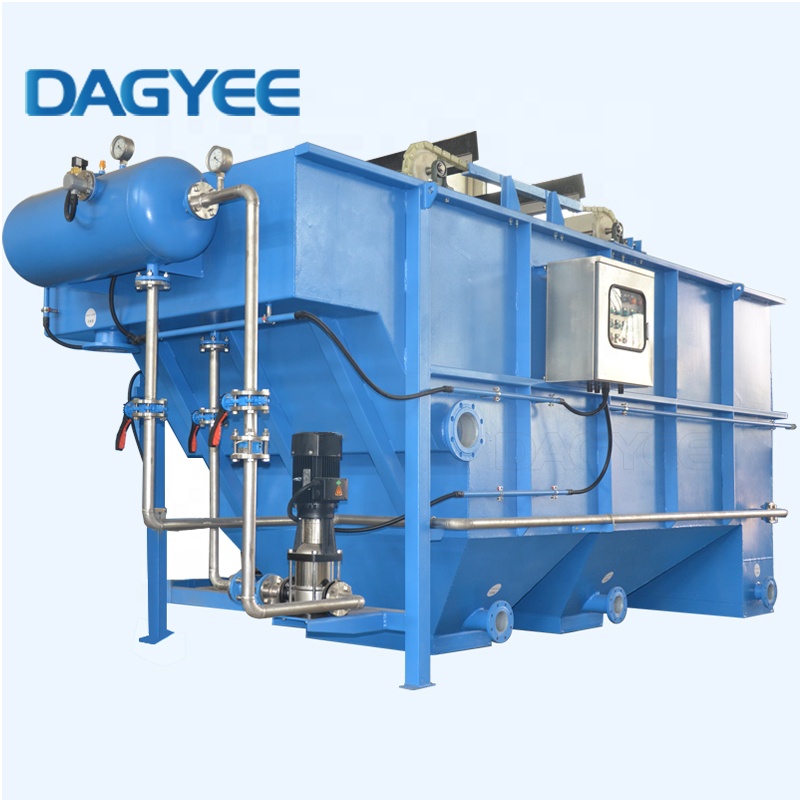
The name says it all. It combines Dissolved air flotation and sedimentation in a single tank.
Here is what happens inside.
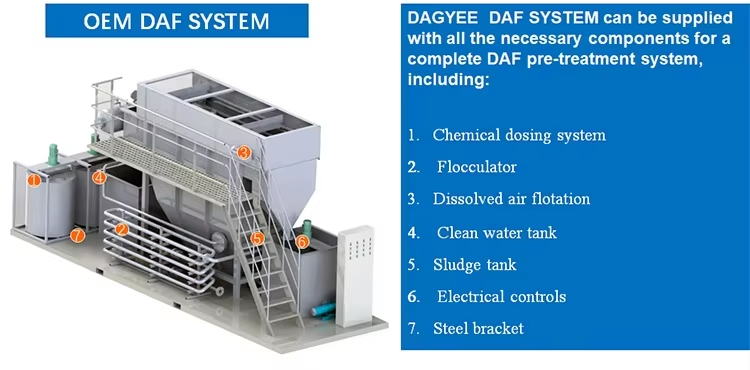
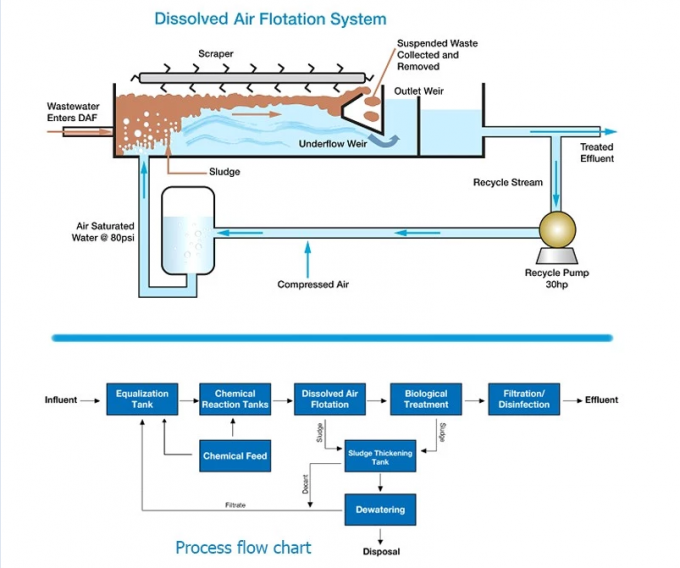
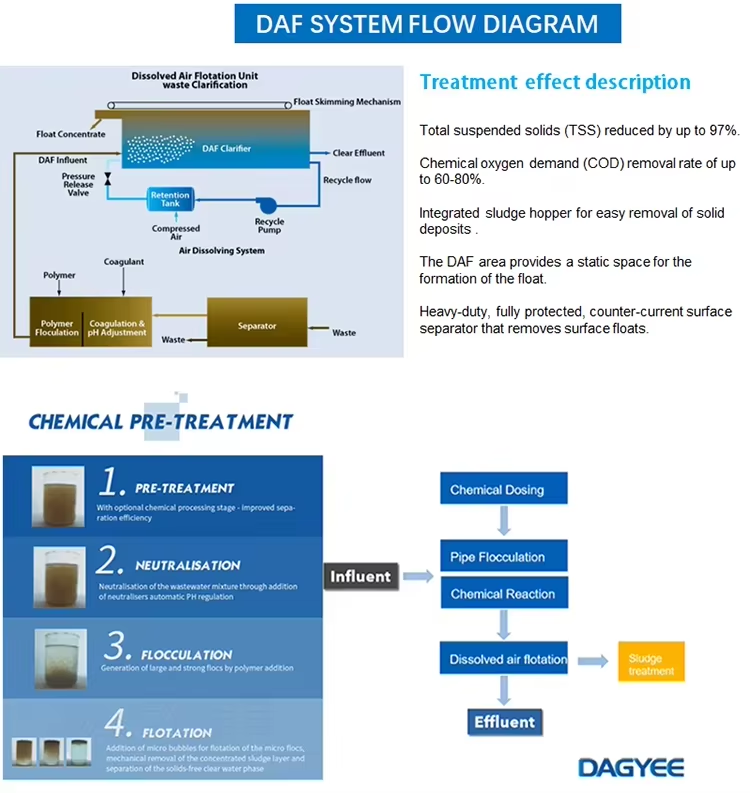
Wastewater enters a small mixing zone first. Chemicals are added to help particles stick together into flocs. Then the water moves into the DAF zone. A dissolved air system releases millions of tiny bubbles — about 20 to 50 microns in size. These bubbles attach to the flocs and carry the lighter ones up to the surface. A scraper pushes the floating sludge off the top.
At the same time, heavier particles that the bubbles cannot lift — sand, metal hydroxides, larger solids — sink to the bottom by gravity. They collect in a cone-shaped hopper and are discharged as settled sludge.
One tank. Two separation processes. Working at the same time.
No more walking back and forth between two different units. No more extra piping. No more energy loss between stages.
2. How Much Can You Really Save?
Let us look at the numbers from real installations.
Space
A conventional DAF plus sedimentation setup needs about 200 to 300 square meters. For a 100 cubic meter per hour integrated unit, you need about 60 square meters. That is roughly one quarter of the space.
For a factory that is already packed tight, that extra space can make the difference between being able to upgrade and being stuck with old technology.
Cost
Building two separate tanks with all their piping and controls runs 80,000to120,000. An integrated unit with the same capacity costs 50,000to80,000.
One municipal plant upgraded to two integrated units in parallel. They spent 460,000.Theconventionalapproachwouldhavecost680,000. They saved $220,000 right off the top.
Energy
Conventional systems use 0.8 to 1.2 kWh per cubic meter. Integrated units use 0.4 to 0.8 kWh per cubic meter.
For a 50,000 cubic meter per day plant, that difference adds up to 1.35 million kWh per year. At 0.08perkWh,thatisover100,000 in electricity savings every single year.
The integrated design has less head loss. The control system adjusts the air pressure, recirculation rate, and sludge discharge based on what is actually coming in — instead of running at full power all the time like most conventional systems.
3. DAGYEE Integrated Unit Specifications
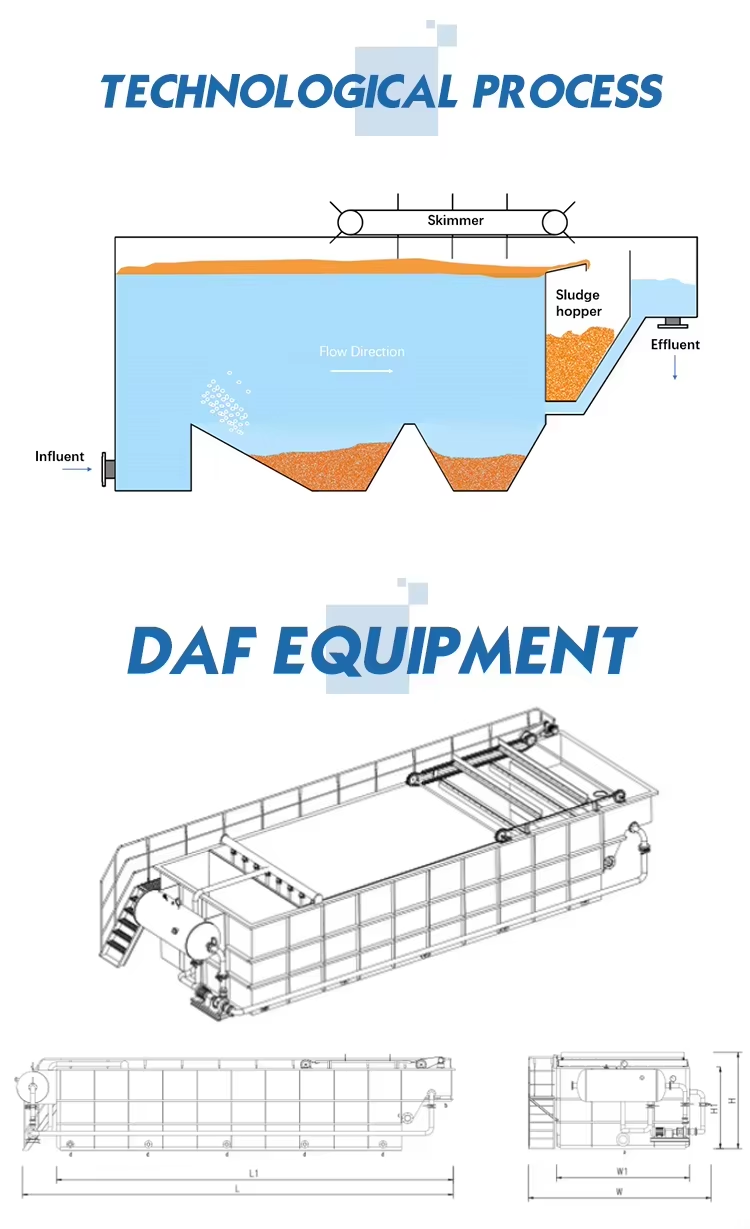
DAGYEE makes 14 standard models, from 2 m³/h up to 120 m³/h. Here are the full specification.
| Model | Capacity (m³/h) | Piping Connections (mm) | Dimensions (m) | Empty Weight (kg) | Operating Weight (kg) | Reflux Pump (kW) | Air Compressor (kW) | Total Power (kW) | |||
|---|---|---|---|---|---|---|---|---|---|---|---|
| Inlet/Outlet | Sludge/Vent | L/L1 | W/W1 | H/H1 | |||||||
| DAF-002 | 2 | DN50/DN50 | DN100/DN100 | 3.4/2.5 | 2.2/1.7 | 1.7 | 1300 | 4000 | 0.75 | 0.55 | 0.2 |
| DAF-003 | 3 | DN50/DN50 | DN100/DN100 | 3.7/2.8 | 2.4/1.7 | 1.7 | 1500 | 5000 | 0.75 | 0.55 | 0.2 |
| DAF-005 | 5 | DN80/DN80 | DN100/DN80 | 4.0/3.0 | 2.4/1.7 | 1.7 | 1600 | 7000 | 1.10 | 0.55 | 0.2 |
| DAF-010 | 10 | DN100/DN100 | DN100/DN100 | 4.65/3.8 | 2.7/1.9 | 1.9 | 2000 | 12000 | 1.50 | 0.55 | 0.2 |
| DAF-015 | 15 | DN125/DN100 | DN150/DN100 | 5.6/4.5 | 2.9/2.0 | 2.0 | 2200 | 18000 | 2.20 | 0.75 | 0.2 |
| DAF-020 | 20 | DN150/DN150 | DN150/DN100 | 5.9/4.8 | 3.2/2.0 | 2.0 | 3000 | 22000 | 3.00 | 0.75 | 0.2 |
| DAF-030 | 30 | DN150/DN150 | DN150/DN100 | 6.8/5.5 | 3.2/2.2 | 2.2 | 3800 | 32000 | 3.00 | 0.75 | 0.4 |
| DAF-040 | 40 | DN200/DN150 | DN150/DN100 | 8.0/6.7 | 3.6/2.2 | 2.2 | 5000 | 45000 | 5.50 | 0.75 | 0.4 |
| DAF-050 | 50 | DN200/DN150 | DN150/DN100 | 8.4/7.0 | 3.6/2.2 | 2.2 | 5500 | 55000 | 7.50 | 0.75 | 0.4 |
| DAF-060 | 60 | DN250/DN200 | DN150/DN100 | 9.9/8.4 | 3.8/2.4 | 2.4 | 6000 | 66000 | 7.50 | 1.50 | |
| DAF-070 | 70 | DN250/DN200 | DN150/DN100 | 10.4/9.0 | 3.8/2.4 | 2.4 | 6500 | 75000 | 11.00 | 1.50 | |
| DAF-080 | 80 | DN250/DN250 | DN150/DN100 | 10.8/9.4 | 4.0/2.4 | 2.4 | 7500 | 100000 | 11.00 | 1.50 | |
| DAF-100 | 100 | DN300/DN250 | DN150/DN100 | 12.1/10.6 | 4.2/2.4 | 2.4 | 9000 | 110000 | 15.00 | 1.50 | |
| DAF-120 | 120 | DN300/DN250 | DN150/DN100 | 12.5/11.4 | 4.4/2.4 | 2.4 | 10000 | 130000 | 15.00 | 1.50 | |
Note on model numbers: DAF-010 means 10 m³/h. DAF-050 means 50 m³/h.
Dimensions: Shown as total length / effective length, total width / effective width, and total height / effective height. Effective dimensions are the actual working space inside the tank.
Total power: Sum of the reflux pump, air compressor, and any auxiliary equipment.
4. Does It Actually Clean the Water Well?
Some people worry that combining two processes into one tank might hurt performance. The opposite is true. The two processes help each other.
Here are typical results from real installations.
| Wastewater Type | What Comes Out | Notes |
|---|---|---|
| Municipal sewage | SS below 10 mg/L, TP removal 70-80% | Can replace primary clarifiers |
| Paper mill | SS from 1000 mg/L down to under 50 mg/L | Fiber recovery over 90% |
| Food processing | COD from 1500 mg/L down to under 300 mg/L | Grease removal over 95% |
| Electroplating | Heavy metals removal 85-95% | Sludge volume cut by 40% |
| Textile dyeing | Color removal 85-90%, COD removal 60-70% | Best with decolorizing agents |
| Slaughterhouse | SS and COD both cut by 70-90% | Grease removal very effective |
In most cases, the integrated unit produces cleaner water than separate systems. The effluent quality is also more stable because there are no hydraulic fluctuations between two different tanks.
5. What Makes DAGYEE Units Different
We have been building these units for years. Here is what we have learned.
The Two Processes Work Together
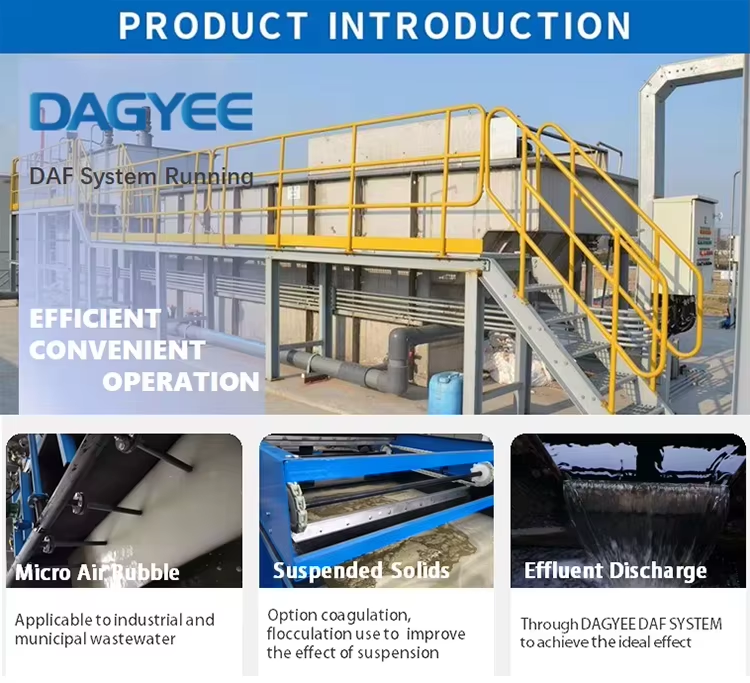
The unit has both a fine bubble generator and a settling zone. Light flocs float. Heavy flocs sink. They do not interfere with each other. One tank does both jobs.
Better Bubbles
Operating pressure is 0.4 to 0.5 MPa. Bubbles are 20 to 50 microns. That is significantly smaller than conventional DAF bubbles, which are often over 100 microns. Smaller bubbles mean much more surface area to attach to flocs.
Automatic Controls
A PLC runs everything — feed pumps, chemical dosing, skimmer, sludge valves. The system adjusts itself when the incoming water changes. You can also monitor it remotely. Operator attention is cut by more than 70%.
Small Footprint
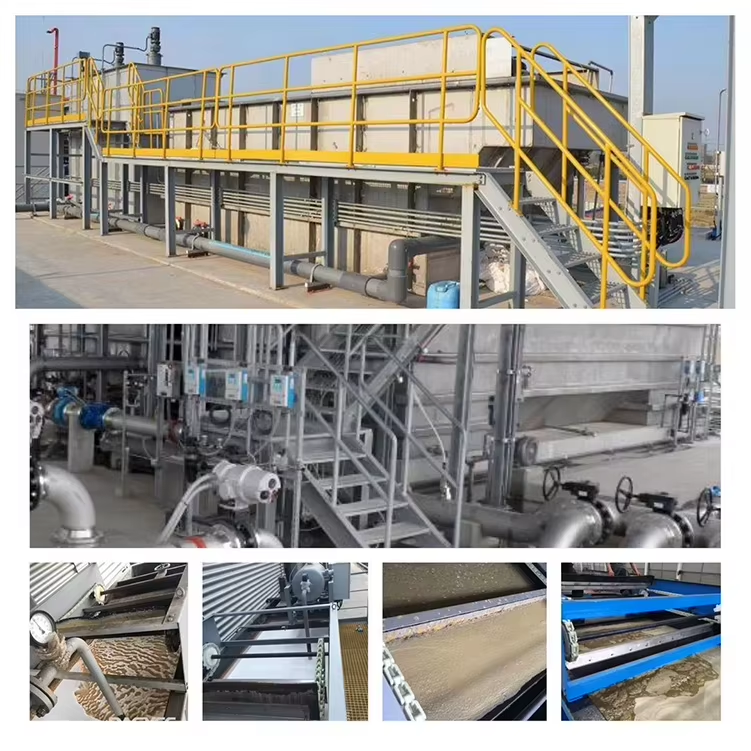
The DAF zone, settling zone, chemical reaction zone, and sludge collection are all in one tank. Footprint is reduced by more than half compared to separate systems.
Easy to Match Your Flow
We have 14 standard models. If you need more capacity later, you can add another unit in parallel without tearing up concrete.
6. A Real Example: Food Plant That Made the Switch
A food processing plant had high-COD, high-oil, high-solids wastewater. They were using separate DAF and sedimentation tanks. The setup took over 200 square meters. Energy costs were high. Operators were running back and forth between two units and still could not keep up.
What they dealt with every day:
- Two tanks far apart; operators wasted time walking
- No room left to expand — the plant was surrounded on all sides
- Old equipment broke down often and used too much electricity
| Metric | Before | After | Change |
|---|---|---|---|
| Floor space | 200 m² | 80 m² | 60% less |
| Money spent | $95,000 | $58,000 | 39% less |
| Energy per m³ | 0.95 kWh | 0.55 kWh | 42% less |
| Operators needed | 2 | 1 | 1 person freed up |
| SS removal | 85% | 93% | Better |
| COD removal | 75% | 85% | Better |
"Before, two people were always busy and still falling behind. Now one person runs the unit and still has time for other work. Two years in, the only downtime has been for routine maintenance."
— Plant Manager
The equipment paid for itself in about a year and a half.
7. How to Pick the Right Model
By flow rate
| Wastewater Type | Recommended Model | Notes |
|---|---|---|
| Oily (food, slaughterhouse) | DAF-030 or larger | Need good skimmer |
| Paper mill white water | DAF-040 or larger | Add Lamella Plates for fiber recovery |
| Textile dyeing | DAF-050 or larger | Use with decolorizing chemicals |
| Municipal sewage | Two or three units in parallel | Gives you backup if one needs service |
By wastewater type
| Flow Range | Recommended Model | Typical Use |
|---|---|---|
| Under 5 m³/h | DAF-002 / 003 / 005 | Lab tests, small restaurants |
| 5 to 20 m³/h | DAF-010 / 015 / 020 | Small food plants, small slaughterhouses |
| 20 to 60 m³/h | DAF-030 / 040 / 050 / 060 | Medium food plants, paper mills, chemical plants |
| 60 to 120 m³/h | DAF-070 / 080 / 100 / 120 | Large industrial plants, municipal treatment |
8. What About Operating Costs?
Many people focus only on the purchase price. That is a mistake. The real cost is what you spend over five or ten years.
Here is a comparison based on actual projects.
| Cost Item | Separate System | DAGYEE Integrated Unit | Savings |
|---|---|---|---|
| Floor space | 200-300 m² | 60-100 m² | 50-60% |
| Civil work | $30,000-50,000 | $10,000-15,000 | 60-70% |
| Equipment | $50,000-70,000 | $40,000-60,000 | 20-30% |
| Total installed | $80,000-120,000 | $50,000-80,000 | 30-40% |
| Energy per m³ | 0.8-1.2 kWh | 0.4-0.8 kWh | 20-30% |
| Installation time | 30-45 days | 10-15 days | 50-60% |
| Operators | 2 | 1 | 50% |
The 50,000 m³/day municipal plant we mentioned earlier saved $220,000 on capital cost alone. That does not include the energy savings or the labor savings.
9. What to Watch Out For
A few things to keep in mind.
Water quality can change. Industrial wastewater is rarely constant. When you size your unit, add a safety factor of 1.2 to 1.5. If your peak flow is 50 m³/h, get a 60 or 70 m³/h model.
Chemicals matter. DAF works best when flocculation is right. An automatic dosing system is worth the money. It adjusts when the water changes, which saves chemicals and keeps the effluent stable.
Keep the air system clean. The dissolved air release valves can clog over time. Check them every few months. Change the air compressor oil on schedule.
Do not let sludge sit too long. Both the floating sludge and the settled sludge need to be discharged regularly. Use automatic timers. Do not rely on people to remember.
\d
10. Which Industries Get the Most Benefit
Based on what we have seen in the field, these industries see the strongest results.
| Industry | Main Problem | Why the Integrated Unit Helps |
|---|---|---|
| Paper mills | Fiber loss, white water pollution | Over 90% fiber recovery, water can be reused |
| Food processing | High COD, high grease | COD cut 60-80%, grease cut over 95% |
| Electroplating | Heavy metals, lots of sludge | Metals removed 85-95%, sludge volume cut by 40% |
| Textile dyeing | High color, hard to treat | Color cut 85-90%, COD cut 60-70% |
| Slaughterhouses | Blood, grease, solids | SS cut ~90%, COD cut ~70%, grease cut over 95% |
| Municipal plants | No room to expand, need to upgrade |
Footprint cut by half — fits where nothing else will |
11. Final Thoughts
The integrated DAF and sedimentation unit is not just two old technologies bolted together. It is a smarter way to do the same job.
Less space. Less money up front. Lower electric bills. Better water quality.
For plants that are out of room, short on budget, or just tired of running two separate systems, this is worth a serious look.
Not sure if this fits your plant?
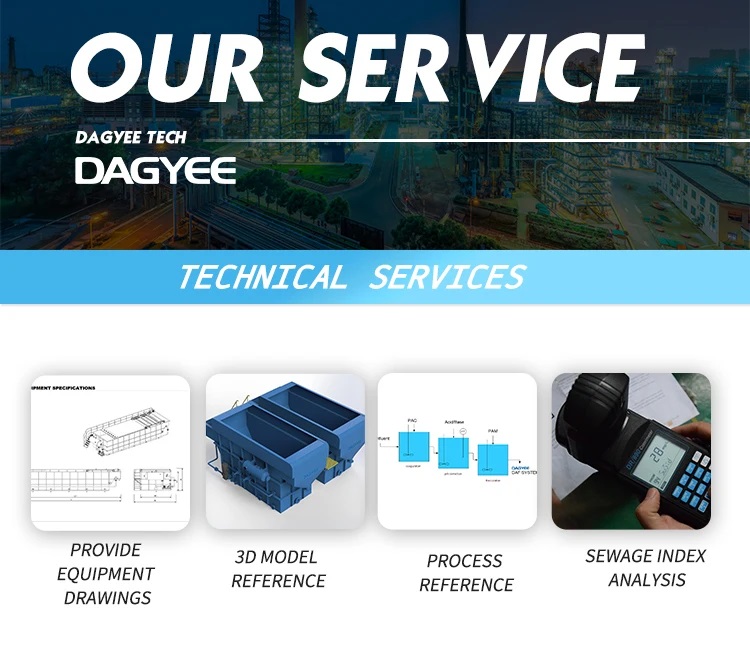
DAGYEE offers free phone consultations. Tell us your flow rate, what is in your water, and how much space you have. We will give you a straight answer.
Related News