Chemical Wastewater Pretreatment: Why You Can't Skip Sedimentation and DAF
Chemical Wastewater Treatment: Why Sedimentation + DAF Is the "Standard Configuration"
Anyone who works in chemical wastewater treatment knows one thing — if you flip through any chemical wastewater treatment proposal, nine times out of ten you'll find sedimentation and DAF somewhere in the process flow. Not just in one spot, but often appearing multiple times: up front, in the middle, and sometimes even at the back end.These two processes have never been about "choose one or the other." They're meant to be used together.
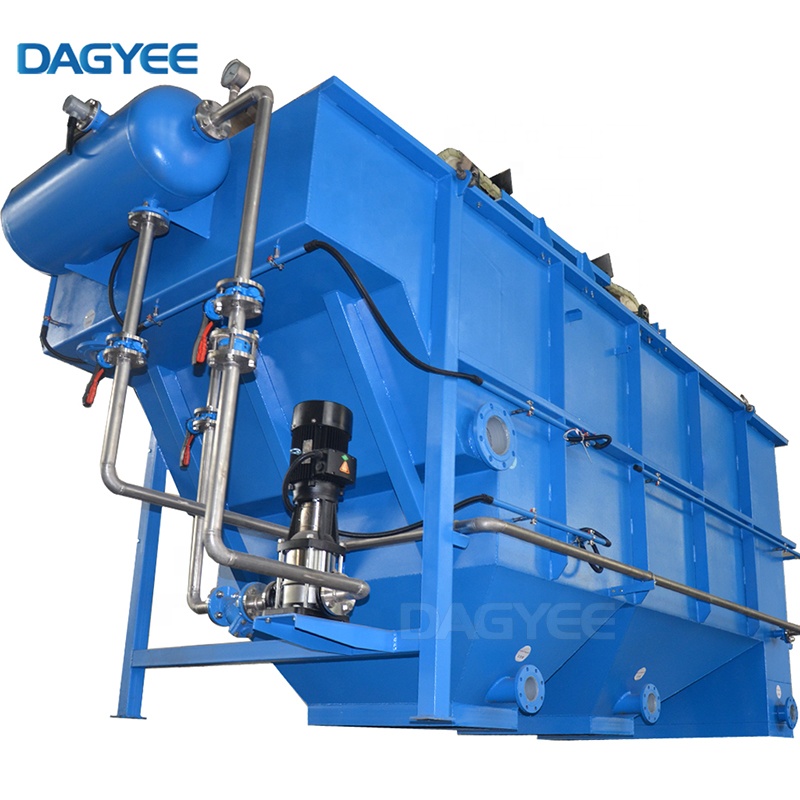
Saying chemical wastewater is hard to treat isn't just talk. It has several characteristics that domestic sewage and general industrial wastewater don't have.
Complex composition. A single chemical plant's wastewater can contain dozens of organic compounds, inorganic salts, heavy metals, and oils simultaneously. Different pollutants require different removal mechanisms — a single process simply can't cover them all.
High COD and poor biodegradability. Many chemical wastewaters have COD values in the thousands or even tens of thousands, but BOD/COD ratios are very low. This means conventional biological treatment has limited effectiveness — physical-chemical treatment must come first to improve biodegradability.
Oil and suspended solids. Common oil contaminants in chemical wastewater include free oil, emulsified oil, and dissolved oil — each in different forms requiring different removal methods. Suspended solids include both heavy particles and light flocs, which is exactly where sedimentation and DAF each step in.
Significant fluctuations in flow and quality. Chemical production is batch-based, and wastewater from different production stages varies widely. Water discharged in the morning can be completely different from water discharged in the afternoon. This requires the front-end physical-chemical treatment stage to have sufficient shock-load resistance.
High levels of toxic and hazardous substances. Benzene compounds, phenols, cyanides, heavy metals — these inhibit microorganisms. If they're not removed before entering the biological system, the activated sludge tank will be "poisoned" and fail.
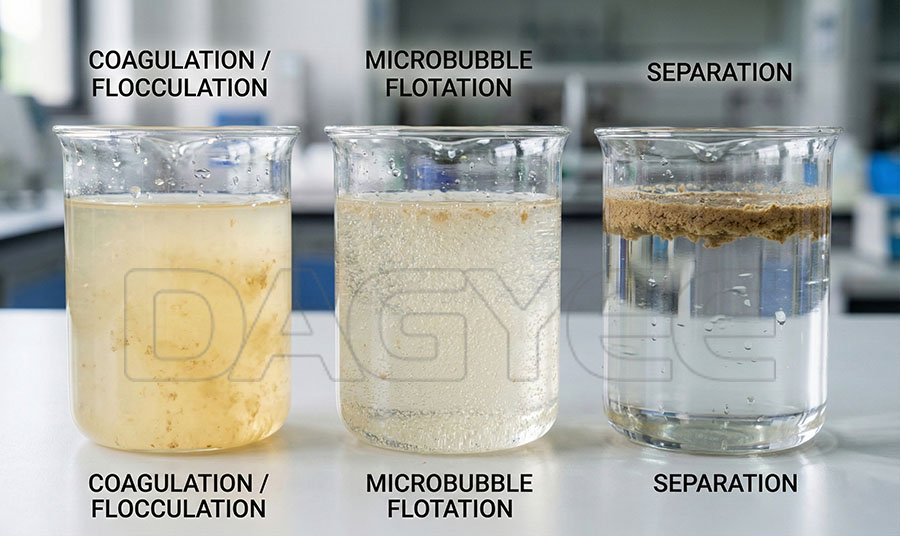
Once you understand the characteristics of chemical wastewater, the division of labor between sedimentation and DAF becomes clear.
Sedimentation vs. DAF — Comparison
How these two core separation processes differ in chemical wastewater treatment
| Process | Sedimentation | DAF (Dissolved air flotation) | Why It Matters |
|---|---|---|---|
| Core Principle | Gravity settling | Microbubble adhesion and flotation | Two fundamentally different physical mechanisms — gravity vs. buoyancy. Each targets a different type of pollutant. |
| Target Pollutants | High-density particles, high-concentration suspended solids, large flocs | Light suspended solids, emulsified oil, colloidal particles | Sedimentation handles "heavy" pollutants; DAF handles "light" pollutants. They cover different parts of the contaminant spectrum. |
| Advantages | Low operating cost, simple operation, high throughput | Effective removal of light suspended solids and oils/grease | Sedimentation is cheap and simple for heavy loads. DAF is the right tool for light solids and oils that won't settle. |
| Weaknesses | Ineffective against emulsified oil and light flocs | Sensitive to heavy particle loading, requires energy input | Each process has a clear blind spot — which is exactly why they work best together. |
Key insight: Sedimentation handles the "heavy" stuff; DAF handles the "light" stuff. Neither can do the other's job effectively. In chemical wastewater treatment, they're not competitors — they're partners.
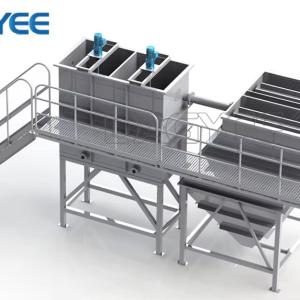
Sedimentation handles heavy particles and the bulk of suspended solids. Heavy materials in chemical wastewater — metal hydroxide precipitates, sand, large flocs — are most efficiently removed by gravity settling. Sedimentation tanks let these "heavyweights" sink to the bottom for removal. Low operating cost, simple operation, suitable for high-flow, high-concentration front-end wastewater.
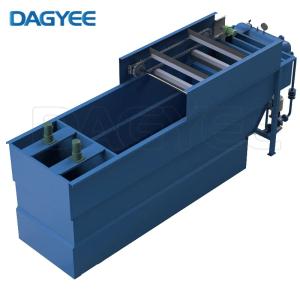
DAF handles light suspended solids and oils. Emulsified oil, colloidal particles, and fine flocs that are close to water in density — sedimentation can't touch them because they won't sink. DAF works in reverse: it injects 20-50 micron microbubbles into the water, letting the bubbles attach to these "lightweights" and carry them to the surface for skimming. Common chemical wastewater contaminants like emulsified oil, surfactants, and fine flocs are more effectively removed by DAF than by sedimentation.Put these two processes together, and each does its own job — sedimentation handles the "heavy" stuff, DAF handles the "light" stuff. Neither can replace the other.
In chemical wastewater treatment, the design parameters of sedimentation and DAF units directly affect pretreatment performance. Below are common design reference values:
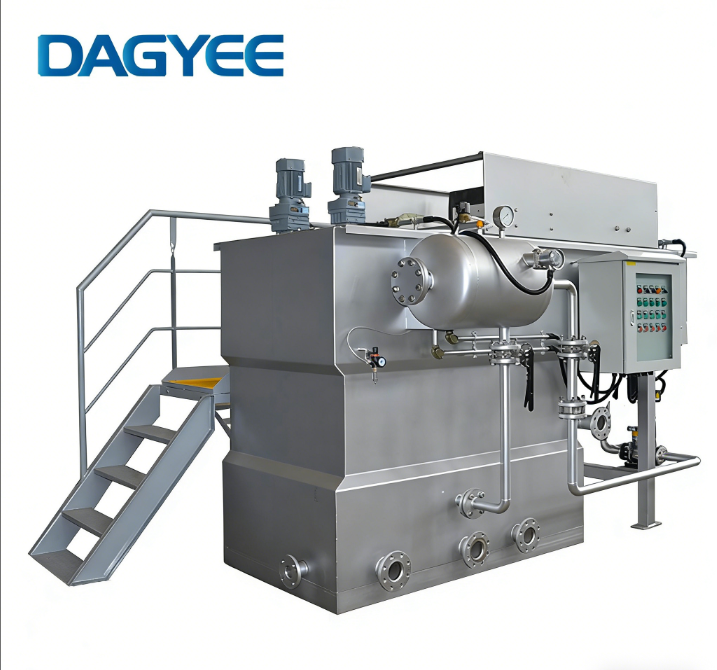
DAF Unit — Design Parameters
Common design reference values for chemical wastewater treatment
| Parameter | Reference Value | Notes |
|---|---|---|
| Dissolution pressure | 0.3-0.5 MPa | Too low results in insufficient bubble volume |
| Recycle ratio | 20-40% | Recycle flow as percentage of total feed |
| Hydraulic retention time | 15-30 min | Much faster than sedimentation |
| Surface loading rate | 4-8 m³/(m²·h) | Related to dissolution efficiency |
| Bubble diameter | 20-50 μm | Smaller bubbles = higher adhesion efficiency |
| PAC dosage | 30-150 mg/L | Typically lower than sedimentation dosage |
Note: Values are for reference only. DAF design should be optimized through pilot testing for each specific wastewater stream.
Sedimentation vs. DAF — Design Differences
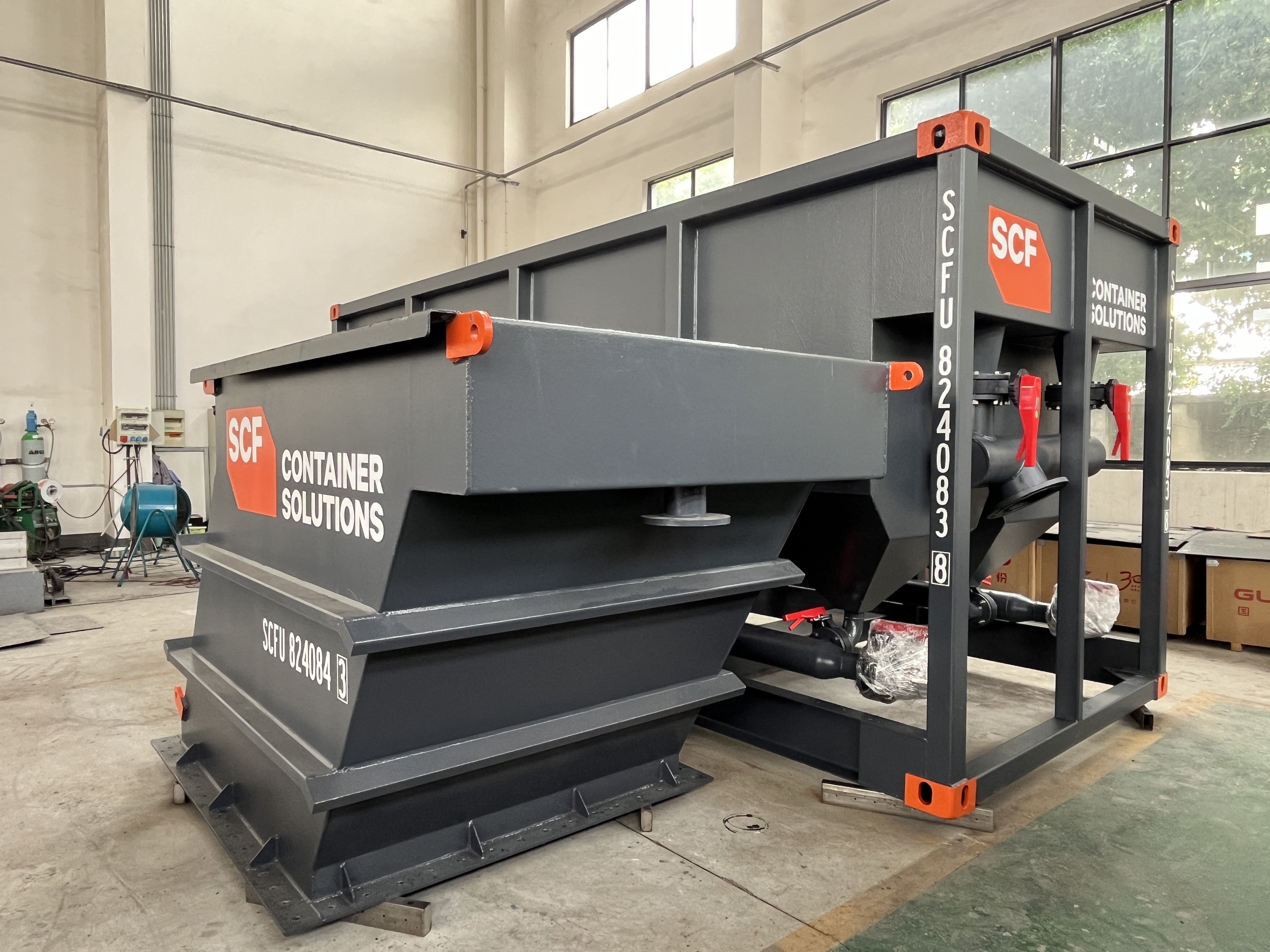
How these two core separation processes compare in key design metrics
| Comparison | Sedimentation | DAF | Why It Matters |
|---|---|---|---|
| HRT | 1.5-3.0 hours | 15-30 minutes | DAF is 5-10x faster — takes up much less space for same flow |
| Emulsified oil removal | Poor | Good | This is the key reason DAF is often added to sedimentation |
| Light floc removal | Poor | Good | DAF captures light flocs that sedimentation can't hold |
| Heavy particle removal | Good | Fair | Sedimentation is the right tool for heavy particles |
| Shock-load resistance | Good | Moderate | Sedimentation handles flow/load spikes better than DAF |
| Energy consumption | Low | Moderate | Sedimentation relies on gravity — no energy input required |
Key insight: Sedimentation and DAF have clear performance differences across every metric. They're not interchangeable — they're complementary. The right combination depends on your wastewater characteristics.
These parameters tell us three important things:
- First, the time efficiency gap is huge. Sedimentation is measured in hours; DAF is measured in minutes. For the same treatment capacity, DAF units take up significantly less floor space — which is why DAF is often prioritized in space-constrained retrofit projects.
- Second, chemical dosing conditions differ. Sedimentation and DAF have different coagulant requirements. Dosing points and chemical feed rates need to be set separately — you can't use one dosing system for both. Some designs share chemical feed systems for sedimentation and DAF, and the results often suffer.
- Third, their targets are clear. Sedimentation excels at heavy particles; DAF excels at light suspended solids and oils. Their design parameters are so different that you can't apply the same design logic to both.
Theory is one thing — but real project data shows you the value of this combination.
Case 1: ABS Production Wastewater
A large chemical enterprise's wastewater came primarily from ABS production, along with PDH production wastewater and acrylonitrile pretreatment wastewater. Influent COD was 2000-2500 mg/L, ammonia nitrogen 60-100 mg/L, and SS 1000-2000 mg/L. Pretreatment used a "coagulation-sedimentation + DAF" process, followed by modified A/O biological treatment.
Results: Effluent COD stabilized at 15-36 mg/L, ammonia nitrogen at 0.6-1 mg/L, and SS at 1-5 mg/L — all meeting the local WWTP's influent requirements. Sedimentation removed the bulk of suspended solids and some COD; DAF captured the remaining light suspended solids and emulsified oil. The two-stage process created clean conditions for the downstream biological treatment.
Case 2: STP Resin Wastewater
STP resin wastewater has complex composition and high COD concentration, making it difficult to treat. The actual project used "DAF-Fenton-coagulation sedimentation" as pretreatment, followed by "hydrolysis-contact oxidation-final sedimentation" biological treatment.
Results showed stable and reliable treatment performance, with effluent meeting the Class III standard of the Integrated Wastewater Discharge Standard (GB 8978-1996). DAF went first to remove light suspended solids and some COD; Fenton oxidation broke down recalcitrant organics; coagulation sedimentation finished the job by settling oxidized byproducts and remaining suspended solids.
A fine chemical wastewater contained COD, ammonia nitrogen, copper ions, nickel ions, and other pollutants at 100 m³/d. The process used chemical precipitation to pretreat heavy metals, followed by "Fenton oxidation / coagulation-DAF / hydrolysis-acidification / aerobic aeration" as the core treatment train.
Results: COD removal exceeded 94%, total phosphorus removal exceeded 90%, total copper removal exceeded 99%, and total nickel removal exceeded 80% — effluent fully met discharge standards. Heavy metals were removed by chemical precipitation; organics were removed through coagulation-DAF and biological degradation. This combination proved particularly effective for wastewater containing both heavy metals and organics.
Case 4: Phenol-Cyanide Wastewater
A steel coking plant's phenol-cyanide wastewater contained high concentrations of COD, ammonia nitrogen, volatile phenols, plus cyanides, thiocyanates, and sulfides. The treatment process used "gravity oil removal + pressurized DAF + SDN biological treatment + coagulation sedimentation" with a capacity of 150 m³/h.
Key results: DAF effluent oil concentration was below 2.0 mg/L, suspended solids below 15 mg/L, and the biological treatment stage performed excellently on both COD and ammonia nitrogen removal. In this case, DAF sat upstream of biological treatment, responsible for reducing oil and suspended solids to levels the biological system could tolerate. Coagulation sedimentation followed biological treatment, handling sludge-water separation. Sedimentation and DAF appeared twice in the flow — at different positions, serving different functions.
Sedimentation + DAF has become the standard configuration for chemical wastewater treatment for three reasons:
First, chemical wastewater's complexity demands a physical-chemical + biological combination strategy. As seen in the case studies, the typical chemical wastewater treatment route follows "physical-chemical pretreatment + biological treatment." Sedimentation and DAF appear at the front end of this flow. Their job is to remove substances that are toxic to microorganisms, recalcitrant, or likely to foul downstream equipment — so the biological system can function properly.
Second, sedimentation and DAF handle different types of pollutants. Sedimentation handles the "heavy" stuff; DAF handles the "light" stuff — they complement each other. Chemical wastewater contains both large-particle suspended solids and emulsified oil plus light flocs. Using either process alone only solves half the problem; combining them achieves full coverage. China's national standard "Code for Design of Chemical Industry Wastewater Treatment and Reuse" lists DAF and sedimentation in separate sections (5.4 and 5.7) within physical-chemical treatment, confirming them as standard unit processes for chemical wastewater treatment.
Third, pretreatment quality directly affects biological performance. Poor oil removal in coal chemical wastewater pretreatment can cause severe foaming in subsequent aerobic treatment — or even kill microorganisms. When sedimentation and DAF are properly coordinated at the front end, the biological stage's loading remains stable and effluent stays compliant.
Conclusion
Sedimentation and DAF have become the "standard configuration" in chemical wastewater treatment because the complexity of chemical wastewater makes single-process approaches insufficient. Sedimentation handles the "heavy" stuff; DAF handles the "light" stuff. Two processes, each doing its own job, creating the necessary influent conditions for downstream biological treatment. From multiple real-world case studies, this combination performs excellently on COD, suspended solids, and oil removal, with stable, reliable effluent quality.The fact that national standards list both as standard physical-chemical treatment units confirms that this isn't one engineer's preference — it's an industry-accepted best practice.
If your chemical wastewater project is still struggling with pretreatment process selection, it's worth considering whether this "standard configuration" can solve your problems.
DAGYEE — Water Treatment Equipment Solutions