DAF + Lamella in One Package: When Does It Make Sense and When Doesn't It?
DAF + lamella clarifier in One Unit: Does Combining Two Processes into One Tank Deliver 1+1>2 or Just a Compromise?
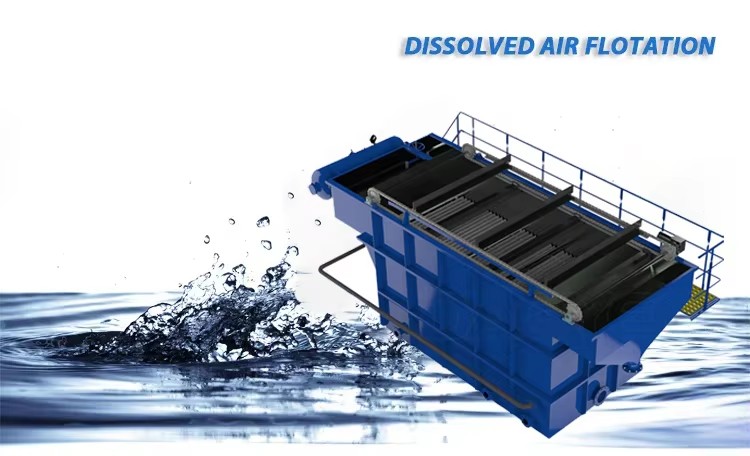
So someone came up with an idea: why not put both processes into a single tank?
That's how the DAF + lamella clarifier integrated unit was born.
But the question is: does combining two processes into one piece of equipment actually work? Do they complement each other, or do they just get in each other's way? This article breaks down the technology, looks at real performance data, and helps you figure out whether this approach makes sense for your application.
First, Understand That Flotation and Clarification Are Fundamentally Different
Flotation and clarification might both be solid-liquid separation methods, but their underlying principles are entirely different.Clarification relies on gravity. Particles heavier than water settle down given enough time. Lamella clarifiers use inclined plates to shorten the settling distance from meters to centimeters, dramatically improving efficiency. Clarification is good at dealing with dense, larger particles.
Flotation relies on microbubbles. A dissolved air system dissolves air into water under pressure, then suddenly releases it to create millions of tiny bubbles (20-50 microns). These bubbles attach to suspended solids and oil droplets, carrying them to the surface where a skimmer removes them. Flotation is good at dealing with light flocs and emulsified oils that won't settle.
The problem is that most industrial wastewater is a mixture. Chemical wastewater has both heavy suspended solids and light oils. Slaughterhouse wastewater has solid residues and grease. Food processing wastewater has pulp particles and fats. Single-stage settling or flotation only handles part of the load.
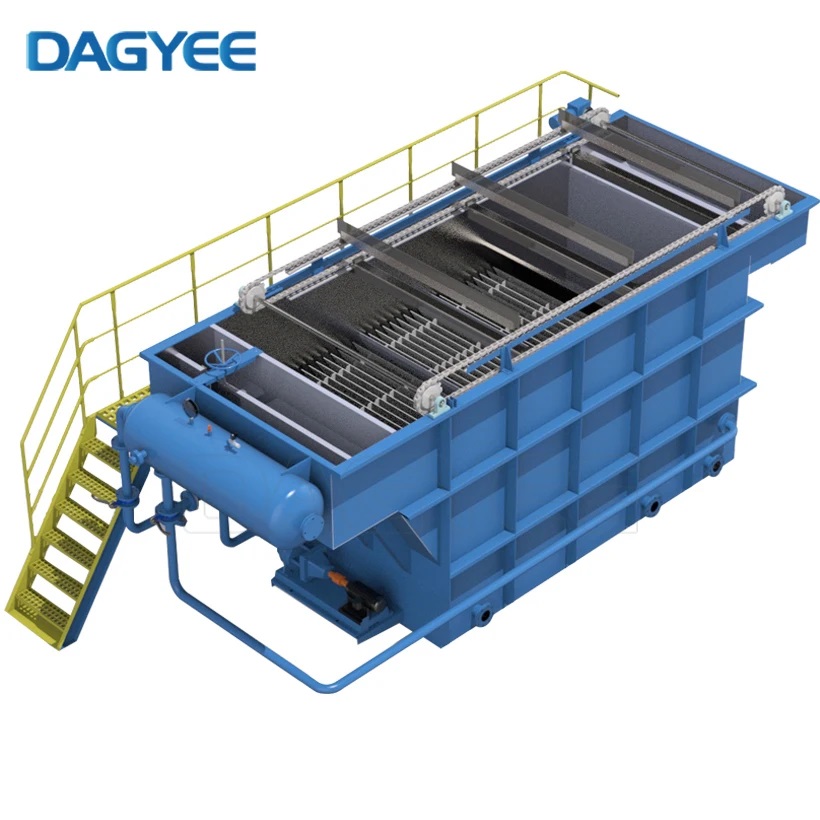
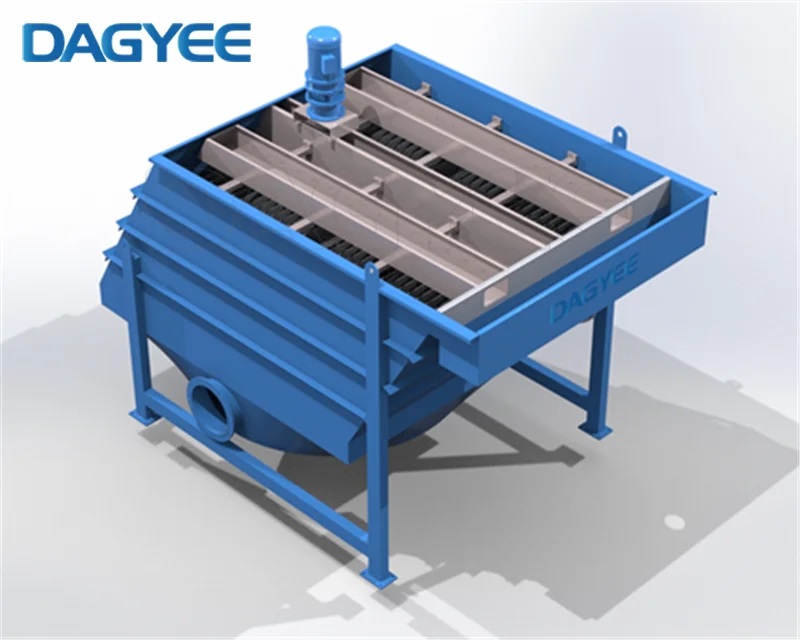
How an Integrated Unit Works: Each Process Does Its Own Job
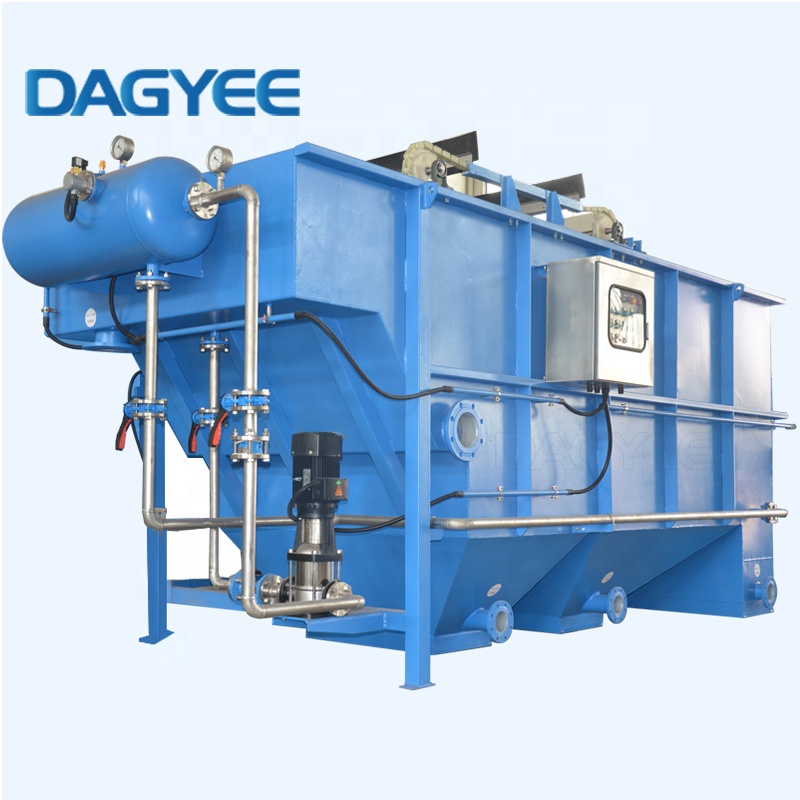
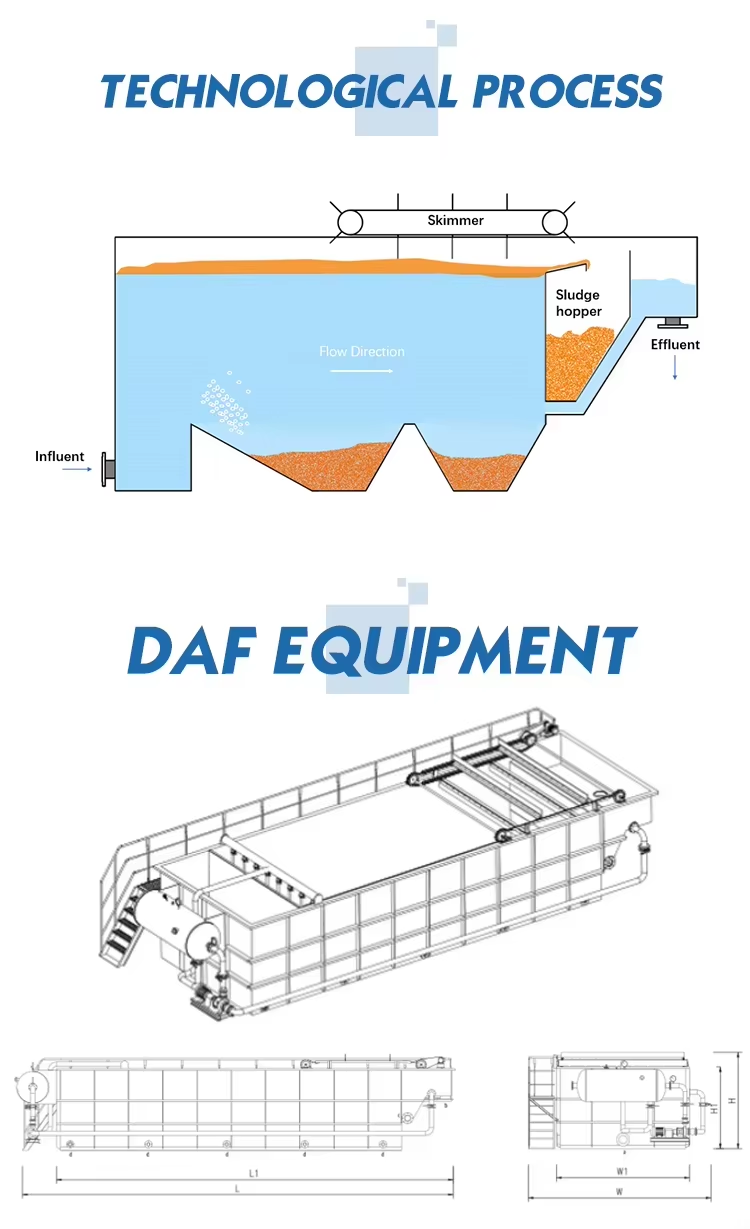
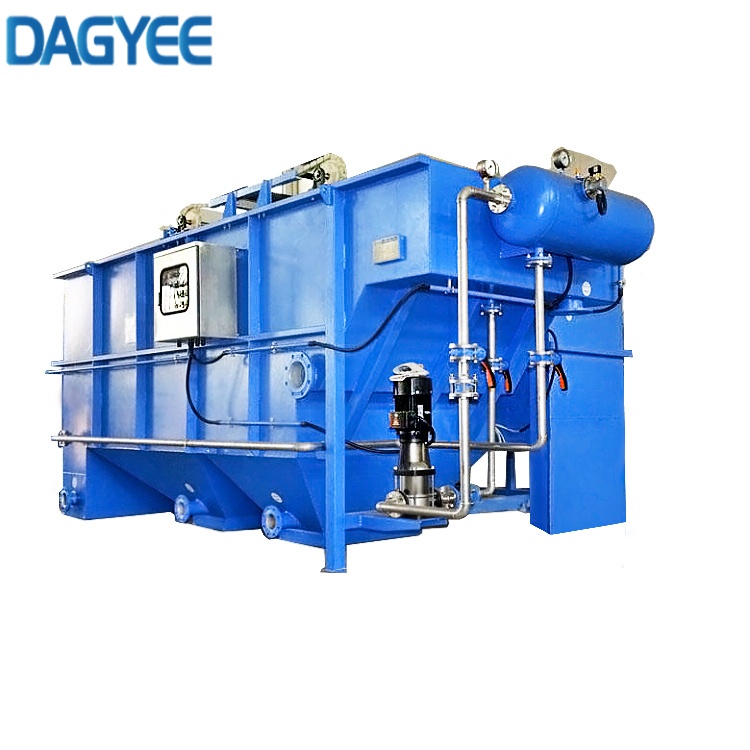
The design logic of a DAF + lamella clarifier integrated unit is straightforward — it puts both a lamella settling zone and a DAF zone in the same tank. Wastewater goes through settling first, then flotation.Here's how it works in practice:
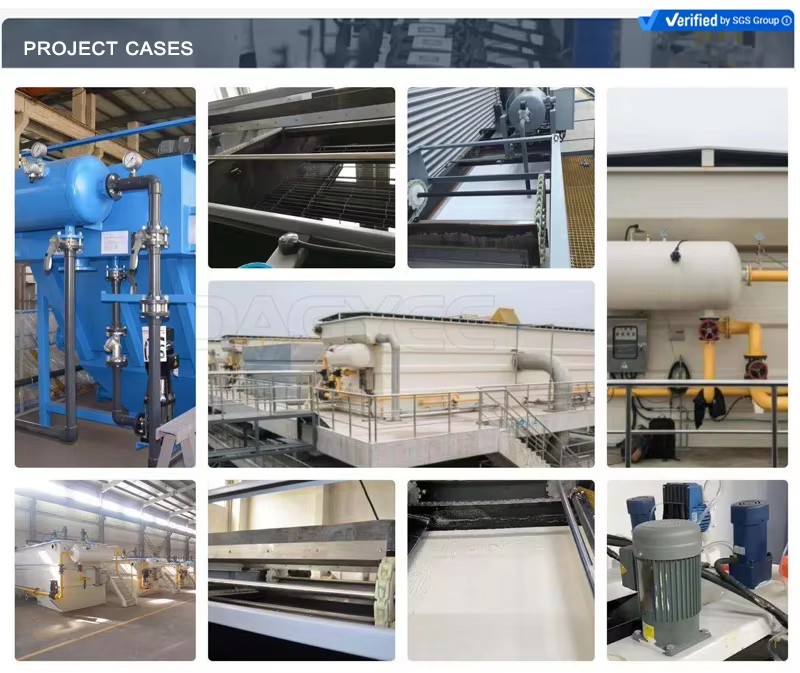
Step 1 — Lamella settling: Wastewater enters the settling zone, typically equipped with Lamella Plates inclined at 45 to 60 degrees from the tank bottom, allowing sludge to slide down by gravity into a collection hopper. This stage handles the heavy stuff — sand, metal hydroxides, large flocs. In most cases, this accounts for the majority of total suspended solids.
Step 2 — DAF flotation: The clarified effluent from the settling zone moves into the flotation zone. Pressurized water (0.3-0.5 MPa) saturated with dissolved air is suddenly released through a pressure reducing valve, generating 20-50 micron bubbles. These bubbles attach to light solids and emulsified oils, carrying them to the surface where a scraper removes them.
One settles, one floats. Two processes targeting different types of contaminants. They don't interfere with each other.
Real Performance Data: What the Numbers Say
The core advantage of the integrated design is process complementarity — flotation handles what settling misses (light solids and oils), and settling handles what flotation can't (heavy particles). Combined treatment efficiency is significantly higher than either process alone.Here's some actual data to show what this means:
Overall removal efficiency: DAF + lamella clarifier integrated units typically achieve 90-99.5% suspended solids removal, ≥90% oil and grease removal, and 65-90% COD removal. These numbers are consistently higher than what either settling or flotation can deliver on their own.
Hydraulic retention time: Integrated units typically run at 15-30 minutes, with high-rate models getting down to 3-5 minutes. Conventional settling tanks operate in hours. The efficiency gain is substantial.
Energy consumption: Energy consumption for integrated units is typically 1/8 to 1/10 of conventional DAF systems. Why? Two reasons: the compact design eliminates intermediate pumping and piping losses, and the recirculation pump itself is small — for a 5-50 m³/h unit, pump power is only 0.75-2.2 kW.
A real-world example from the oilfield: CNOOC conducted a 10-day field trial on produced water treatment at Bohai Bay using a combined coagulation-hydrocyclone-DAF integrated unit. At a 5 m³/h feed rate, the unit achieved 91.2% oil removal (about 5% higher than conventional DAF) and 86.2% suspended solids removal (about 8% higher). This is a more complex unit with extra separation mechanisms, but the principle is the same — multiple separation mechanisms working together outperform any single process.
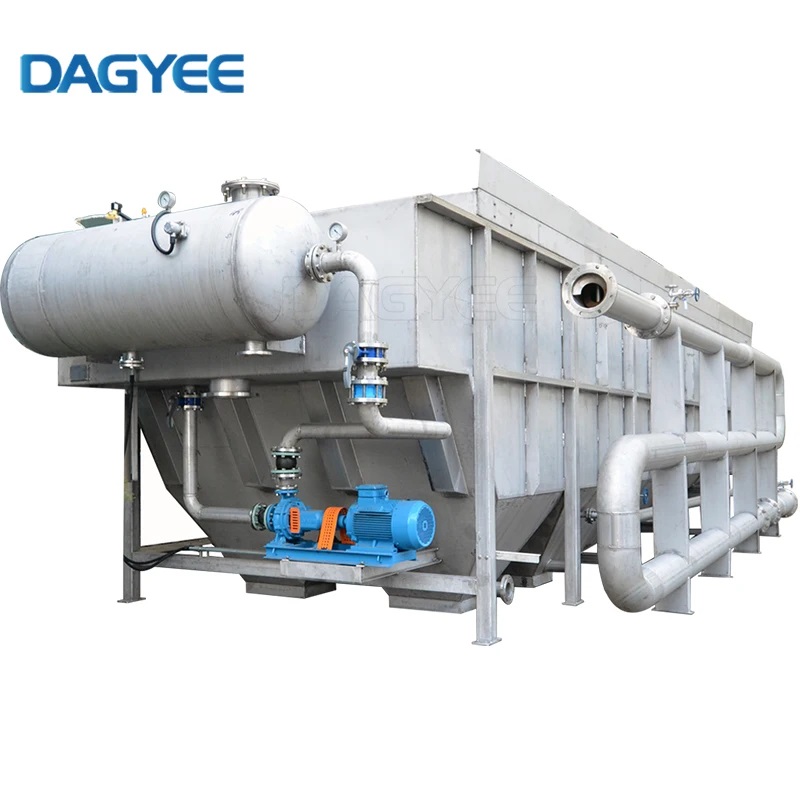
Where Does an Integrated Unit Make the Most Sense?
Based on current market applications, DAF + lamella clarifier integrated units are most commonly used in these scenarios:
Industrial wastewater pre-treatment: Petrochemical, machining, food and beverage, textile, printing and dyeing, and slaughterhouse wastewater are the main application areas. These wastewaters all share one thing in common — complex composition with both heavy solids and light suspended matter. Single-process systems don't work well enough.
Oily wastewater treatment: Oil removal efficiency can reach over 90%. Oilfield drilling wastewater, refinery wastewater, and machining coolant wastewater have oil that settling can't touch — flotation is the right tool for that job.
Retrofit and upgrade projects: Integrated units take up about 40% less floor space than separate systems. They can fit into existing facilities without additional land purchase.
Emergency and mobile treatment: Truck-mounted integrated units can be deployed quickly for black-odor water body treatment and emergency river water treatment.
Integrated units have clear advantages, but they're not a universal solution. Here are a few things to think about before making a decision:
1. Feed concentration matters. Inlet TSS should generally be in the 500-5,000 mg/L range. Too high, and both the settling zone and flotation zone get overloaded, and performance drops.
2. Chemical dosing needs careful tuning. Both settling and flotation require coagulants (typically PAC) and flocculants (PAM). But the optimal dosing conditions differ between the two processes. While an integrated unit combines both, dosing points and chemical feed rates must be optimized for your specific water quality — you can't just set it and forget it.
3. Sludge and scum removal can't be skipped. Scum from the flotation zone and sludge from the settling zone both need regular removal. Scum that sits too long on the surface will affect flotation performance. Sludge that accumulates in the hopper will reduce effective volume.
4. Material selection depends on the wastewater. Carbon steel with anti-corrosion coating works for most applications. Stainless steel (SS304 or SS316L) is recommended for corrosive wastewater with tar, strong acids, or aggressive chemicals.
Integrated vs. Separate Systems: Pros and Cons
Here's the direct comparison — this will help you decide whether an integrated unit is right for your project.
Advantages of an integrated unit:
1. Smaller footprint. Integrated units typically use 40-60% less floor space than separate systems. If you're tight on space — which is often the case in existing plants or retrofit projects — this is a major plus.
2. Lower capital investment. One tank instead of two means less civil work and lower construction costs.
3. Simpler operation. Integrated units typically come with PLC control systems that run automatically after commissioning — no dedicated full-time operator required.
1. Limited access for maintenance. The compact design means settling plates, the dissolved air system, and the scraper mechanism are all squeezed into one tank. When something goes wrong, getting to it is harder than in a separate system.
2. Less flexibility. With separate systems, you can adjust the settling tank and the DAF unit independently. With an integrated unit, you've got less room to fine-tune.
The Bottom Line
Combining DAF and lamella clarification into a single unit isn't a compromise — it genuinely delivers 1+1>2. Settling does its job on heavy solids. Flotation does its job on light solids and oils. Two complementary mechanisms working together deliver better overall treatment efficiency than either process alone.
But it's not the right fit for every application. It works best when feed concentration is moderate (500-5,000 mg/L TSS), when the wastewater contains both heavy and light solids, when floor space is limited, and when the operation and maintenance team will stay on top of cleaning schedules and chemical dosing.
Equipment is only as good as the operator running it. Three parts design, seven parts operation and maintenance.
DAGYEE — Water Treatment Equipment Solutions
Need help deciding between integrated and separate systems for your project? Send us your wastewater characteristics and site conditions. We'll recommend the approach that fits — no sales pressure, just practical advice.
Related News