Starch, Protein, Juice, Fat: How Decanter Centrifuges Handle Food Processing Wastewater
Food Processing Wastewater Treatment: How Decanter Centrifuges Achieve Efficient Solid-Liquid SeparationFood processing wastewater is completely different from municipal sewage. Municipal wastewater has relatively stable composition, but food processing wastewater varies widely—potato washing water contains starch, whey contains protein particles, fruit juice pressing contains pulp and pectin, slaughterhouse wastewater contains fat and blood.
Each type of wastewater has its own characteristics. Not every solid-liquid separation device can handle them all.
Compared to other industries, food processing wastewater has several distinct features:
High organic content. COD values often reach several thousand to tens of thousands mg/L, and most of it is suspended or colloidal organic matter—starch, protein, fat, cellulose. If these materials aren't removed upfront, the biological treatment system gets overloaded.
Fine solid particles. Potato starch particles are typically 5-25 microns. Whey protein particles are even finer. These particles won't settle in a clarifier, and they'll blind belt press cloths quickly.
Prone to spoilage. Food wastewater is full of nutrients. At slightly elevated temperatures, it ferments and produces odors, which is a common problem in processing plants.
Variable discharge. Flow surges during equipment cleaning and drops during idle periods. This intermittent discharge places high demands on the treatment system's shock load capacity.
2. Four Main Sources of Food Processing Wastewater
Starch processing wastewater. Potato, sweet potato, corn, and wheat starch production generates large volumes of wastewater containing starch and fiber. Traditional plate-and-frame presses leave cake moisture at 75% and lose about 15% of soluble protein.
Dairy processing wastewater. Whey protein particles are extremely fine. Traditional vibrating screens combined with clarifiers achieve low recovery rates. Many dairy plants struggle with protein loss and odor issues.
Fruit and vegetable processing wastewater. Juice pressing, fruit and vegetable washing, and canning operations generate wastewater containing pulp fragments, pectin, and sugars.
Oily wastewater. Slaughterhouses, meat processing, and edible oil production generate wastewater with high fat and protein content.
3. Why Traditional Equipment Falls Short
Many food processing plants still use traditional methods: gravity settling, vibrating screens, and plate-and-frame filter presses.
Each has its limitations.
Settling tanks. They're slow, take up lots of space, and fine starch particles won't settle. Potato washing water with starch particles passes right through.
Belt filter presses. Filter cloths clog easily, especially with oily or fine-particle wastewater. They need frequent cleaning. The open design also creates hygiene issues—residual material clings to the cloth, and the open dewatering process can contaminate the plant environment.
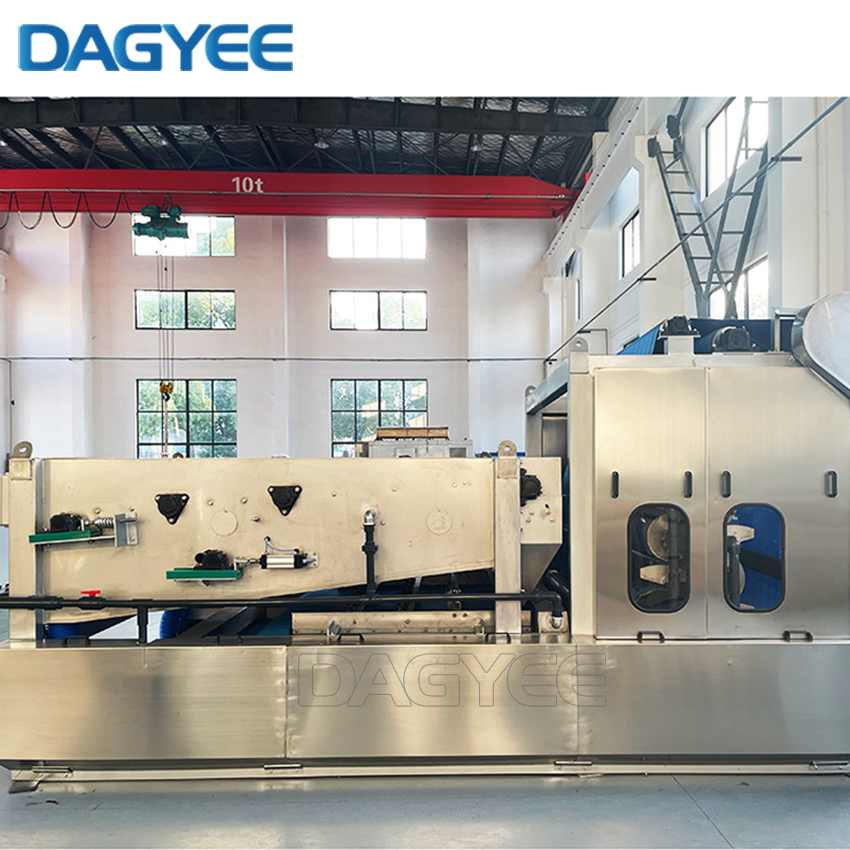
Plate-and-frame presses. They run in batches, require manual cake discharge, and need frequent cloth changes. Labor costs are high, and the semi-enclosed design doesn't meet strict food hygiene standards.
4. What Decanter Centrifuges Can Do
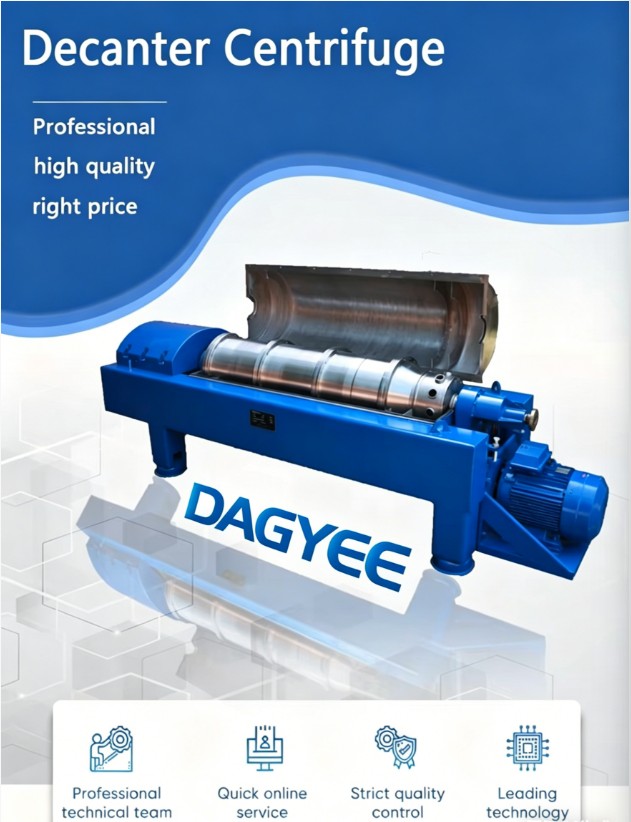
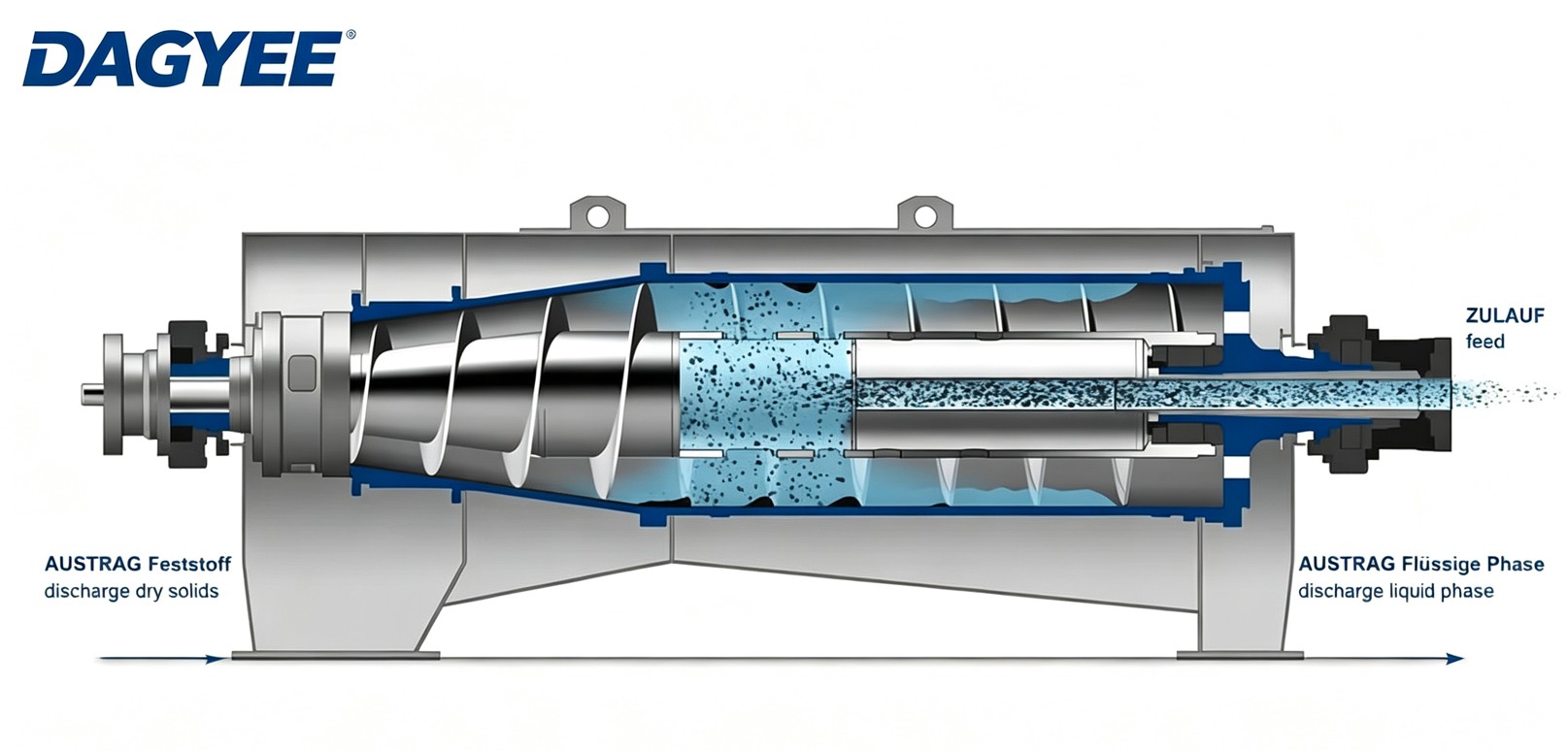
The advantage of decanter centrifuges is that they use enclosed sedimentation—not filtration through cloth, but centrifugal force that separates materials by density difference. This fundamental difference gives them unique value in food processing wastewater treatment.
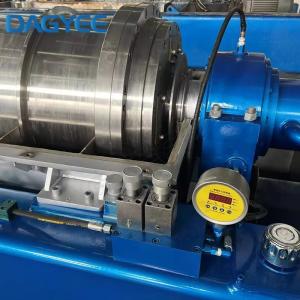
Fully enclosed operation meets food hygiene standards. Decanter centrifuges use fully enclosed bowls with polished stainless steel on all wetted parts and no filter media to replace. This eliminates cross-contamination risk. One dairy plant switched to a decanter centrifuge with SUS316L bowl and passed a BRC food safety audit easily.
Continuous discharge without stopping. Belt presses need frequent stops for cloth washing. Plate-and-frame units need manual cake discharge. Decanter centrifuges run 24/7 continuously, with the screw conveyor pushing solids out the discharge port without interruption.
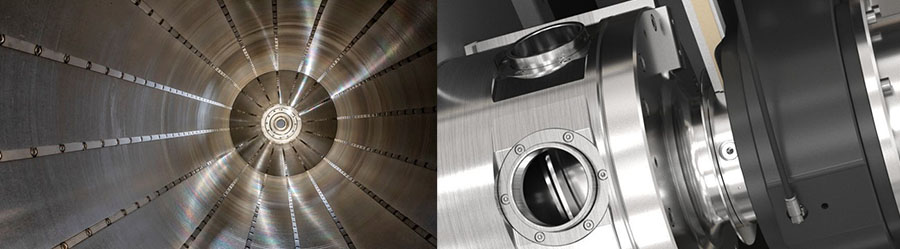
Adaptable to different particle sizes. From 20-micron starch particles to several-millimeter fiber particles, decanter centrifuges can achieve good separation by adjusting differential speed and G-force. Different materials can be matched with different L/D ratios and screw designs.
Clear centrate suitable for reuse. Clarifying decanter centrifuges used for starch recovery from potato washing water produce clear liquid that can be reused for potato washing. Based on industry data, every ton of potatoes processed can save 0.5 to 1 cubic meter of fresh water through this recovery system.
5. Key DAGYEE Decanter Centrifuge Configurations
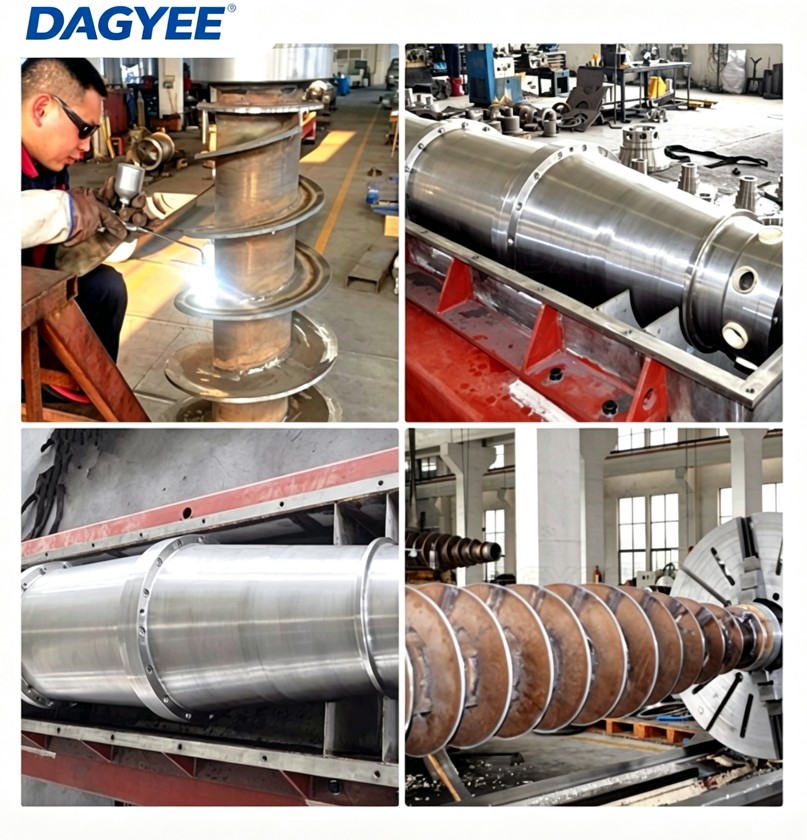
Material selection. Food processing requires food-grade stainless steel for all wetted parts. DAGYEE decanter centrifuges use 2205 duplex stainless steel for the bowl and end covers, which outperforms 304 and 316 in corrosion resistance. For applications with stricter hygiene requirements, upgrades to 316L are available.
Wide differential speed range. Food processing wastewater varies greatly in solids characteristics—potato starch is fine, sweet potato residue is viscous, whey protein is extremely fine. DAGYEE uses dual-motor dual-VFD drives with precise differential speed control to adapt to different material properties.
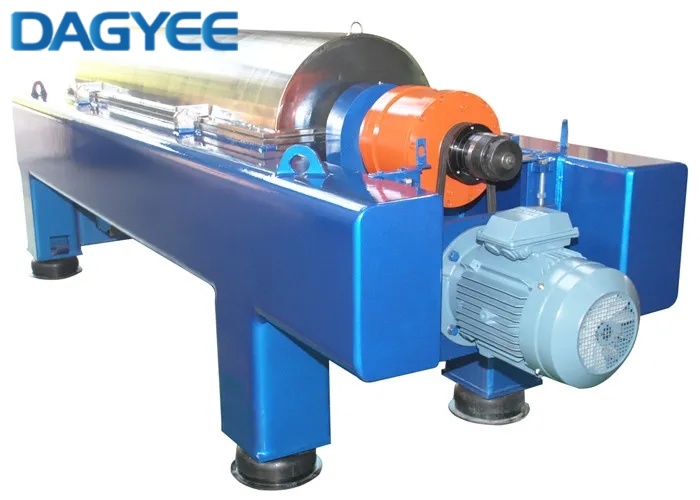
Wear protection. Discharge ports and other wear-prone areas are protected with replaceable carbide inserts to extend equipment life. For materials with high sand content, tungsten carbide-coated screw flights are optional.
6. DAGYEE LW Series Technical Specifications
The table below shows selected DAGYEE LW Series decanter centrifuge models for food processing wastewater applications:
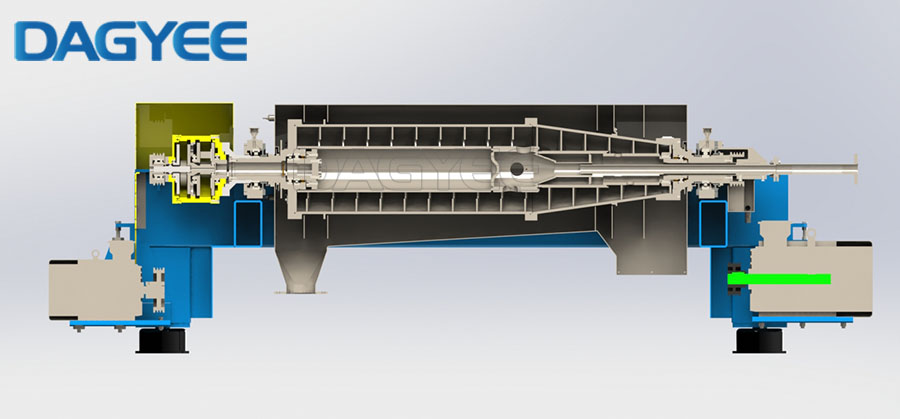
Solid-liquid separation — model selection and performance data
| Model | Bowl Dia. (mm) | Length (mm) | Max Speed (rpm) | Max G-Force (g) | Capacity (m³/h) | Main/Back Motor (kW) |
|---|---|---|---|---|---|---|
| LW250-900 | 250 | 900 | 5000 | 3500 | 0.5-3 | 11/5.5 |
| LW350-1500 | 350 | 1500 | 3800 | 2850 | 1-5 | 18.5/5.5 |
| LW400-1600 | 400 | 1600 | 3400 | 2581 | 2-10 | 22/7.5 |
| LW450-1800 | 450 | 1800 | 3200 | 2572 | 5-20 | 30/7.5 |
| LW530-2280 | 530 | 2280 | 2800 | 2350 | 10-50 | 45/15 |
| LW600-2400 | 600 | 2400 | 2600 | 2265 | 15-65 | 55/18.5 |
| LW720-2500 | 720 | 2500 | 2200 | 1950 | 25-90 | 75/90 |
| LW800-3200 | 800 | 3200 | 2000 | 1800 | 30-110 | 90/132 |
| LW900-3200 | 900 | 3200 | 1800 | 1650 | 30-150 | 132/200 |
Note: The main motor drives the bowl; the back motor drives the screw conveyor. Dual-motor configuration enables stepless differential speed adjustment. Final selection should be based on actual material characteristics and processing requirements.
7. Selection Guide
Food Processing — Selection Guide
Recommended decanter centrifuge models by application
| Food Type | Typical Solids Characteristics | Recommended Model | Key Configuration |
|---|---|---|---|
| Potato/sweet potato starch | Fine starch particles, high sand content | LW450-1800 | Tungsten carbide screw + wear-resistant discharge |
| Whey protein recovery | Very fine protein, high CIP requirements | LW350-1500 | SUS316L materials + automatic CIP |
| Fruit/vegetable juice clarification | Pectin, pulp fiber | LW400-1600 | High L/D ratio, clarifying design |
| Yeast recovery | High viscosity, fine particles | LW530-2280 | Dual-motor VFD, wide differential speed range |
Selection Tip: Match the decanter centrifuge configuration to your specific material characteristics. Different food processing applications require different bowl designs, materials, and differential speed ranges. Contact DAGYEE for application-specific recommendations.
8. Summary
For food processing wastewater treatment, decanter centrifuges aren't the only option. But for plants seeking "high recovery, low cake moisture, continuous automated operation, and food-grade hygiene compliance," their combined advantages are clear.The numbers tell the story. For a potato chip plant processing 30,000 tons of potatoes annually, starch recovery alone can generate nearly $500,000 in additional profit.
This isn't just environmental compliance. It's an economic calculation that makes sense.
DAGYEE — Food Processing Wastewater Solid-Liquid Separation Solutions
From starch recovery, protein extraction, juice clarification, to distiller's grain separation—DAGYEE offers a full range of decanter centrifuge solutions. Need selection advice? Tell us your material type, throughput, and separation requirements. We'll match the right model for your application.
Related News