Mining Wastewater a Headache? Here's Why Lamella Clarifiers Are the Industry Standard
Mining Wastewater Treatment: Why Is the lamella clarifier the First Choice?
Introduction: A Problem That Won't Go Away
Process water, tailings water, mine drainage — high volume, high suspended solids, fluctuating quality. Poor treatment leads to environmental fines, production shutdowns, and community complaints. And environmental regulations keep getting stricter. Many mines are finding that their old treatment systems just cannot keep up.
To make things worse, mines are often located in remote mountainous areas. They have no space to expand. Their budgets are tight. Their operators are not water treatment experts.
So what is the solution?
Over the years, a consensus has emerged across the industry: the lamella clarifier is the first choice for mining wastewater treatment.
Why? This article explains why, with real case studies and technical principles.
1. What Makes Mining Wastewater So Difficult
To understand why the lamella clarifier works so well for mining wastewater, you first need to understand what makes mining wastewater so difficult.
Mining wastewater contains ore fines, coal fines, and tailings particles. Concentrations can easily reach hundreds of milligrams per liter. In some cases, they go up to several thousand.
Take coal mine drainage as an example. Suspended solids typically run between 200 and 500 mg/L. During peak production or in complex geological conditions, concentrations can spike to 1000-3000 mg/L. Larger particles settle quickly, but fine particles (under 50 microns) take a very long time to settle.
Rainy seasons, production peaks, equipment maintenance — all cause big swings in water quality and quantity.
Sometimes the turbidity is a few hundred. Sometimes it is several thousand. A sudden storm can double or triple the flow in a matter of hours. Fragile equipment simply cannot handle that kind of shock. Conventional sedimentation tanks, designed for average flow, often "wash out" during peak events — solids carry over, and the effluent goes out of compliance.
Mines are often located in narrow valleys. Flat land is scarce and valuable. Building a large conventional sedimentation tank often requires cutting into hillsides and massive earthwork. Many older mines have no room to expand at all.
Mine water treatment plants are usually in remote areas. Experienced water treatment professionals are hard to recruit. Most operators are mine workers who were reassigned. The simpler the equipment, the better. If it breaks, they have to be able to fix it themselves.
These four challenges add up to a very specific set of requirements: high efficiency, shock resistance, small footprint, and simple operation.
The lamella clarifier meets all of them.
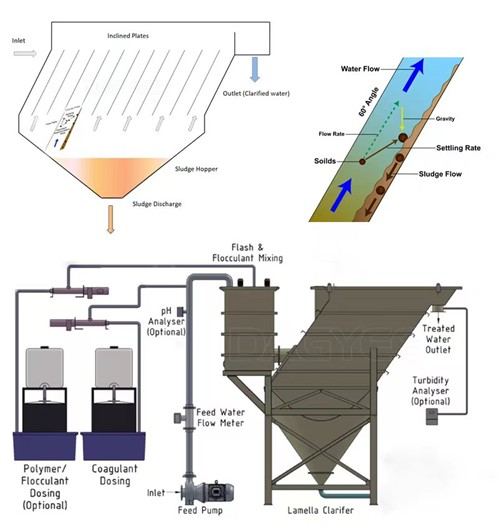
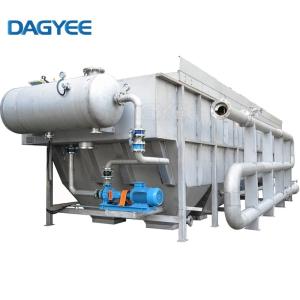
Why are lamella clarifiers so efficient? The answer lies in the "shallow pool theory."
This theory was proposed by Hazen in 1904. The principle is simple: the time a particle takes to settle is proportional to the distance it has to fall.
Inside a conventional sedimentation tank, a particle might have to fall 2-3 meters to reach the bottom. That takes a long time. To treat more water in a given time, you have to make the tank bigger — which means more land, more excavation, more concrete.
The lamella clarifier flips this logic around.
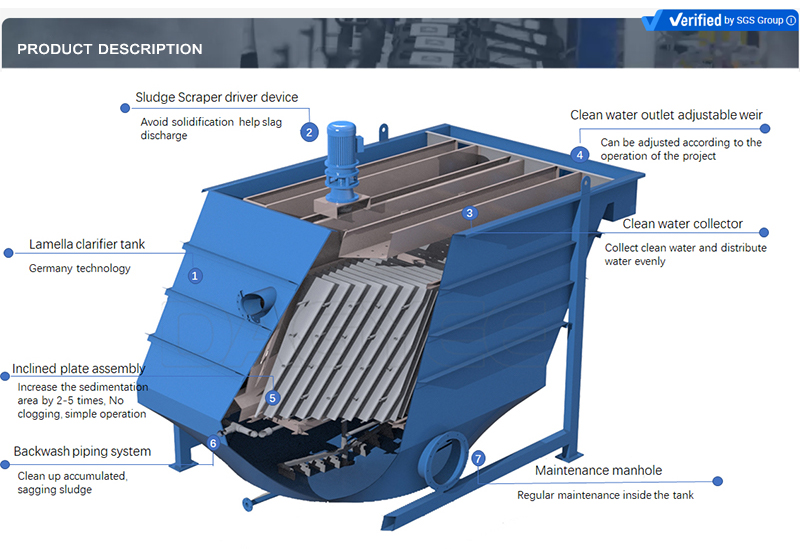
It adds a set of inclined plates inside the tank. The spacing between plates is only a few centimeters. Particles only have to settle onto the plate above or below them. The falling distance drops from meters to centimeters. The settling time drops from hours to minutes.
In technical terms: the effective settling area of a lamella clarifier is 6 to 10 times its footprint.
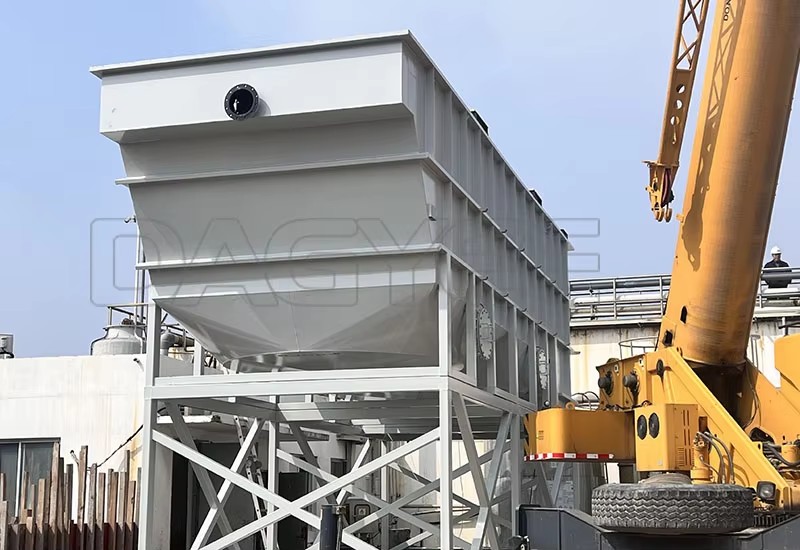
What does that mean in practice? A lamella clarifier with a 50 square meter footprint can have an effective settling area of 300 to 500 square meters. For the same treatment capacity, a lamella clarifier takes up only 10 to 20 percent of the space of a conventional sedimentation tank.
Claims of "80% space savings" are not marketing hype. They are real.
3. Six Solid Reasons Why Mines Choose Lamella Clarifiers
Space is at a premium at most mine sites. The lamella clarifier's compact design addresses this directly.
Here is a real comparison. A coal mine treating 10,000 m³/day of mine drainage needed a settlement tank. A conventional horizontal flow tank would have required about 500 square meters. A lamella clarifier did the same job in 80 square meters. That is an 84% reduction in footprint.
For mines squeezed into narrow valleys with no room to expand, this is a decisive advantage. Less land, less civil work, same capacity — and room left over for future upgrades.
The Changping Company's Lujiayu mine water treatment plant is a good example. They previously used a "pre-settling tank + coagulation + tube settler" process. With upgrades, they significantly increased capacity — without expanding their site. The plant now treats 9,000 to 10,000 m³/day.
A lamella clarifier can achieve over 95 percent suspended solids removal.
Take coal washing wastewater as an example. Influent turbidity typically ranges from 500 to 1500 mg/L. After coagulation and lamella settling, effluent turbidity can drop below 5 mg/L — clean enough to be reused directly in production or even as cooling water makeup for power plants.
After its upgrade, the Changping Lujiayu plant achieved Class III surface water quality standards. The treated water is reused for underground operations and surface landscaping.
Mining wastewater fluctuates. A lot of equipment cannot handle that. The lamella clarifier can.
Its key advantage: using clarified effluent as the flow control medium makes the unit less sensitive to flow variations and less prone to clogging.
In simple terms: when flow suddenly surges or solids spike, the lamella clarifier keeps working. No washout during storms. No upsets during peak production. This is why it has become the industry standard.
The Lujiayu plant, for example, handles high-concentration shock loads while maintaining stable effluent quality. For remote mines with limited maintenance capabilities, this rugged reliability is invaluable.
A lamella clarifier has very few moving parts.
No motors. No mechanical scrapers (except on larger models, and even those are simple). Very little to break. Maintenance is limited to periodic checks for plate clogging and verifying that the sludge discharge system is working.
Power consumption is very low — just one chemical dosing pump and one sludge discharge pump. Chemical consumption is also lower. Because the hydraulic conditions inside a lamella clarifier promote good flocculation, typical chemical doses are 10 to 20 percent lower than conventional sedimentation.
The Huayuan Coal Mine reported annual recovery of about 300 tons of coal fines, generating about $20,000 in revenue while reducing effluent suspended solids. That does not even include water savings, power savings, or labor savings.
Unlike some equipment that breaks down frequently with expensive replacement parts, a lamella clarifier runs for years with very little trouble. For mines where qualified repair technicians are hours or days away, that matters a lot.
Mining wastewater is not just waste. It also contains resources. The solids settled out by a lamella clarifier are often high-purity coal fines or ore concentrates that can be recovered and sold.
The Caofeidian Ore Terminal project in Hebei Province is a great example. The project includes ore blending, screening, and beneficiation. The contaminated water is collected, chemically treated, pre-settled, then treated in a lamella clarifier followed by sand filtration. The treated water is reused for dust suppression, irrigation, and landscaping. Non-traditional water recovery exceeds 50 percent, saving about $350,000 per year in water costs. Recovered ore fines are also reused.
For concentrators, high-purity recovered fines can even be returned directly to the process. An asset that both achieves discharge compliance and generates revenue? That is hard to beat.
Lamella Plates come in different materials.
PP and PVC plates are lightweight, chemical-resistant, smooth, and easy to clean. They typically last 10 years or more. Stainless steel plates last even longer — 20 to 30 years.
The Changping Company specifically chose thickened PP tube settlers for their upgrade. They learned from experience — older plastic settlers had collapsed, requiring a full tank shutdown and costly cleanup. They were not going to make the same mistake twice.
DAGYEE lamella plates are integrally molded with seamless construction for high strength. Plates are fixed with positioning pins so spacing remains accurate — no shifting or deformation under flow.
Choose the right material and the right design, and a lamella clarifier will run reliably for 15 or even 20 years. For mining companies that value stability and low long-term costs, that is a huge plus.
4. Typical Process Flow for Mining Wastewater Treatment
For coal mine drainage, a typical process flow is:
Mine drainage → Collection tank → Equalization tank → Coagulation tank (PAC/PAM) → Lamella clarifier → Filtration (sand filter/activated carbon) → Disinfection → Clean water tank → Reuse or discharge
This process may look involved, but each step is well established and reliable. For most mines, it can reliably achieve:
• Effluent suspended solids below 10 mg/L
• Effluent turbidity below 5 NTU
• Treated water suitable for underground use, dust suppression, and landscaping
For stricter discharge requirements, membrane treatment can be added at the end to achieve zero discharge or even resource recovery.
5. Case Study: Lujiayu Mine Water Treatment Plant
Background: The plant originally used a "pre-settling tank + coagulation + tube settler" process. With increasing mine inflow and tightening discharge standards, the old facility could no longer keep up.
Scale: 9,000 to 10,000 m³/day
Key components: Equalization tank, coagulation tank, lamella clarifier, filtration unit
Upgrade highlights:
• Upgraded lamella clarifier with more plates and increased effective settling area
• Thickened PP tube settlers chosen to prevent future collapse
• Optimized Chemical dosing system for more precise control
• Added automatic controls to reduce operator workload
Results:
• Effluent meets Class III surface water quality standards
• Treated water reused for underground operations and landscaping
• Settled coal fines recovered and reused
This project shows that lamella clarifiers can not only meet routine discharge requirements but also play a key role in plant upgrades to meet tougher standards.
6. DAGYEE Lamella Clarifier Advantages for Mining Applications
DAGYEE has customized its lamella clarifiers specifically for mining wastewater characteristics.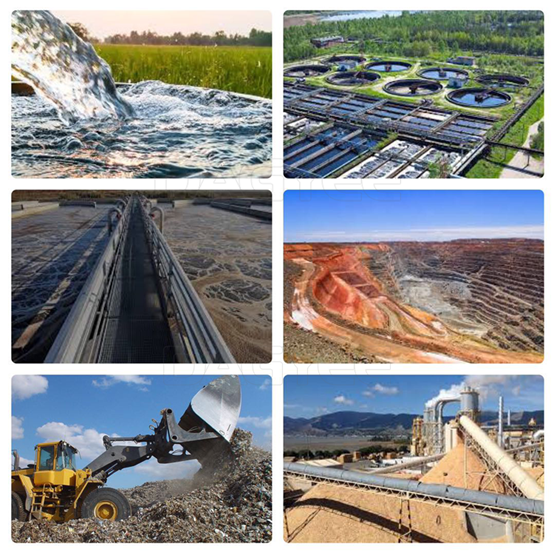
6.1 Adjustable Plate Spacing
Different mines have different particle sizes and concentrations. We offer customizable plate spacing.
• Coarse particles → wider spacing (50-80 mm) to prevent clogging
• Fine particles → tighter spacing (35-50 mm) for higher efficiency
Standard options: 35mm, 50mm, and 80mm spacing — covering everything from fine separation to coarse particle removal.
6.2 Flexible Material Options
Mining wastewater pH and corrosivity vary widely. We offer multiple material options:| Material | Features | Best For |
|---|---|---|
| Carbon steel + epoxy coating | Cost-effective, strong | Neutral pH, conventional mine water |
| Stainless steel 304 | Corrosion-resistant, long life | Acidic or chloride-containing water |
| Stainless steel 316 | High corrosion resistance | Strong acids, high salt, high chloride |
| PP (Polypropylene) | Lightweight, chemical resistant | Fluctuating pH, moderately corrosive water |
Note: Material selection should consider temperature, abrasion, and specific chemical composition.
Mining wastewater produces a lot of sludge. The discharge system must be reliable.
DAGYEE lamella clarifiers include:
• Conical sludge hopper with slope ≥60 degrees — sludge slides off, no buildup
• Manual or pneumatic discharge valves
• Optional automatic discharge system based on sludge level sensors
• Anti-clogging design with periodic flushing capability
Mine sites often have irregular layouts. Our units can be arranged flexibly.
• Single unit capacity: 10 m³/h to 500 m³/h
• Multiple units can be arranged in parallel to fit irregular spaces
• Some models can be stacked vertically to further reduce footprint
6.5 Integrated Chemical Dosing Systems
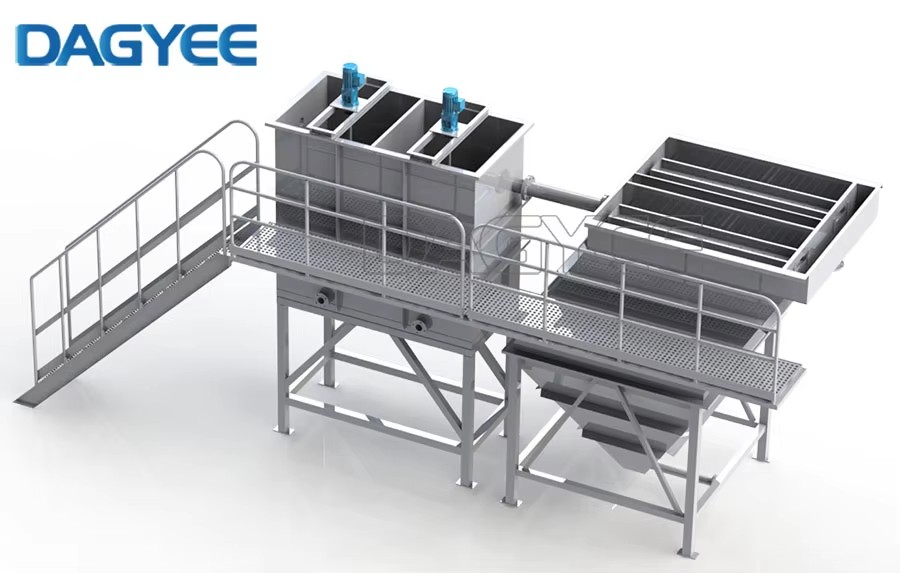
We provide complete PAC/PAM dosing packages — mixing tanks, agitators, metering pumps, control panels — integrated with the lamella clarifier for coordinated operation. The system automatically adjusts chemical feed when water quality changes.
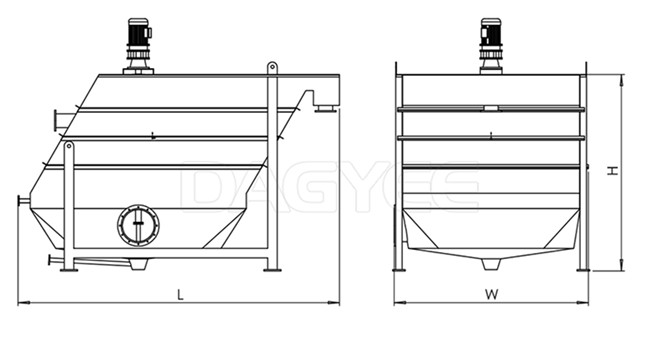
7. DAGYEE Lamella Clarifier Technical Specifications
8. Should You Choose a Lamella Clarifier? A 7-Step Self-Assessment
If you are still on the fence, run through these seven questions.
Question 2: Are your suspended solids consistently high? If SS regularly exceeds 500 mg/L, conventional sedimentation may struggle. A lamella clarifier is a better choice.
Question 3: Does your flow and quality fluctuate a lot? Big swings between wet and dry seasons? Variable production loads? Lamella clarifiers handle shocks better.
Question 4: Are your discharge standards strict? If you need SS below 10 mg/L or even lower, a lamella clarifier plus filtration is the proven solution.
Question 5: Do you want to recover coal fines or ore concentrates? If you want to extract value from your waste stream, the sludge from a lamella clarifier is high-purity and easy to recover.
Question 6: Is your operations staff limited or not highly trained? If you have few people and limited technical expertise, choose a lamella clarifier — little that can go wrong, easy to fix.
Question 7: Is your budget adequate? A lamella clarifier has higher upfront cost than a conventional tank. But when you add up land, civil work, and operating costs over the long term, it is usually cheaper.
If you answered "yes" to four or more of these questions, a lamella clarifier is likely the right choice for you.
9. Conclusion
The lamella clarifier has become the industry's first choice not because it is flashy, but because it saves space, delivers high efficiency, handles shock loads, costs less to run, and is simple to maintain — exactly what mining wastewater treatment needs.
It is not new technology. But that is precisely the point. After decades of real-world use, it has proven itself to be reliable.
At the end of the day, mining companies do not need the most advanced equipment. They need solutions that work. The lamella clarifier is one of those solutions.
If your mine is struggling with wastewater treatment or you are planning an upgrade, DAGYEE can help with a free preliminary design. Tell us your flow rate, water quality, and site conditions. We will help you figure it out.