Sludge Dewatering Equipment: How to Choose Between Belt Press, Plate Press, and Screw Press
Belt Press, Plate & Frame Press, or Screw Press? This Comparison Table Tells You Everything
By DAGYEE – Water Treatment Specialist
Introduction: Choose the Right Equipment and Save Years of Trouble
If you work in wastewater treatment, sooner or later you'll face the same question: Which sludge dewatering equipment should I choose?
There are three mainstream options on the market — Belt filter press, plate and frame filter press, and screw press sludge dewatering machine. Each has its own strengths and weaknesses. None is absolutely "better" than the others. It all depends on your specific application.
Choose right, and you get stable operation, low maintenance, and controllable costs.
Choose wrong, and you'll deal with constant clogging, frequent repairs, high electricity bills, and expensive chemicals. Over three years, that could cost you hundreds of thousands.
This article uses one comparison table to clearly explain the differences between these three technologies. Whether you're selecting equipment for a new project or upgrading an existing dewatering system, you'll have a clear answer after reading this.
1. Quick Overview of Three Technologies
Belt Filter Press
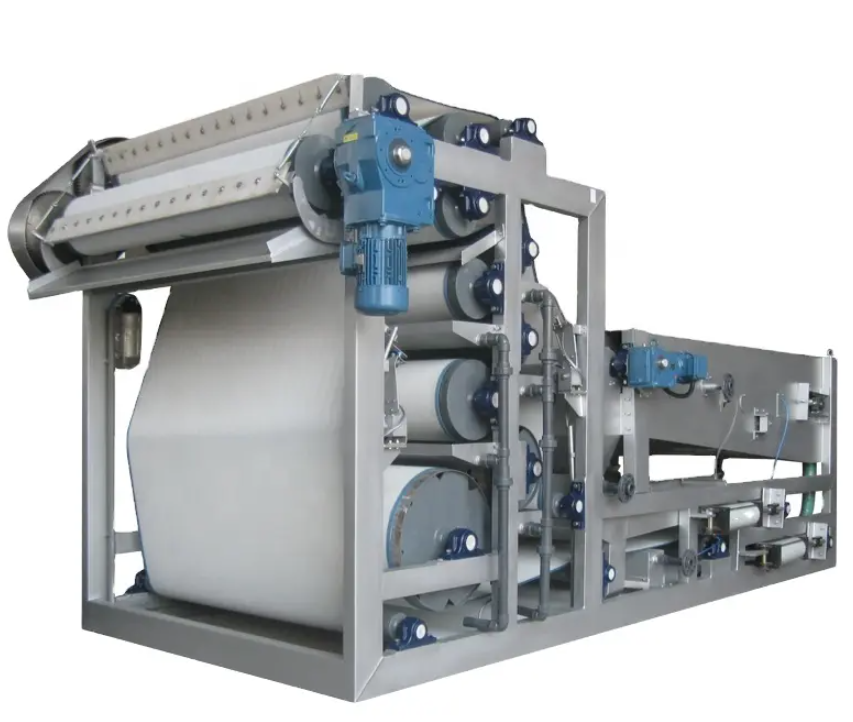
A belt filter press uses two tensioned filter belts to squeeze water out of sludge as it passes through a series of rollers. Think of it like wringing out a wet towel.
• Advantages: High capacity, mature technology, relatively low equipment price
• Disadvantages: Filter cloth clogs easily, requires large amounts of wash water, complicated operation, high labor costs
• Best for: Large municipal WWTPs, high-volume projects, facilities with plenty of space
Plate and Frame Filter Press
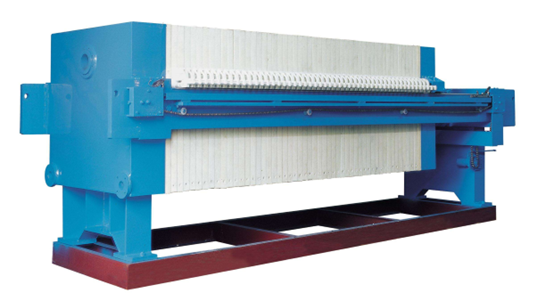
A plate and frame filter press pumps sludge into a chamber formed by filter plates and frames, then squeezes water out under high pressure.
• Advantages: Lowest cake moisture (as low as 60-70%), dry cake, high solid recovery rate
• Disadvantages: Batch operation (not continuous), labor-intensive cake discharge, long cycle time
• Best for: Applications requiring extremely low cake moisture, projects where reducing sludge disposal weight is critical
Screw Press Sludge Dewatering Machine
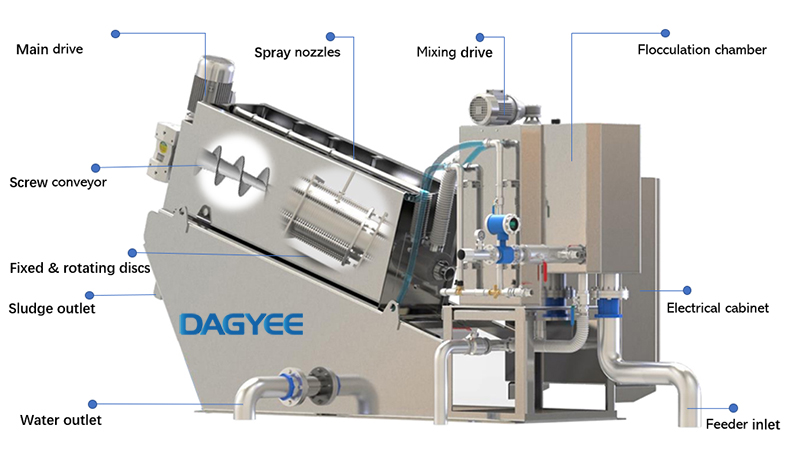
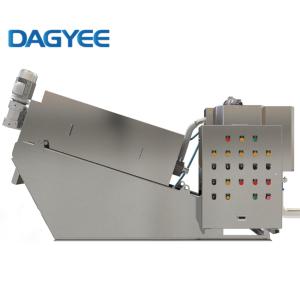
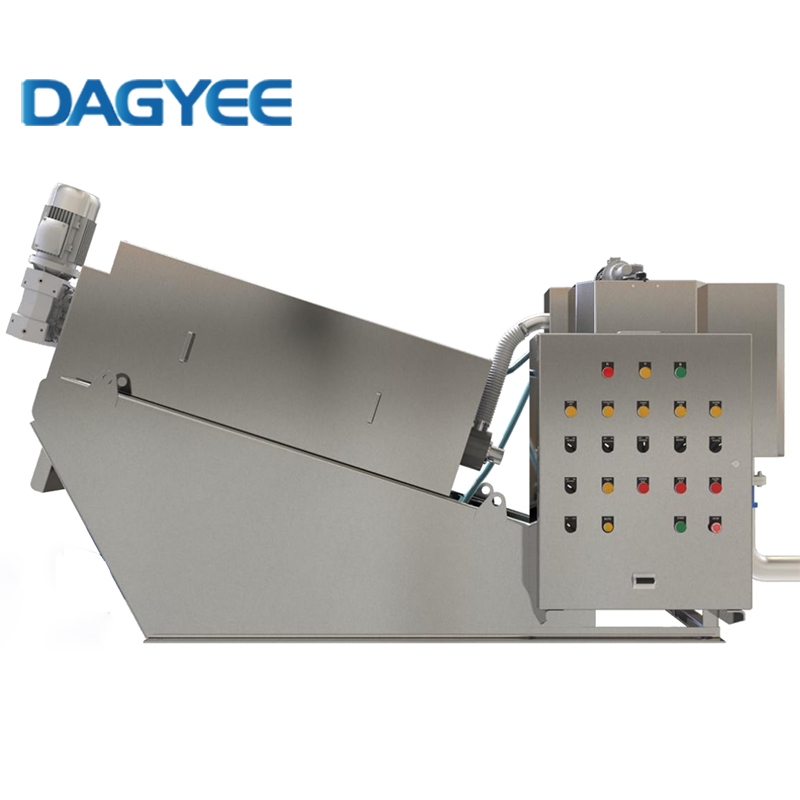
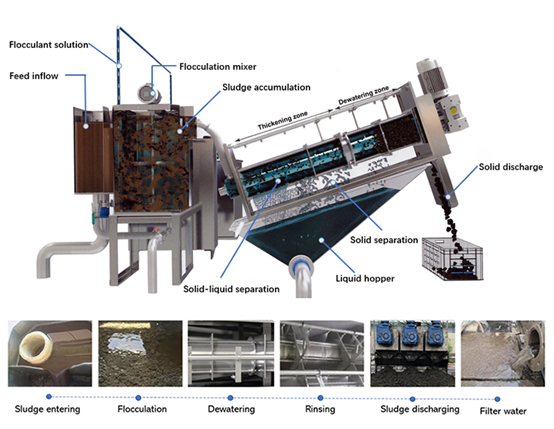
The screw press is a newer technology. It uses a screw shaft to push sludge through a chamber formed by alternating fixed rings and moving rings. The volume decreases as the sludge moves forward, squeezing water out. The moving rings rotate with the screw, creating a self-cleaning effect.
• Advantages: Low energy consumption, no clogging, automatic operation, minimal wash water, small footprint
• Disadvantages: Single-unit capacity is relatively limited, sensitive to hard particles
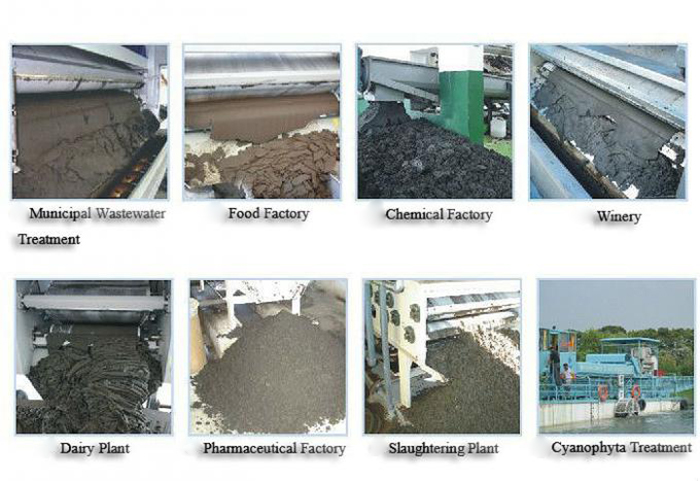
• Best for: Small to medium WWTPs, industrial wastewater (food, slaughterhouse, textile), space-constrained retrofit projects, oily and fibrous sludge
2. One Comparison Table That Tells You Everything
Parameter
Belt Filter Press
Plate & Frame Press
DAGYEE Screw Press
Working Principle
Belt squeezing
High-pressure filtration
Screw squeezing + self-cleaning
Operation Mode
Continuous
Batch
Continuous
Energy Consumption
High
Higher
Lowest
Wash Water Usage
Very high
Medium
Minimal
Filter Cloth/Media Replacement
Frequent
Frequent
No filter cloth
Clogging Risk
High
High
Very low
Labor Requirement
Requires attention
Labor-intensive
Automatic, unattended
Footprint
Large
Large
Small
Cake Moisture
80-85%
60-70%
75-85%
Suitable for Oily Sludge
Poor
Poor
Good
Suitable for Fibrous Sludge
Poor
Poor
Good
Equipment Cost
Low
Medium
Medium
Operating Cost
High
Higher
Lowest
Maintenance Frequency
High
High
Low
3. How to Choose Based on Your Conditions
Oily Sludge → Choose DAGYEE Screw Press
Oil and grease clog filter cloths. When treating oily sludge, belt and plate presses get blinded quickly, requiring frequent cleaning with poor results. The screw press's self-cleaning moving ring design handles oily sludge effectively. For slaughterhouses, food processing plants, and grease trap waste, the DAGYEE screw press is the way to go.
Fibrous Sludge → Choose DAGYEE Screw Press
Fibers from textile, paper, and printing wastewater also clog filter cloths. The screw press's moving ring structure resists fiber wrapping, ensuring continuous stable operation. One textile plant used to clean their belt press filter cloth every two days. After switching to a DAGYEE screw press, a weekly check is all they need.
Extremely Low Cake Moisture Required → Choose Plate & Frame Press
Some projects have special requirements for cake moisture — for example, sludge needs to be below 70% moisture for incineration. For these applications, the plate and frame press is the best choice, producing the driest cake. The trade-offs are batch operation and manual cake discharge.
High Volume, Plenty of Space → Choose Belt Press
Large municipal plants processing hundreds of tons of sludge per day may find that a single screw press doesn't have enough capacity, requiring multiple units in parallel. Belt presses offer high single-unit capacity at a lower equipment cost. If you have the space, the labor, and the water supply, a belt press is still a viable option.
Space-Constrained, High Automation Required → Choose DAGYEE Screw Press
Retrofit projects rarely have extra space. The DAGYEE screw press's compact footprint allows it to fit into existing buildings. Add PLC automatic control, and the system runs with minimal operator attention. One food plant replaced a 200m² belt press system with a DAGYEE screw press that took only 18m² — freeing up space for production expansion.
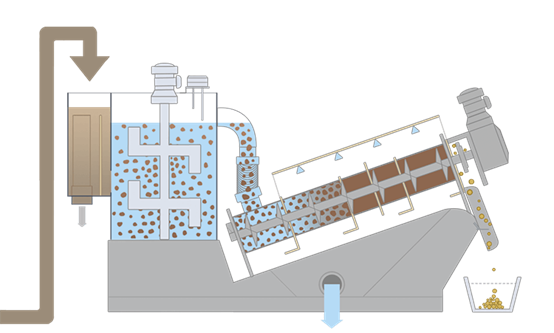
4. DAGYEE Screw Press: Built for Real-World Conditions
DAGYEE has been designing and manufacturing screw press sludge dewatering machines for over 20 years. We've learned what works and what doesn't. Here's what sets our equipment apart.
Feature
How It Helps You Save
Low-speed screw design
Only 2-5 rpm operation consumes 1/3 the energy of belt presses and 1/5 of centrifuges
Self-cleaning moving rings
No filter cloth means no replacement costs and no clogging downtime
PLC automatic control
Runs unattended 24/7, reducing labor costs significantly
Minimal wash water
Intermittent spray uses only 24-216 liters per hour — 1/50 of a belt press
Integrated screw press
Dewaters screenings to 40-60% solids, reducing disposal volume and weight
Corrosion-resistant construction
SUS304/SUS316L stainless steel — no painting, no peeling, no hidden rust
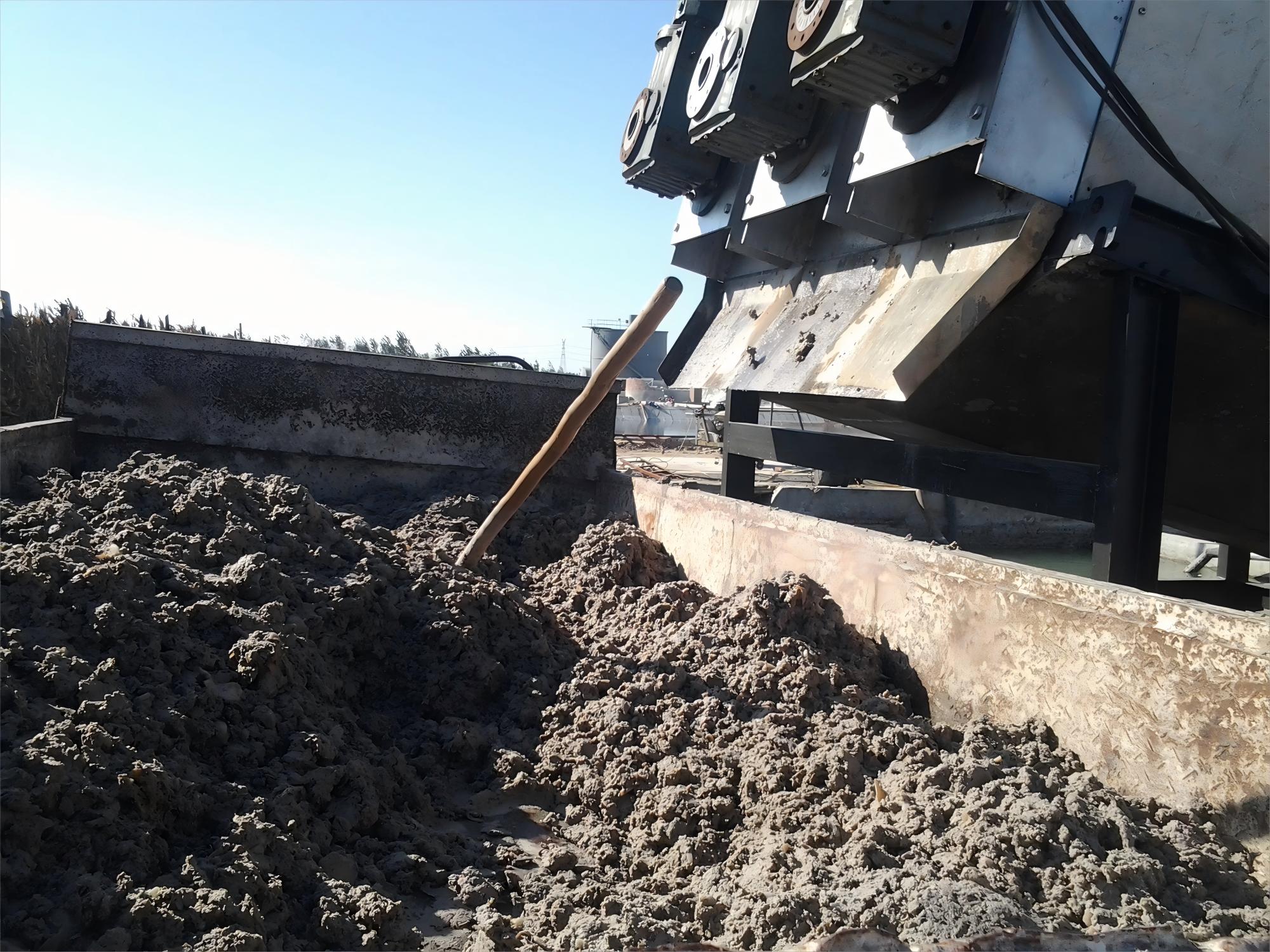
Built for Tough Applications
DAGYEE screw presses don't run in laboratories. They run in factories with variable flows, changing loads, and operators who have other things to do. We design ours to handle that.
• Forgiving design: Our systems keep working even when inlet conditions change
• Easy access: Everything you need to check or clean is right where you can reach it
• Clear documentation: We provide startup guides, troubleshooting flowcharts, and maintenance schedules that actual operators can understand
• Remote monitoring ready: PLC systems with optional connectivity let you check performance without walking out to the tank
5. DAGYEE Screw Press Technical Specifications
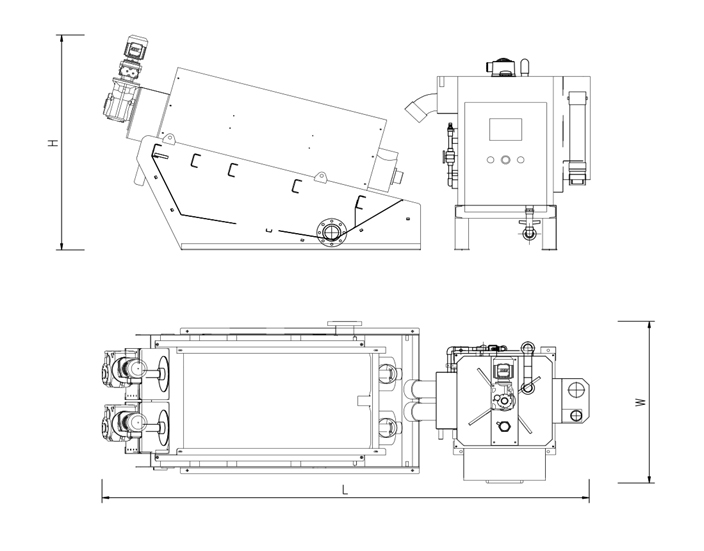
Specifications Notes:
Model
DS Capacity (kg/h)
Sludge Capacity (m³/h)
Power (kW)
Dimensions (mm)
Weight (kg)
DL101
3-5
1.5 / 0.6 / 0.25
0.2
1816×756×1040
290
DL131
6-10
3.0 / 1.2 / 0.5
0.36
1969×756×1040
315
DL202
18-30
9.0 / 3.6 / 1.5
1.1
2930×1257×1470
1110
DL301
30-50
15.0 / 6.0 / 2.5
0.74
3255×985×1600
1320
DL302
60-100
30.0 / 12.0 / 5.0
1.1
3455×1295×1600
2230
DL352
120-200
60.0 / 24.0 / 10.0
6.0
4420×2100×2250
4850
DL403
180-300
90.0 / 36.0 / 15.0
6.0
4420×2100×2250
4850
• DS Capacity: Dry solids processed per hour — the core capacity metric
• Sludge Capacity: Based on inlet concentration — lower concentration requires higher flow capacity
• Cake Moisture: 75-85% depending on sludge characteristics (organic vs. inorganic, conditioning, etc.)
• Solid Recovery Rate: ≥95% — minimal solids lost to filtrate
• Material: SUS304 stainless steel as standard (SUS316L available for corrosive applications)
• Screw Speed: 2-5 rpm, adjustable via VFD
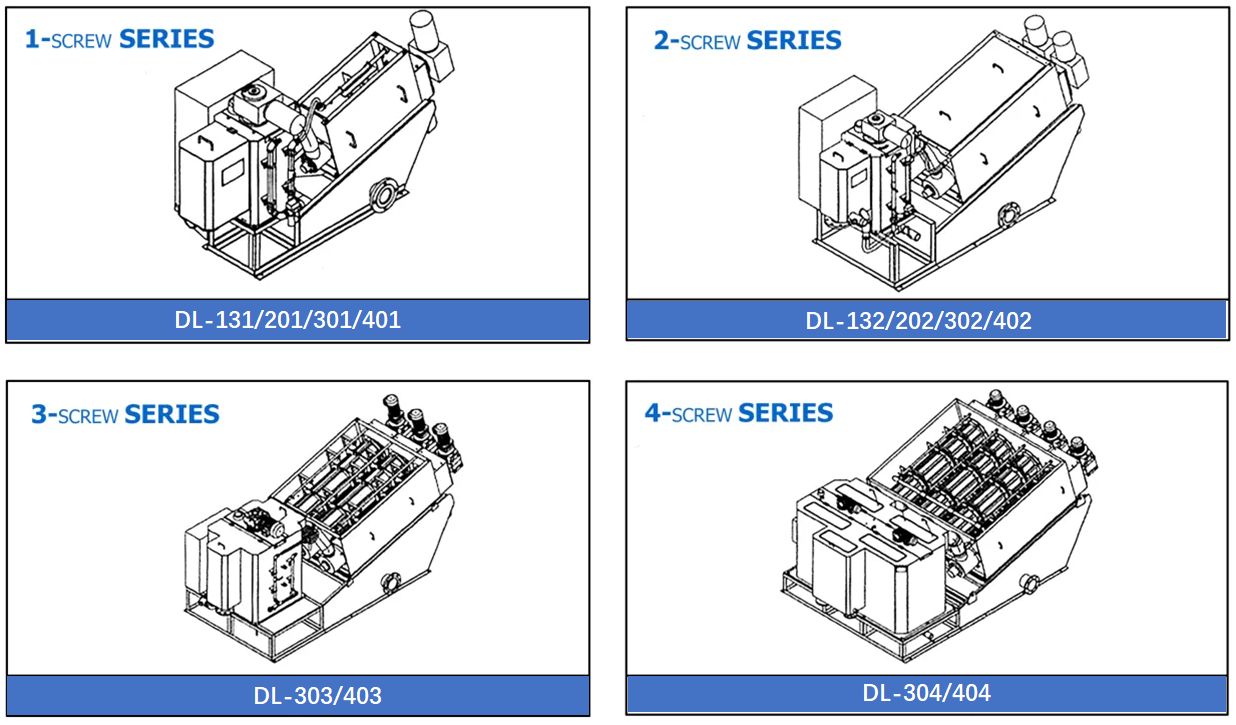
6. DAGYEE Screw Press Core Advantages
Advantage
Description
No Clogging
Moving and fixed rings create self-cleaning action, ideal for oily and fibrous sludge
Low Energy
Only 2-5 rpm, consumes 1/3 the energy of belt presses, 1/5 of centrifuges
Automatic Operation
PLC control with programmable cycles, unattended operation
Compact Footprint
Only half the space of a belt press — perfect for retrofits
Low Wash Water
Only 24-216 liters per hour — 1/50 of a belt press
Wide Application
Handles low-concentration sludge down to 2000mg/L, no thickening tank needed
No Filter Cloth
No replacement costs, no downtime for cloth changes
Low Maintenance
Only annual gearbox oil change and occasional ring inspection
Long Service Life
SUS304 stainless steel, corrosion-resistant, designed for 10+ years
Safe Operation
Low speed (2-5 rpm), no pinch points, quiet (<65 dB)
7. What Customers Say About DAGYEE Screw Press
*"We replaced our old belt press with a DAGYEE screw press. Our electricity bill dropped by 40%, and we no longer spend hours cleaning filter cloths. The machine runs 24/7 with almost no attention."*
— Plant Manager, Food Processing Plant
"The self-cleaning design is a game-changer. Our previous equipment would clog every time we got fibrous material. The DAGYEE screw press just keeps running."
— Operations Supervisor, Paper Mill
*"We were out of space — literally no room to expand. The DAGYEE screw press fit into our existing building and handled the same sludge volume as our old belt press in 1/10 the footprint."*
— Facilities Engineer, Municipal WWTP
"What I appreciate most is the support. When we had questions during startup, their engineer walked us through it on the phone. They didn't just sell us a box and disappear."
— Maintenance Manager, Slaughterhouse
8. Real-World Results: Before and After
A food processing plant had been using a belt filter press for years. They were frustrated with constant clogging, high water bills, and the time their operators spent cleaning filter cloths.
Before (Belt Press)
| Energy cost | $1,800/month |
| Wash water | 400 m³/day |
| Filter cloth replacement | Every 3 months |
| Operator attention | Several hours daily |
| Footprint | 200 m² |
After (DAGYEE Screw Press)
| Energy cost | $1,100/month (39% reduction) |
| Wash water | 2 m³/day (99.5% reduction) |
| Filter cloth replacement | None — no filter cloth |
| Operator attention | Weekly check |
| Footprint | 18 m² (91% reduction) |
Total annual savings: Over $15,000 in energy and water alone, plus significant labor savings.
"If I'd known it was this simple, I would have switched years ago."
— Plant Manager
— Plant Manager
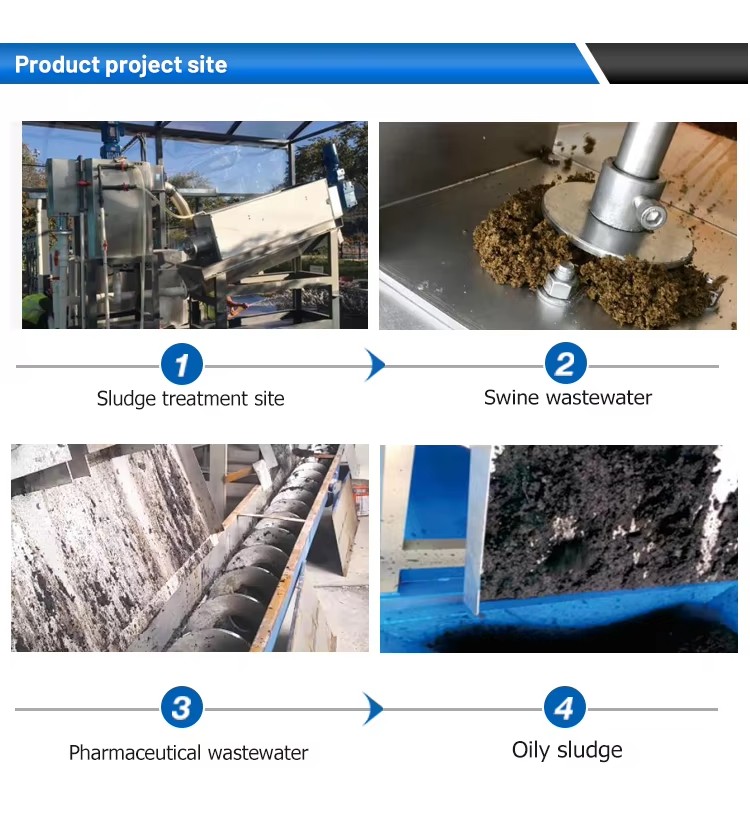
9. When to Choose DAGYEE Screw Press
Situation
Why DAGYEE Screw Press
You're short on space
80-90% smaller footprint than belt presses
You have oily or fibrous sludge
Self-cleaning design handles what clogs others
Water is expensive or scarce
Uses 1/50 the wash water of a belt press
You want to reduce labor costs
PLC automatic control, runs unattended
You're retrofitting an old plant
Compact design fits into existing buildings
You process low-concentration sludge
Handles down to 2000mg/L, no thickening tank needed
You want the lowest total cost of ownership
Lower energy, no filter cloths, less maintenance, less labor
10. One Sentence Summary
| Your Situation | Recommended Equipment |
|---|---|
| Oily or fibrous sludge | DAGYEE Screw Press |
| Tight on space, want to reduce labor | DAGYEE Screw Press |
| Need cake moisture below 70% | Plate & Frame Press |
| High volume, plenty of space, cheap labor | Belt Filter Press |
| New project, pursue long-term low operating costs | DAGYEE Screw Press |
Not sure which one is right for you?
DAGYEE offers free technical consultation. Tell us your sludge type, treatment volume, and site conditions, and we'll help you make the right choice.
We can also:
• Run lab tests on your sludge sample
• Provide a detailed cost comparison for your specific case
• Arrange a factory visit to see our equipment in action
Note: Data in the comparison table are typical values for reference. Final selection should be confirmed with technical staff.
Related News