Submersible Mixer Export to Mexico: 5 Customization Details Most Manufacturers Overlook
Submersible Mixer Export to Mexico: 5 "Non-Standard Customization" Details Hidden in This Small Order
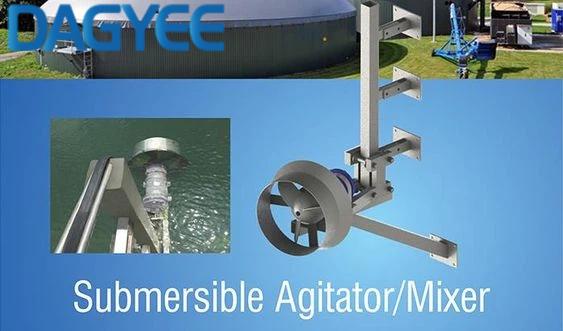
It wasn't a big order — just one unit. But from selection to production to packaging, every step involved "non-standard customization" details.
Today, I'll break down the configuration of this order and the reasoning behind it. I hope it helps those working on overseas projects or dealing with special operating conditions. And along the way, I'll also share some general knowledge about submersible mixers to help you understand the value of non-standard customization more broadly.
Background: Paint Line Wastewater, 25m³ Small Tank
The tank is small: 3.25m × 3.1m × 2.5m water depth, total volume around 25m³. In the wastewater industry, that's a "mini tank."
But the media isn't simple: Paint line wastewater contains paint particles, solvent residues, and cleaning agents — it's corrosive. Not strong acid or alkali, but over long-term immersion, standard materials won't hold up.
The customer's requirements were straightforward: keep the tank mixed, prevent solids from settling, use durable equipment that doesn't break down every few months.
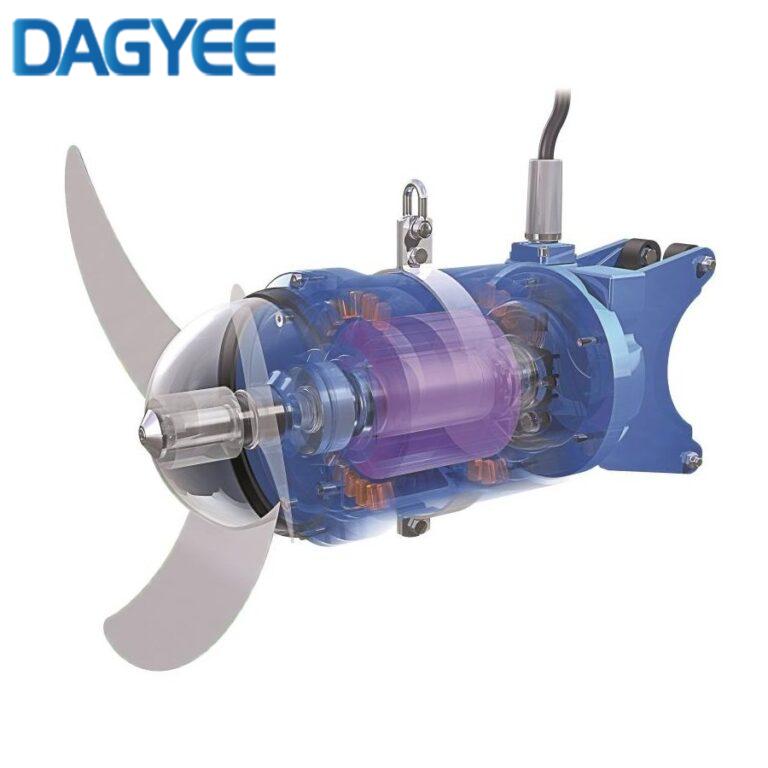
This equipment model is MA0.55-4-220-1400, with SUS316L material specification.
Many manufacturers say "stainless steel construction," but they really only mean the housing is stainless — internal parts remain carbon steel. True "full-wetted-parts" stainless means every single component that contacts the media is stainless steel.
Material Configuration · Mexico Export Order
| Component | Material |
|---|---|
| Housing | Q235 carbon steel base + SUS316L stainless steel cladding |
| Impeller | SUS316L |
| Shaft | SUS316L |
| Fasteners (bolts, nuts) | SUS316L |
| Rotor hub | SUS316L |
| Pumping system | SUS316L |
| Guide cone | SUS316L |
Impeller, shaft, fasteners, hub, guide cone — all SUS316L. That's true "full-wetted-parts stainless."
Why this spec? Paint line wastewater contains chlorides and solvent residues. SUS304 is at risk of stress corrosion cracking in chloride environments. SUS316L contains molybdenum, which provides much better chloride resistance. Even though the tank is only 25m³, the media characteristics determine the material grade — tank size doesn't matter.Key takeaway: Stainless steel is not all the same. SUS304 is standard. SUS316L is "enhanced corrosion resistance." For chemical wastewater, paint line effluent, or chloride-containing media, go straight to 316L — don't try to save money here.
Detail 2: 480V/60Hz Voltage — The Most Overlooked Pitfall in Export Orders
China runs on 380V/50Hz. The difference seems small, but if you plug a Chinese motor into a 60Hz grid, either it won't run properly or it will burn out. Frequency change from 50Hz to 60Hz increases motor speed by about 20%, which puts extra stress on bearings, seals, and impeller balance.
What we did:
• Motor windings redesigned for 60Hz frequency
• F-class insulation (155°C rating) to handle temperature rise at 60Hz
• Cable length recalculated — voltage drop at 480V is different from 380V
Key takeaway: For export equipment, voltage and frequency are the first hurdle. North America (US, Canada, Mexico) runs 480V/60Hz. Some South American countries too. Europe and most of Southeast Asia run 400-415V/50Hz. Always confirm the destination country's power standard before exporting — motor windings, cables, and control systems all need adjustment.
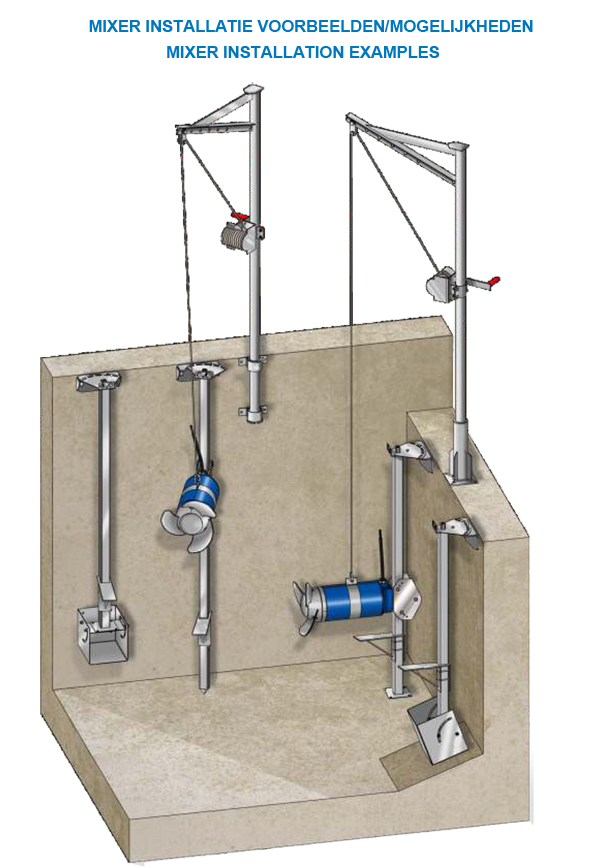
Detail 3: Guide-Rail Lifting System — Maintenance Without Entering the Tank
What the system includes:
• Guide rails (stainless steel, underwater)
• Lifting frame (carbon steel with anti-corrosion coating, tank-top mounted)
• Manual winch (for lifting the unit)
• Stainless steel wire rope (connecting winch and mixer)
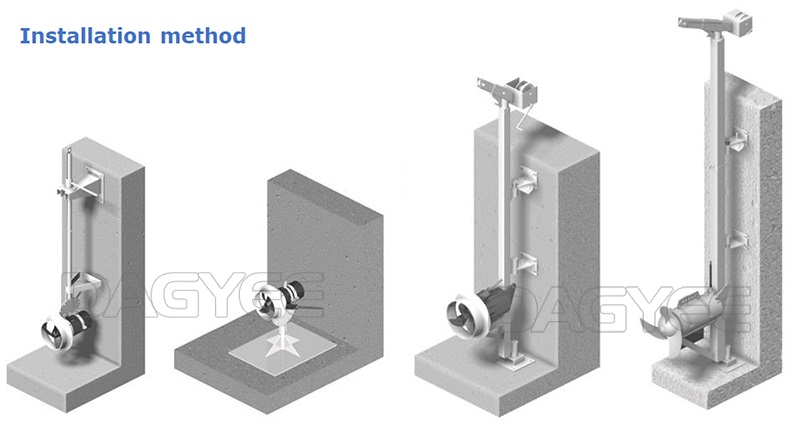
Underwater parts are stainless; the lifting frame is carbon steel with coating — the logic is clear: anything that's submerged and contacts the media uses stainless; anything above water that doesn't contact media uses coated carbon steel.
Why the guide-rail system? Submersible mixers need regular maintenance — impeller inspection, seal replacement, cable checks. Without the guide system, maintenance requires draining the tank and sending someone down there — which is both difficult and dangerous. With the guide-rail system, one person can crank the winch and pull the unit up. Change an impeller or seal on the ground in 30 minutes.
Key takeaway: For tanks deeper than 1.5 meters, a guide-rail lifting system is strongly recommended. The upfront cost is modest — the maintenance savings are huge.
Detail 4: IP68 and F-Class Insulation — Running Safely Underwater
This unit's protection spec:
• Motor protection: IP68 (continuous operation at depths up to 20 meters)
• Insulation: Class F (155°C rating)
• Submersible cable: 10 meters, oil-resistant and corrosion-resistant
IP68 means the unit can run underwater long-term without water ingress. The seal structure and materials are critical — if the seals fail, the motor floods and the unit is scrap.
F-class insulation is a step above standard. B-class only handles 130°C; F-class handles 155°C. That extra 25°C margin translates to longer motor life and higher reliability.
Key takeaway: IP68 is standard for submersible equipment, but seal design varies widely between manufacturers. Focus on seal structure and materials — tungsten carbide mechanical seals are the industry standard. F-class insulation is sufficient for most applications (H-class is higher but rarely needed).
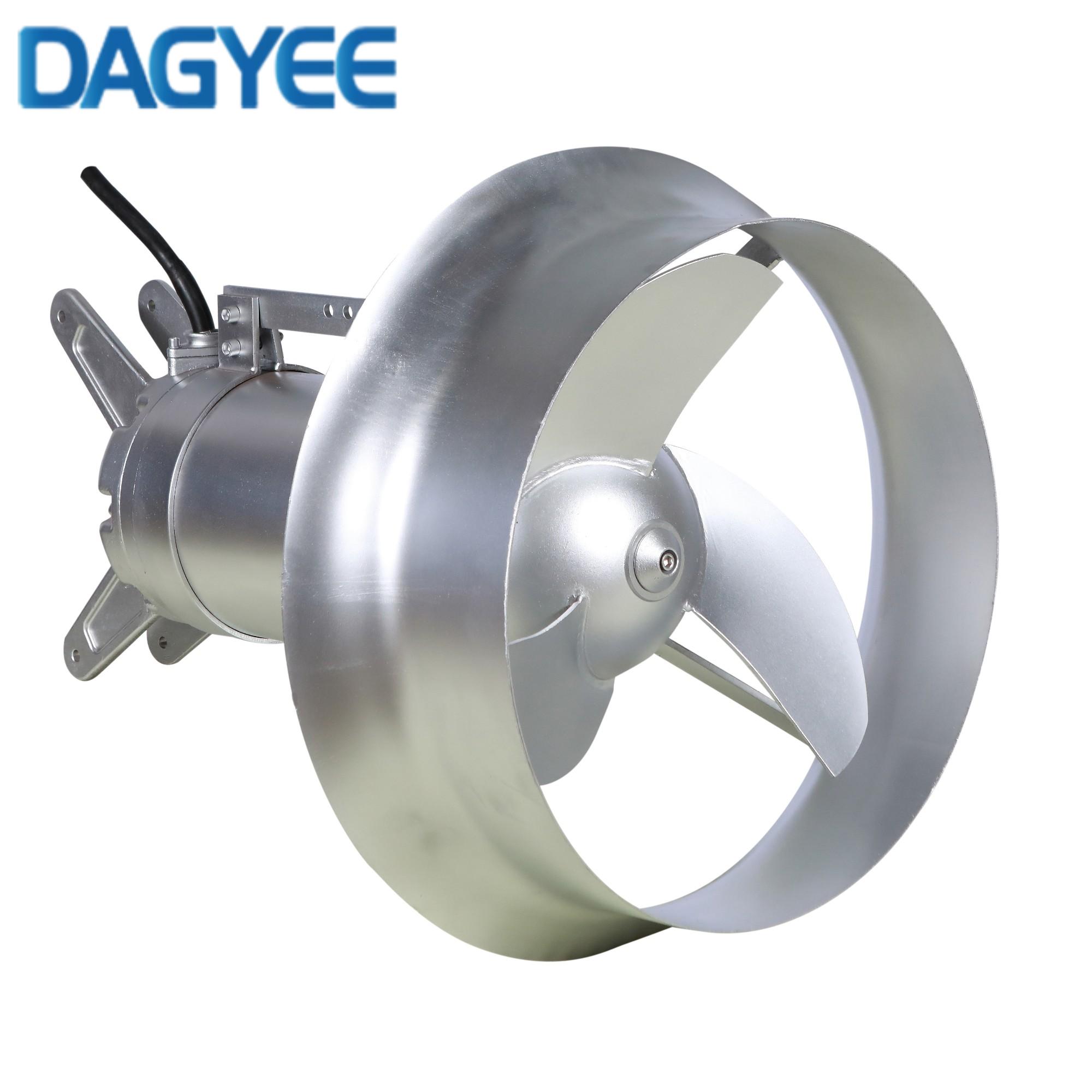
All bolts, nuts, and washers on this unit are SUS316L.
This is a detail many people overlook.
Some manufacturers use stainless for the housing, but replace bolts, washers, and other small parts with plain carbon steel. Run that in corrosive media for a while, and the bolts rust first — rust drips down contaminating the media, bolts eventually break, and the unit falls to the bottom of the tank. Good luck retrieving that.
On this Mexico order, we specified all fasteners in 316L. A single bolt doesn't cost much, but the trouble and losses it can cause are hundreds of times its price.
Key takeaway: Real quality shows in the parts you can't see. Saving a few dollars on fasteners creates major risk. For export orders and corrosive applications, make sure all fasteners are stainless — don't cut corners here.
About This Mexico Order — Key Data
Mexico Export Order · Technical Specifications
| Item | Specification |
|---|---|
| Equipment name | Submersible Mixer |
| Model | MA0.55-4-220-1400 (SUS316L) + Guide-rail lifting system |
| Quantity | 1 set |
| Motor power | 0.55 kW |
| Impeller diameter | 210 mm |
| Speed | 960 rpm |
| Protection / Insulation | IP68 / Class F |
| Submersible cable | 10 meters (oil-resistant, corrosion-resistant) |
| Voltage / Frequency | 480V / 60Hz / 3-phase |
| Starting method | Direct-on-line |
| Mounting system | AZXT1-3C guide-rail lifting system |
| Tank depth | 2.5 meters |
| Submergence depth | 2 meters |
| Tank dimensions | 3.25m × 3.1m × 2.5m |
| Tank volume | ~25 m³ |
Why Non-Standard Customization Matters
Every project has different water quality, different tank geometry, and different operating habits. Standard products can't cover all needs. Real non-standard customization is accurate adaptation based on site data — material, voltage, mounting, controls — every adjustment has a reason. This Mexican customer chose SUS316L not because "expensive is better," but because paint line wastewater specifically requires it.
Two manufacturers can quote the same specs, but the results are worlds apart. An experienced engineer looks at a water quality report and immediately knows what seals, bearings, and cables to use. Less experienced manufacturers might just swap materials and ignore hidden risks.
3. The value of customization shows up after installation — sometimes years later.
A custom unit runs normally from day one. It looks the same as a standard unit. But three years later, the standard unit is rusted and leaking, while the custom unit is still running smoothly. That's when the gap shows.
4. Customization isn't a rejection of standardization.
We emphasize "non-standard customization," but that doesn't mean we reject standardization. On the contrary, we use mature standard designs for common components wherever possible, making changes only where truly needed. That way we get both reliability and fit.
5. Every order deserves the same attention.
One unit is a small order in the industrial equipment world. But every customer who chooses DAGYEE deserves to be taken seriously. This Mexico order was small, but from selection to production to packaging to shipping, we handled every step to export standards. Because once equipment ships overseas, after-sales service is expensive. It's better to get every detail right upfront than to fix problems later.
The phrase has been overused. Some manufacturers call it "custom" just by changing a dimension.
Real non-standard customization is configuring equipment based on your specific operating conditions, media characteristics, installation environment, and usage patterns.
Every "non-standard" choice on this Mexico order addressed a real need:
• SUS316L full-wetted-parts → corrosion resistance for paint line wastewater
• 480V/60Hz → Mexico's power grid
• Guide-rail lifting system → easy maintenance access
• IP68 + F-class insulation → reliable underwater operation
• All fasteners 316L → prevent future rust and failure
Small orders have technical depth too. Export orders especially demand attention to every detail.
DAGYEE — Submersible Mixers Built to Your Specs
Need equipment for an overseas project or special application? Send us your tank dimensions, media type, and operating conditions. We'll recommend the right configuration — no obligation, just advice.