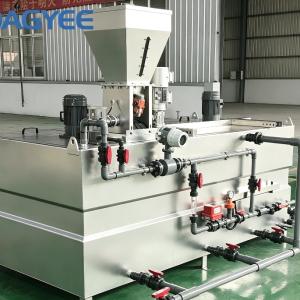
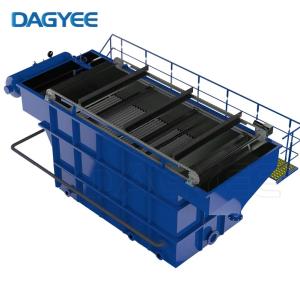
Manual vs Automatic Polymer Preparation: Which One Saves More Chemical?
Why Sludge Dewatering Can't Do Without a polymer preparation unit? From PAM Dissolving to Precise DosingSludge dewatering is one of the most routine and critical tasks at any wastewater treatment plant. The quality of dewatering directly affects sludge disposal costs, transportation expenses, and even the stability of the entire treatment system. Most people focus on the dewatering equipment itself—belt presses, centrifuges, screw presses—but overlook the polymer preparation unit that sits upstream.
If the polymer preparation unit isn't right, the best dewatering equipment won't save you. Poor PAM dissolution, unstable concentration, and chemical waste all end up affecting cake moisture content. Every percentage point increase in cake moisture adds to disposal costs.
This article covers the role of polymer preparation units in sludge dewatering and how DAGYEE helps customers get the most out of their chemicals—and their budget.
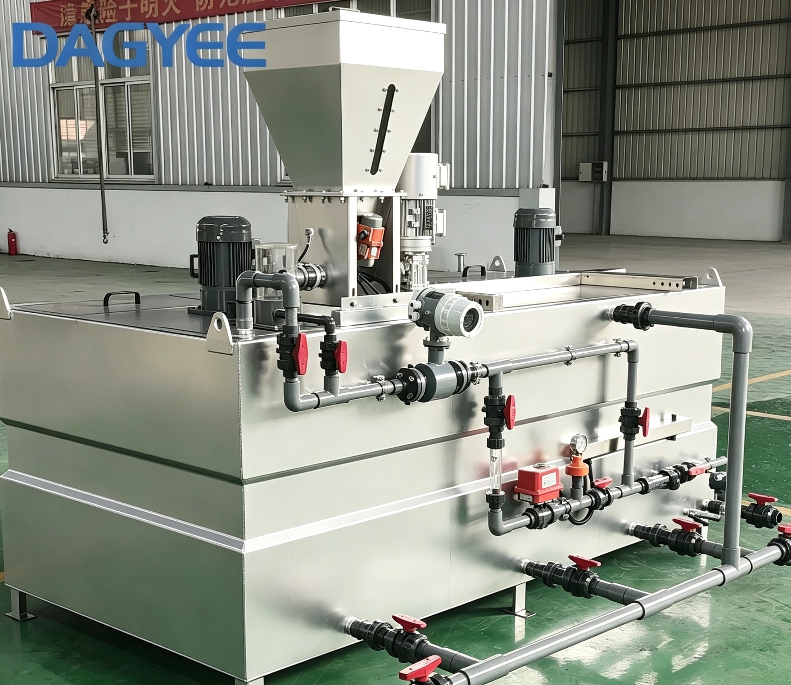
Why Sludge Dewatering Needs Polymer
Untreated sludge has moisture content of 95-99%. At that level, direct mechanical dewatering is inefficient. Adding PAM flocculant causes fine particles to aggregate into larger flocs, making it much easier to squeeze out water. Proper chemical conditioning can bring cake moisture down to 70-80%. Without proper preparation, flocculation suffers.
Test data tells the story. Untreated sludge pressed on a filter press leaves cake moisture at around 82.7%. With the right PAM dose, the same sludge can drop to 68-75%. That 8-point difference in moisture content means roughly half the sludge volume. At a disposal cost of $30 per ton, processing 50 tons per day, that's over $50,000 saved annually.
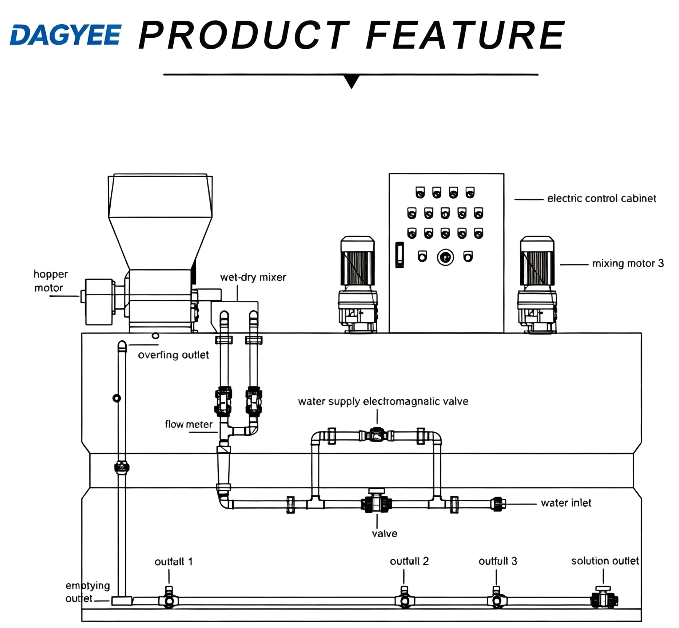
The Challenge with PAM
PAM is a high-molecular-weight polymer—often 10 to 20 million Daltons. These long-chain molecules need time to fully "stretch out" in water. This process is called aging or maturation, and it typically takes 45 to 60 minutes. If aging is cut short, the polymer chains don't fully extend, flocculation efficiency drops to 60-70%.
PAM also has a tendency to form "fish eyes"—gel-like clumps that form when dry powder hits water. The outer layer swells instantly, trapping dry powder inside. These undissolved clumps don't participate in flocculation and they clog pipes and pumps. With poor mixing, fish eye formation can reach 15-30% of the total powder—meaning 2-3 kg out of every 10 kg is wasted.
Manual Mixing: The Hidden Cost
Many older plants still use manual PAM preparation. An operator fills a bucket, adds powder, stirs, and estimates the concentration. The problems are obvious.
Concentration is inconsistent. Human error means the dose varies from batch to batch. Too much wastes chemical; too little hurts flocculation.
Fish eyes are common. Without a pre-wetting system, powder clumps on contact with water. Fish eye rates of 20-30% are normal.
Aging time is unreliable. When operators are in a hurry, they cut the mixing short. The polymer doesn't fully activate.
Labor is heavy. Moving bags, pouring powder, cleaning tanks—it's dirty work. Plants using several tons of PAM per month spend significant time just on manual handling.
Dust is a problem. PAM powder floating in the air affects operators' respiratory health and makes the work environment unpleasant.
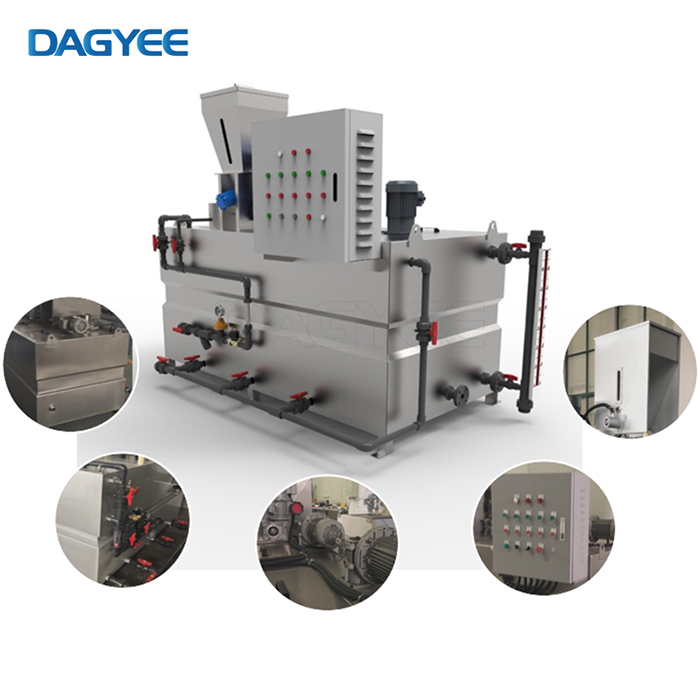
How DAGYEE Polymer Preparation Units Solve PAM Dissolving Problems
Precision Water-Powder Ratio
The core advantage of a fully automatic unit is precise dosing. DAGYEE's variable-frequency screw feeder and inlet flow meter work together to maintain the set ratio of water to powder. Concentration is held to within 0.1-0.5%—a level manual mixing can't achieve.
The control logic: When the storage tank level drops to "low," the PLC opens the water inlet valve and starts the powder screw feeder. The flow meter continuously measures water flow; the VFD adjusts the feeder speed accordingly—more water means more powder, less water means less powder, maintaining the set concentration. When the storage tank reaches "high," the system stops automatically.
The operator simply sets the concentration on the touchscreen. The unit does the rest.
Conical Water-Curtain Pre-Wetting Chamber
Fish eyes form because dry powder hits water and clumps. Traditional methods let powder drop directly into the tank, where it swells and traps dry powder inside.
DAGYEE's powder feed unit uses a conical water-curtain pre-wetting chamber. A 360-degree water spray separates each powder particle and wets it before it reaches the main tank. This ensures complete wetting from the start, preventing fish eyes from forming.
The screw feeder runs at variable speed, and the hopper vibrates to prevent bridging. Overall feeding accuracy is within ±1%.
Three-Tank Staged Aging
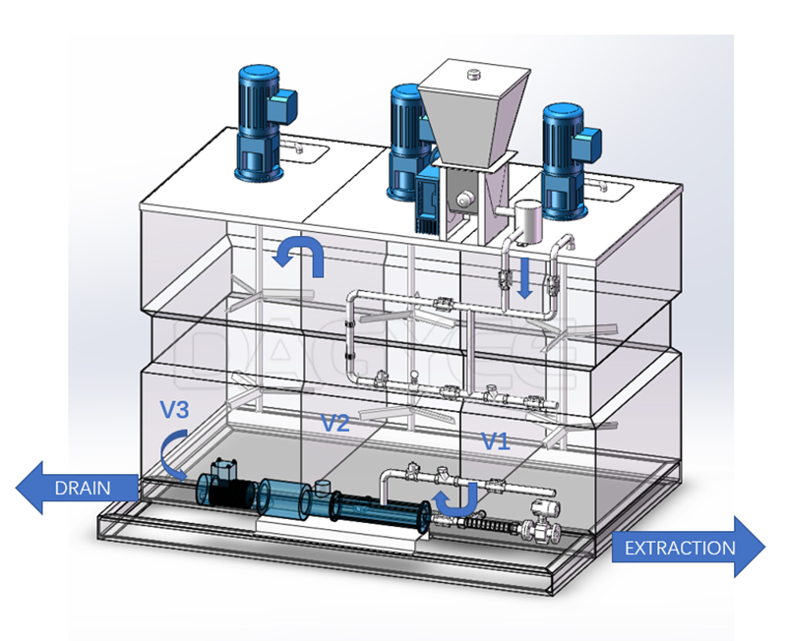
DAGYEE uses a three-tank integrated design—dissolving tank, aging tank, and storage tank—each with its own role, connected by overflow channels.
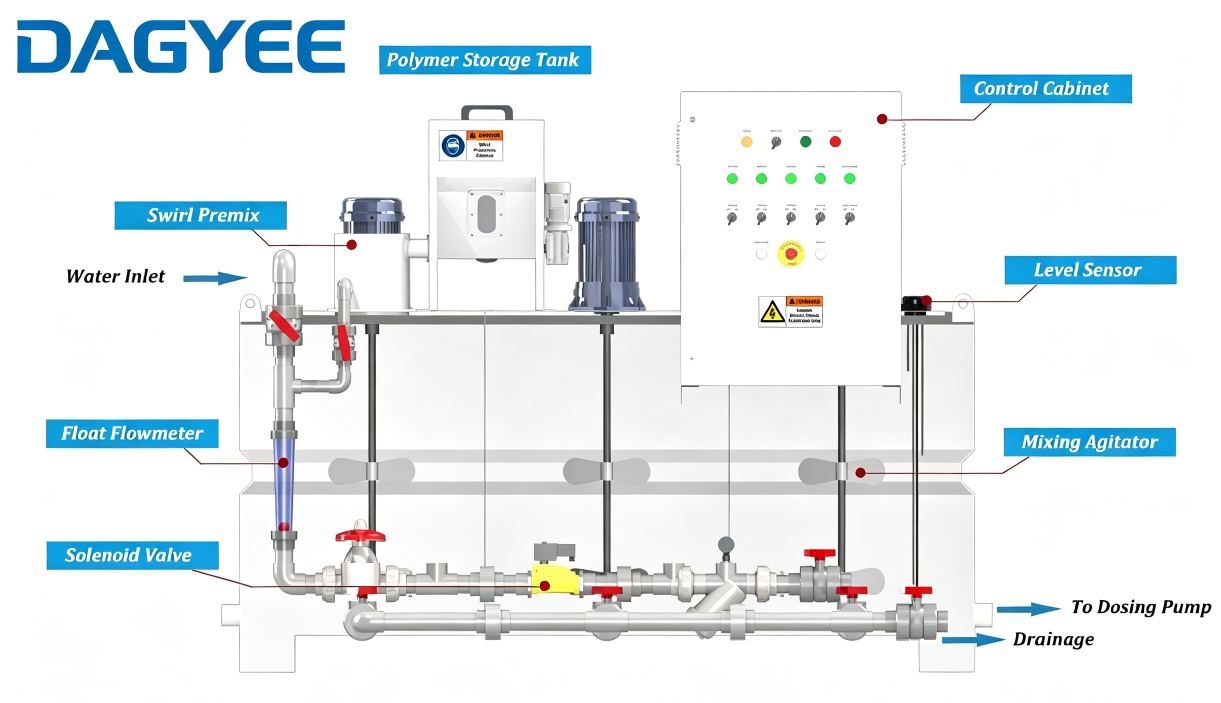
Dissolving tank: Fast mixer (double impeller) quickly disperses powder.
Aging tank: Slow mixer (single impeller) allows the polymer to age for 45-60 minutes, giving molecular chains time to fully extend. Slow mixing prevents shear damage to the polymer chains.
Storage tank: Holds ready-to-use aged solution for continuous dosing.
The three tanks are fully isolated, preventing fresh solution from mixing with aged solution. Concentration and activity remain stable and controllable.
PLC Control System
A good polymer preparation unit should be "set and forget." DAGYEE uses Siemens or Schneider PLC with a touchscreen HMI. The operator sets the concentration, and the unit runs itself.
Capacitive level sensors alert when powder runs low, preventing the system from diluting the solution with water only.
Five-electrode level switches (ultra-high, high, medium, low, ultra-low) provide full protection, with alarms at both extremes.
Water shortage protection, motor overload protection, and alarm logging are all standard, ensuring long-term reliability.
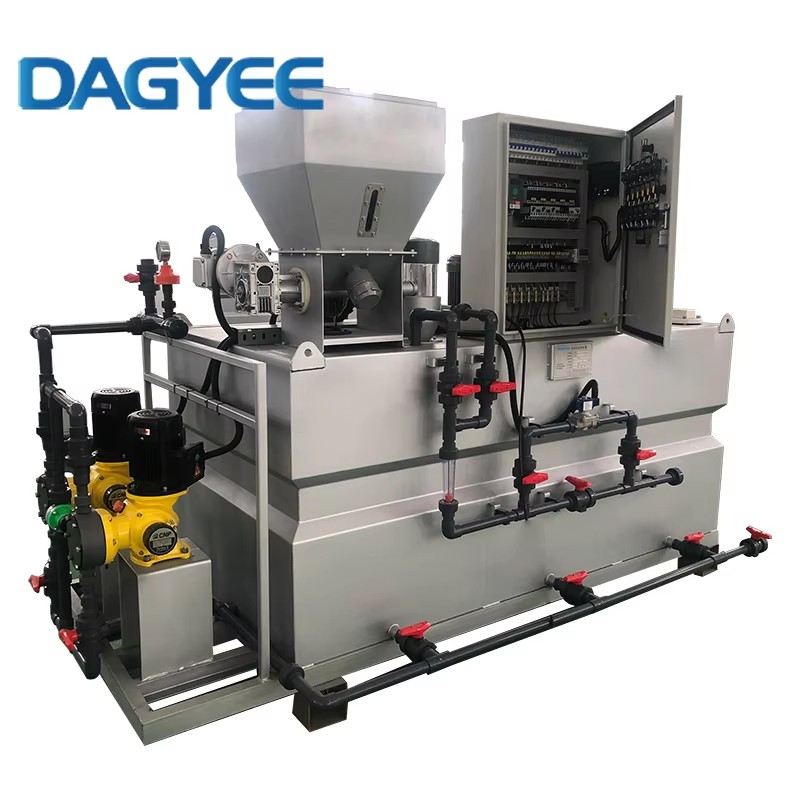
Optional Vacuum Loading
DAGYEE offers an optional vacuum loading system that pulls powder directly from bags into the hopper. This eliminates manual pouring, reduces dust, and lowers labor. Operators simply place the bag at the suction point—no more heavy lifting or dusty work.
Two-Tank vs. Three-Tank
This is a common question during selection.
Two-tank design combines dissolving and aging in one tank. Simpler, cheaper, suitable for small flows or intermittent operation.
Three-tank design separates dissolving, aging, and storage into three isolated tanks. Aging has its own dedicated space.
The key difference: Aging is the most overlooked but most important step in PAM preparation. If the polymer chains don't fully extend, flocculation performance suffers—chemical efficiency drops to 50% or less. A three-tank system gives aging its own dedicated space with guaranteed residence time before the solution moves to storage.
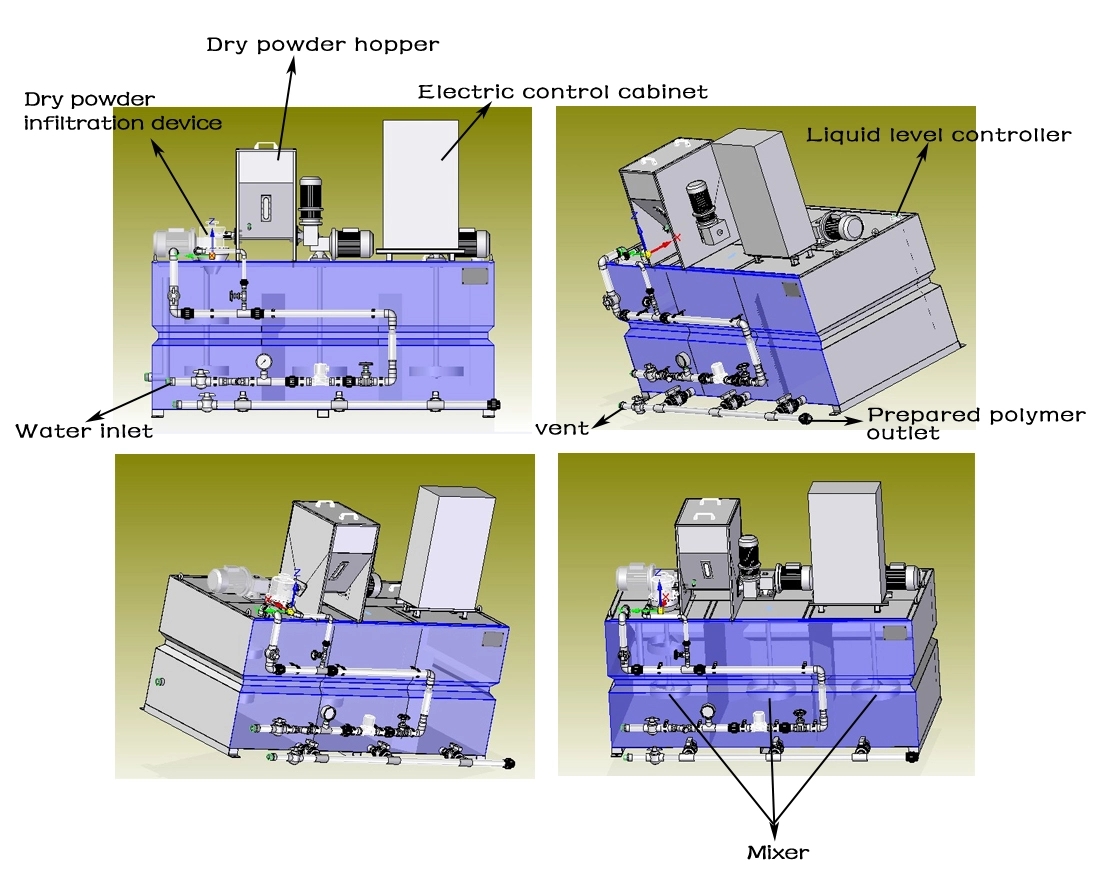
Two-tank works for intermittent operation with limited budgets. Three-tank is for 24/7 continuous operation, where dewatering performance matters and chemical savings are important. Most municipal and industrial plants should choose three-tank.
DAGYEE DT Series Technical Specifications
DAGYEE DT Series — Technical Specifications
Polymer preparation units — standard models
| Model | Capacity (L/h) | Dimensions L×W×H (mm) | Weight (kg) | Power (kW) |
|---|---|---|---|---|
| DT200 | 200 | 940×520×1450 | 250 | 0.54 |
| DT500 | 500 | 1370×730×1450 | 350 | 0.92 |
| DT1000 | 1000 | 1800×950×1620 | 480 | 1.3 |
| DT1500 | 1500 | 2130×1120×1620 | 560 | 1.7 |
| DT3000 | 3000 | 2450×1270×2000 | 790 | 2.4 |
| DT4000 | 4000 | 2780×1440×2250 | 1050 | 3.2 |
| DT6000 | 6000 | 3100×1600×2650 | 1200 | 4.8 |
| DT10000 | 10000 | 3970×2040×2650 | 1450 | 6.4 |
Note: The DT Series covers capacities from 200 L/h to 10,000 L/h. Materials available: SUS304, SUS316L, PP, or FRP. DT1000 suits medium-size plants. DT3000 and above are for large municipal and industrial facilities. Custom configurations are available upon request. Contact DAGYEE for models outside this range.
Selection tip: Calculate your daily PAM solution requirement divided by runtime. Add 20% margin. For example, if you need 5,000 liters per day over 8 hours, choose a unit rated at 600 L/h or above.
Key Selection Details
Several details are often overlooked during selection.
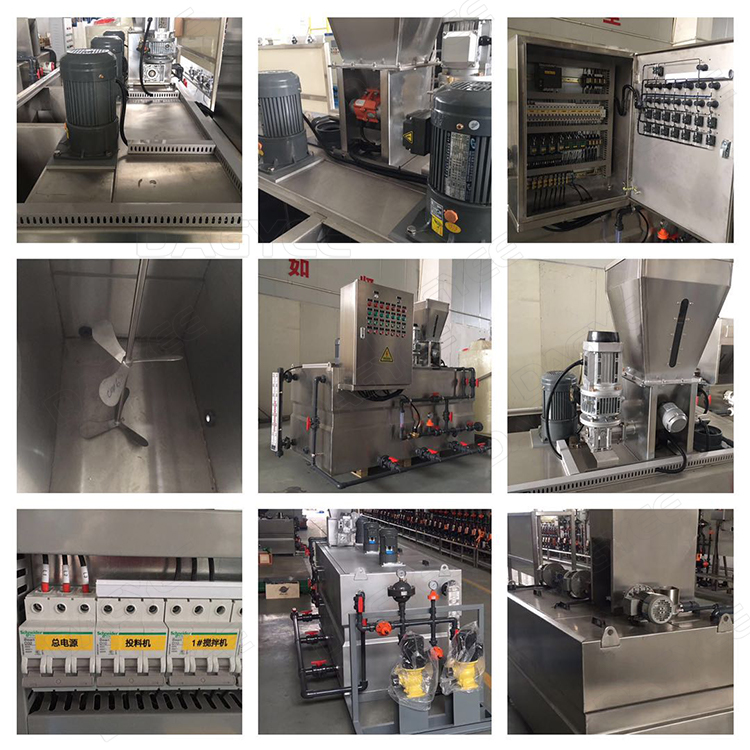
Hopper bridging prevention. PAM absorbs moisture and clumps, blocking the hopper outlet. DAGYEE's hopper has heated discharge outlets, hopper vibrators, and a variable-speed screw feeder to ensure reliable powder flow.
Mixing cone design. A good mixing cone prevents fish eyes. Look for pre-wetting and dispersion features. DAGYEE's conical water-curtain chamber is designed specifically for this.
Control system intelligence. The system should be fully automatic. DAGYEE uses Siemens/Schneider PLC with HMI and a capacitive powder level sensor. The operator sets the concentration once, and the unit runs itself.
Material selection. SUS304 is standard. SUS316L is for high-salt or aggressive chemical environments. PP/FRP is for strong acids and alkalis.
Summary
Chemical conditioning is required for sludge dewatering, but making the most of your chemical is where the value lies. A polymer preparation unit isn't plug-and-play—selection, installation, commissioning, and daily maintenance all matter.
Manual mixing saves upfront equipment cost but wastes chemical and labor. A fully automatic unit delivers precise dosing, complete dissolution, and continuous supply. The savings on chemical costs typically pay for the equipment within the first year.
- Three-tank design ensures full aging → Higher polymer activity → Better flocculation → Lower chemical usage
- Water-curtain pre-wetting eliminates fish eyes → No wasted powder → No clogged pipes → Stable system operation
- PLC automation → Precise concentration control → 24/7 supply → Less operator labor
Need selection advice? Tell us your capacity, polymer type, and operating conditions. We'll recommend the right configuration.

Related News