Municipal Sludge Dewatering: Why Decanter Centrifuges Are Becoming the Industry Standard
Why Are More Municipal WWTPs Choosing Decanter Centrifuges for Sludge Dewatering?
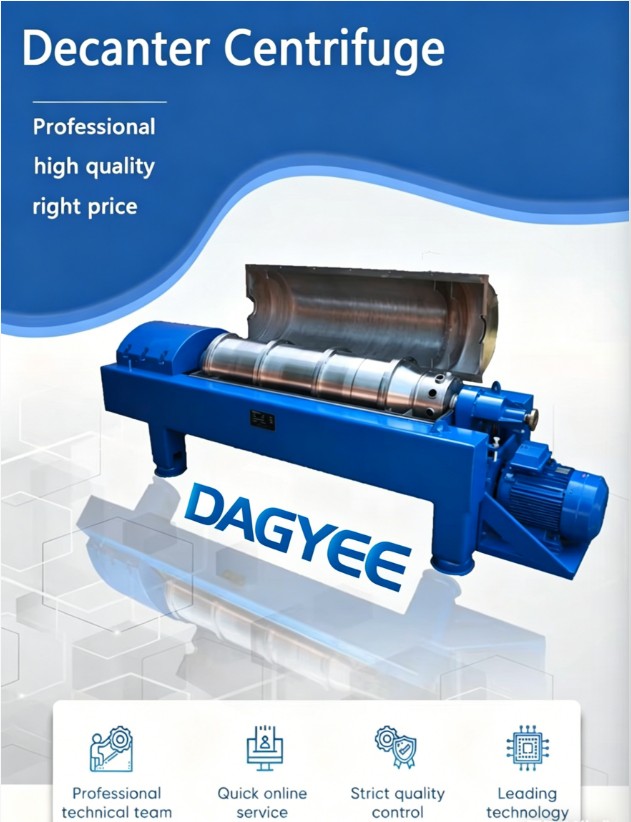
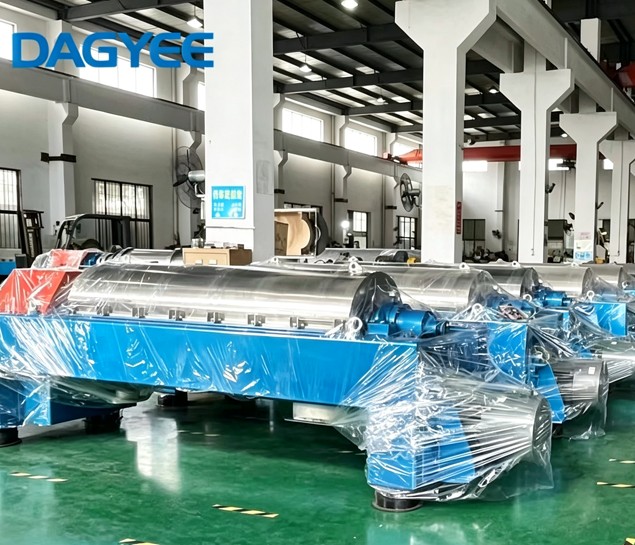
In recent years, more and more municipal WWTPs have been turning to decanter centrifuges. From large plants treating 300,000 m³/day to medium-sized facilities handling 100,000 m³/day, decanter centrifuges are becoming the standard equipment in sludge dewatering rooms.
1. What Makes Municipal Sludge So Difficult to Dewater?
Municipal sludge is notoriously difficult to treat. Excess activated sludge typically has a moisture content of 99.2%-99.8%, and even after thickening, it only drops to 96%-98%. The particles are fine, highly hydrophilic, and the colloidal structure is stable, making it difficult for traditional equipment to reduce moisture content below 85%.
Specifically, municipal sludge has several challenging characteristics:
Extracellular Polymeric Substances (EPS) encapsulation. The polysaccharides and proteins secreted by microorganisms form a dense colloidal network that traps large amounts of free water. Much of this water isn't just "in" the sludge — it's "locked" in the sludge, and conventional dewatering methods struggle to release it.
Fine particles. Most particles in the sludge are smaller than 10 microns, with poor settling characteristics. Organic content can reach 55%-75%, with high viscosity and a tendency to decompose. Traditional belt presses experience frequent filter cloth blinding as a result.
Seasonal fluctuations. Low winter temperatures reduce microbial activity, changing sludge characteristics and further increasing dewatering difficulty.
Large treatment volumes. Among municipal WWTPs with capacities above 10,000 m³/day, over 60% have adopted decanter centrifuges at scale, reflecting growing market recognition of this technology.
2. How Do Decanter Centrifuges Solve These Problems?
The fundamental difference between decanter centrifuges and belt or plate-and-frame presses is that centrifuges rely on sedimentation rather than filtration. Separation is achieved through centrifugal force, not by trapping solids on a filter cloth.
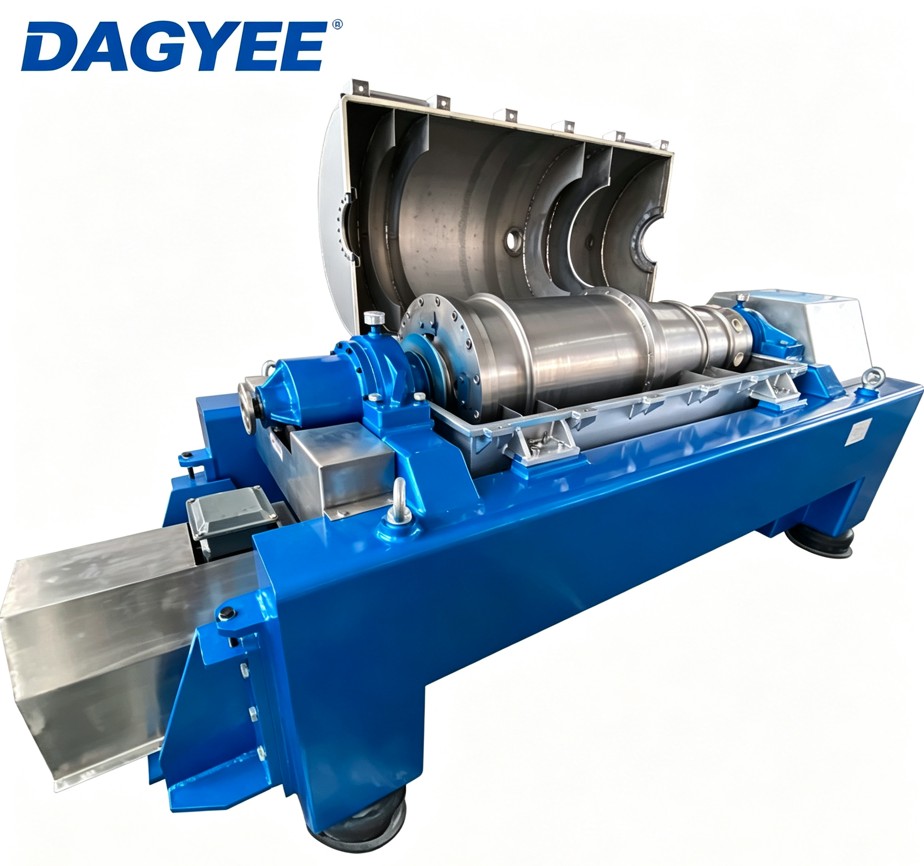
High length-to-diameter ratio bowl (L/D ≥ 4.0). Extends sludge retention time in the bowl, allowing flocs to fully settle and compact, effectively improving cake solids content. A higher L/D ratio means longer retention time and drier cake.
High G-force (≥ 3500G). Generates powerful centrifugal force that effectively breaks down EPS structures, releasing bound water and achieving deep dewatering. Actual operating data shows that large decanter centrifuges can reduce sludge cake moisture from 75%-80% down to 55%-58%, reducing annual sludge haulage volume by 40%.
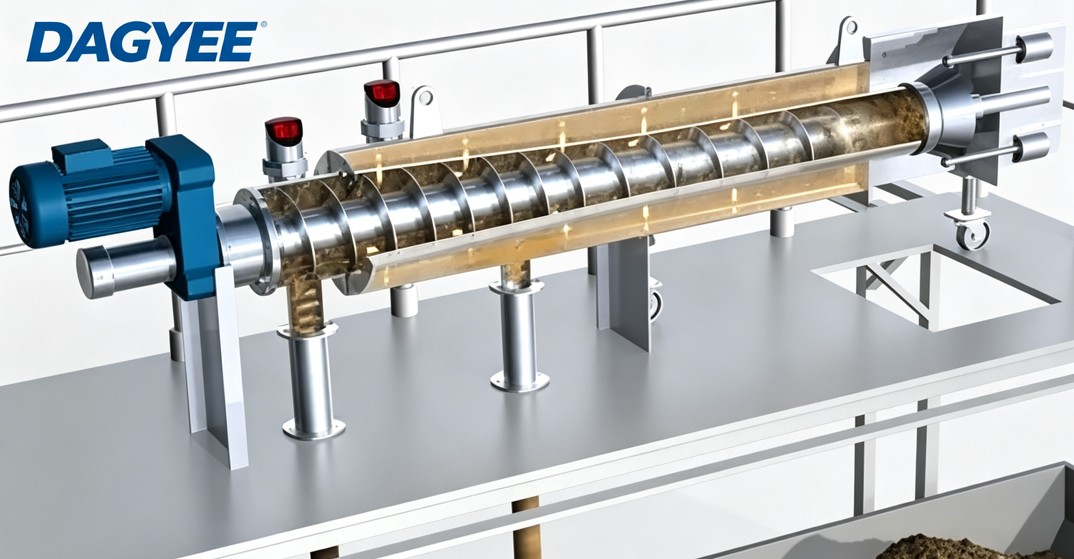
Wear-resistant and corrosion-resistant design. The bowl interior and screw flights are protected with tungsten carbide spray or hardfacing, achieving service life of over 20,000 hours for long-term municipal sludge operation.
3. DAGYEE LW Series Decanter Centrifuge Technical Specifications
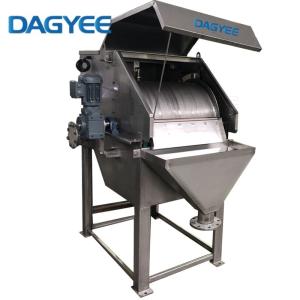
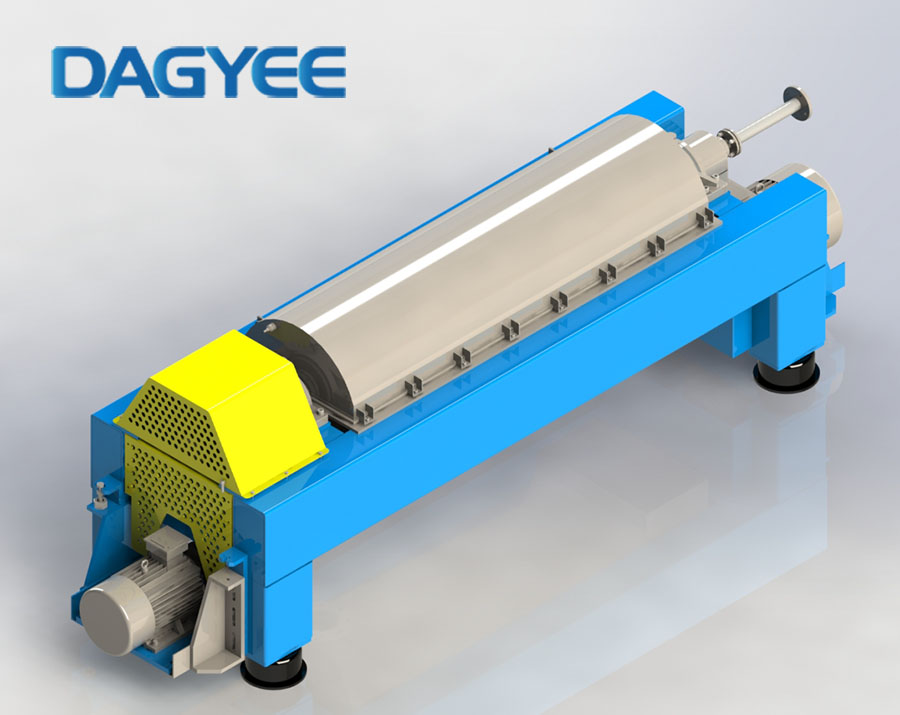
The DAGYEE LW Series decanter centrifuges are specifically designed for municipal sludge dewatering applications. Full technical specifications are as follows:
DAGYEE LW Series — Decanter Centrifuge Specifications
Municipal sludge dewatering — model selection and performance data
| Model | Bowl Dia. (mm) | Length (mm) | Max Speed (rpm) | Max G-Force (g) | Capacity (m³/h) | Main/Back Motor (kW) |
|---|---|---|---|---|---|---|
| LW250-900 | 250 | 900 | 5000 | 3500 | 0.5-3 | 11/5.5 |
| LW350-1500 | 350 | 1500 | 3800 | 2850 | 1-5 | 18.5/5.5 |
| LW400-1200 | 400 | 1200 | 3400 | 2581 | 1-8 | 22/7.5 |
| LW400-1600 | 400 | 1600 | 3400 | 2581 | 2-10 | 22/7.5 |
| LW400-1800 | 400 | 1800 | 3400 | 2581 | 2-12 | 22/7.5 |
| LW450-1800 | 450 | 1800 | 3200 | 2572 | 5-20 | 30/7.5 |
| LW450-2000 | 450 | 2000 | 3200 | 2572 | 5-25 | 30/7.5 |
| LW530-2280 | 530 | 2280 | 2800 | 2350 | 10-50 | 45/15 |
| LW600-2400 | 600 | 2400 | 2600 | 2265 | 15-65 | 55/18.5 |
| LW650-2600 | 650 | 2600 | 2400 | 2100 | 20-80 | 55/90 |
| LW720-2500 | 720 | 2500 | 2200 | 1950 | 25-90 | 75/90 |
| LW800-2560 | 800 | 2560 | 2000 | 1800 | 30-100 | 90/132 |
| LW800-3200 | 800 | 3200 | 2000 | 1800 | 30-110 | 90/132 |
| LW900-3200 | 900 | 3200 | 1800 | 1650 | 30-150 | 132/200 |
Note: The main motor drives the bowl; the back motor drives the screw conveyor. Dual-motor configuration enables stepless differential speed adjustment. For municipal sludge dewatering, models LW450-1800 and above with L/D ≥ 4.0 are generally recommended. Final selection should be based on actual sludge concentration and processing requirements.
4. Municipal Sludge Dewatering Selection Guide
Based on typical municipal WWTP operating conditions:
WWTP Retrofit — Performance Comparison
Belt filter press vs. decanter centrifuge
| Parameter | Before (Belt Press) | After (Decanter Centrifuge) |
|---|---|---|
| Feed moisture | 97.5% | 97.5% |
| Cake moisture | 82%-85% | 72%-75% |
| Daily throughput | ~40 tons DS | ~40 tons DS |
| Power consumption | ~8 kWh/t DS | ~5 kWh/t DS |
| Wash water | ~50 tons/day | ~5 tons/day |
| Cloth replacement | Every 2-3 months | No cloth |
| Daily runtime | 16 hours (batch) | 20 hours (continuous) |
| Operators | 2 per shift | 1 per shift (patrol) |
| Annual runtime | ~6,000 hours | 8,500 hours |
Key improvements: Cake moisture reduced by ~10%, power consumption down ~37%, wash water reduced 90%, cloth replacement eliminated, continuous operation achieved, labor reduced 50%, and annual runtime increased by 42%. Solids capture rate exceeded 98%.
5. Key Operating Parameters for Municipal Sludge Dewatering
Differential speed is the speed difference between the bowl and the screw conveyor, determining the solids discharge rate. Higher differential speed means shorter sludge retention time and higher cake moisture. Lower differential speed slows discharge and may cause plugging.
Test data shows that for low-concentration municipal sludge, differential speed of 3-6 r/min works best. As differential speed decreases, cake solids content increases, but further reduction beyond a certain point yields diminishing returns.
Feed concentration directly affects cake quality.
This is the "Achilles' heel" of municipal sludge dewatering — lower feed concentration means worse dewatering performance. When feed solids drop to 0.426%, cake solids drop to only 20.5%. If concentration falls below 0.4%, cake may not even reach 20% solids.
The solution is to install a thickener upstream of the centrifuge to increase feed solids. If feed solids can be raised to 3%-5%, cake solids can easily exceed 25%.
Flocculant selection and dosage.
Municipal sludge carries a negative charge, making cationic PAM the right choice, with molecular weights of 8-12 million typically working well. There is an "optimal dosage range" — more flocculant doesn't always mean better results. Test data shows that beyond a certain point, solids capture actually decreases with additional polymer.
6. Real-World Case Study: WWTP Retrofit
A municipal WWTP with a treatment capacity of 60,000 m³/day, serving approximately 400,000 people, was experiencing poor performance and high maintenance requirements with its existing belt filter press. The plant switched to a DAGYEE LW450-1800 decanter centrifuge in 2022.
Problems with the belt press.
During operation, cake moisture fluctuated between 82%-85%. Filter cloth required replacement every 2-3 months at a cost of approximately $1,000 per change. Wash water consumption was high at about 50 tons/day. Operators spent significant time adjusting tension and washing cloths — half a shift per day was spent on maintenance alone. Sludge haulage costs are charged by weight; each 1% increase in cake moisture adds approximately $8,000 per year in transportation costs.
Results after the upgrade.
WWTP Retrofit — Performance Comparison
Belt filter press vs. decanter centrifuge
| Parameter | Before (Belt Press) | After (Decanter Centrifuge) |
|---|---|---|
| Feed moisture | 97.5% | 97.5% |
| Cake moisture | 82%-85% | 72%-75% |
| Daily throughput | ~40 tons DS | ~40 tons DS |
| Power consumption | ~8 kWh/t DS | ~5 kWh/t DS |
| Wash water | ~50 tons/day | ~5 tons/day |
| Cloth replacement | Every 2-3 months | No cloth |
| Daily runtime | 16 hours (batch) | 20 hours (continuous) |
| Operators | 2 per shift | 1 per shift (patrol) |
| Annual runtime | ~6,000 hours | 8,500 hours |
Key improvements: Cake moisture reduced by ~10%, power consumption down ~37%, wash water reduced 90%, cloth replacement eliminated, continuous operation achieved, labor reduced 50%, annual runtime increased by 42%, solids capture rate exceeded 98%.
After the upgrade, cake moisture dropped from 82%-85% to a stable 72%-75%, reducing sludge volume by approximately 40%. Haulage trucks decreased from 12 to 7-8 per day, saving about $60,000 annually in transportation and disposal costs. Filter cloth, wash water, and labor savings totaled approximately $25,000 per year. Solids capture reached 98% or higher, with minimal solids loss in the centrate. The equipment ran smoothly with no unplanned shutdowns, and annual runtime increased from 6,000 to 8,500 hours.
Plant feedback: "Since switching to the centrifuge, we haven't had a single plant shutdown caused by dewatering equipment failure. Cake moisture is stable around 75%, and haulage and disposal costs are down significantly. One operator used to struggle with a single belt press; now the same person manages two centrifuges with time to spare."
7. DAGYEE Decanter Centrifuge Core Advantages
Engineering design that delivers measurable value
| Design Feature | Configuration | Customer Value |
|---|---|---|
| High G-force | Up to 3500G | Cake moisture as low as 55%-58% |
| High L/D ratio | L/D ≥ 4.0 | Extended retention time, drier cake |
| Dual-motor dual-VFD | Precise differential speed control | Adapts to concentration fluctuations, stable operation |
| Wear protection | Tungsten carbide hardfacing + alloy weld overlay | Screw flight life over 20,000 hours |
| Full automation | PLC + touchscreen | 24/7 unattended operation |
| Duplex stainless steel | Bowl made of 2205 duplex stainless steel | Corrosion-resistant, high strength, reliable long-term operation |
Built for performance: Every design feature in the DAGYEE LW Series is engineered to deliver lower cake moisture, higher reliability, and reduced operating costs for municipal sludge dewatering applications.
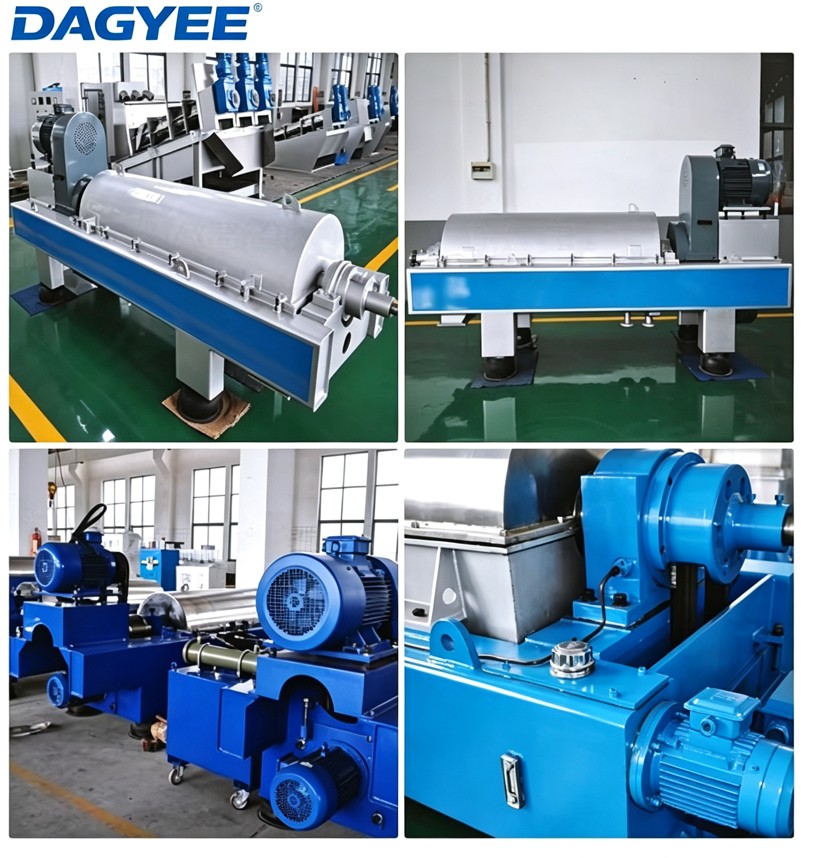
Decanter centrifuges aren't the only choice for municipal sludge dewatering, but for plants seeking "low energy, high dryness, full automation, and minimal maintenance," their combined advantages are hard to ignore.
Looking at equipment selection trends among municipal WWTPs with capacities above 10,000 m³/day, the adoption rate of decanter centrifuges continues to rise. It's not that they cost more than belt presses — it's that they deliver drier cake, more stable operation, and lower labor requirements.
DAGYEE — Municipal Sludge Dewatering Solutions
From primary sludge thickening, waste activated sludge deep dewatering, to digested sludge final treatment, DAGYEE offers a full range of decanter centrifuge solutions. The LW Series covers capacities from 0.5 m³/h to 150 m³/h to meet the needs of different plant sizes.
Need selection advice? Tell us your throughput, sludge type, and moisture requirements. We'll match the right model for your application.