QJB Mixer Model Code Decoder: Stop Guessing What 0.85/8-260/3-740 Means
QJB Submersible Mixer Model Code Explained: What Does 0.85/8-260/3-740 Actually Mean?
But here's the thing: once you understand what each part means, you'll never have to guess again. And more importantly, you'll know exactly what you're paying for.
So let's break it down.
1. What Does QJB Stand For?
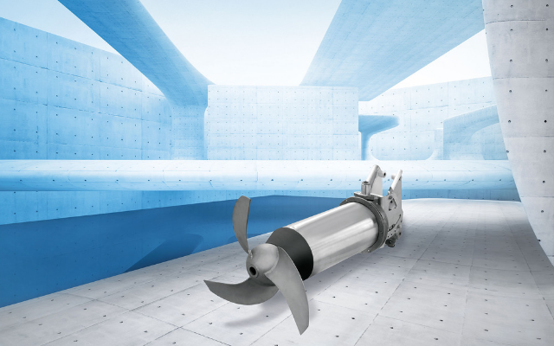
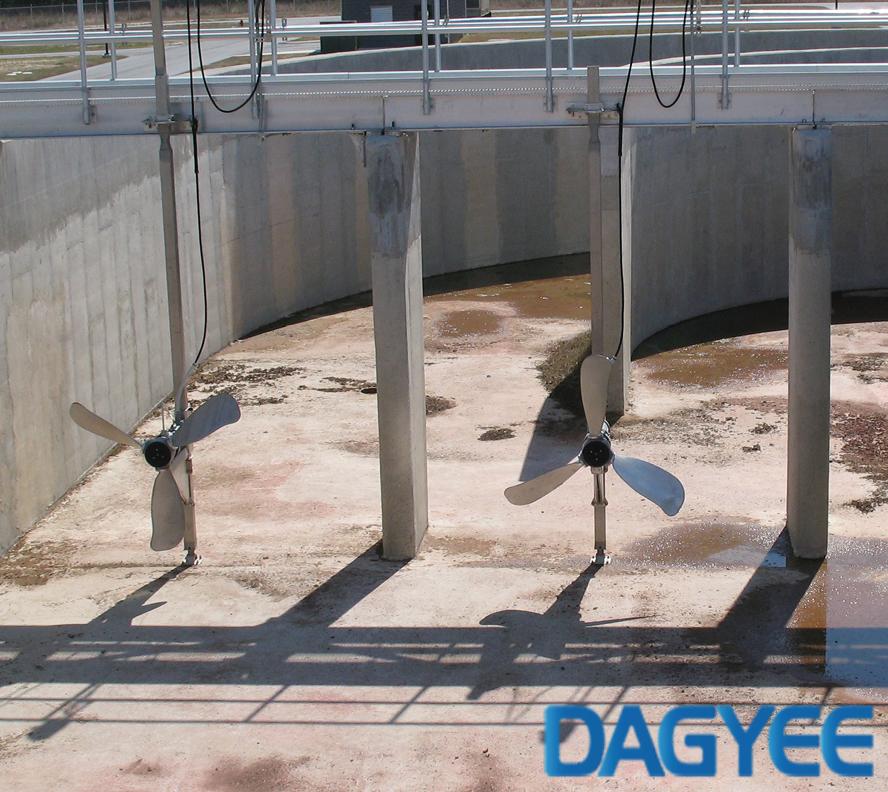
A submersible mixer does exactly what it sounds like: it runs underwater. You'll find them in wastewater treatment plants, industrial equalization tanks, biochemical tanks, and sludge holding tanks. Their job is to keep solids suspended, prevent sludge from settling into a hard cake at the bottom, and maintain even mixing of liquids and solids.
Depending on the model, they handle two different tasks:
• Mixing series — keeps particles suspended in the water column
• Low-speed flow series — pushes water across large areas to create circulation, often used in aeration tanks for nitrification and denitrification processes
Get this wrong during selection, and you'll end up with either a mixer that doesn't do the job or one that wastes energy. I've seen both.
2. Let's Crack the Code: QJB0.85/8-260/3-740
Here's what each piece means, plain and simple:
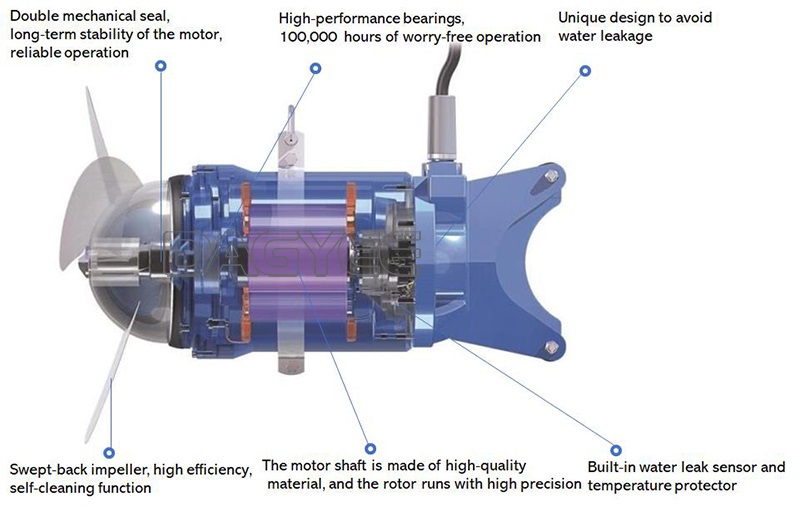
QJB Model Code Breakdown
| Code | Meaning | In This Example |
|---|---|---|
| QJB | Submersible Mixer | QJB = Submersible Mixer |
| 0.85 | Motor power (kW) | 0.85 = 0.85 kilowatts |
| 8 | Motor poles | 8 = 8-pole motor |
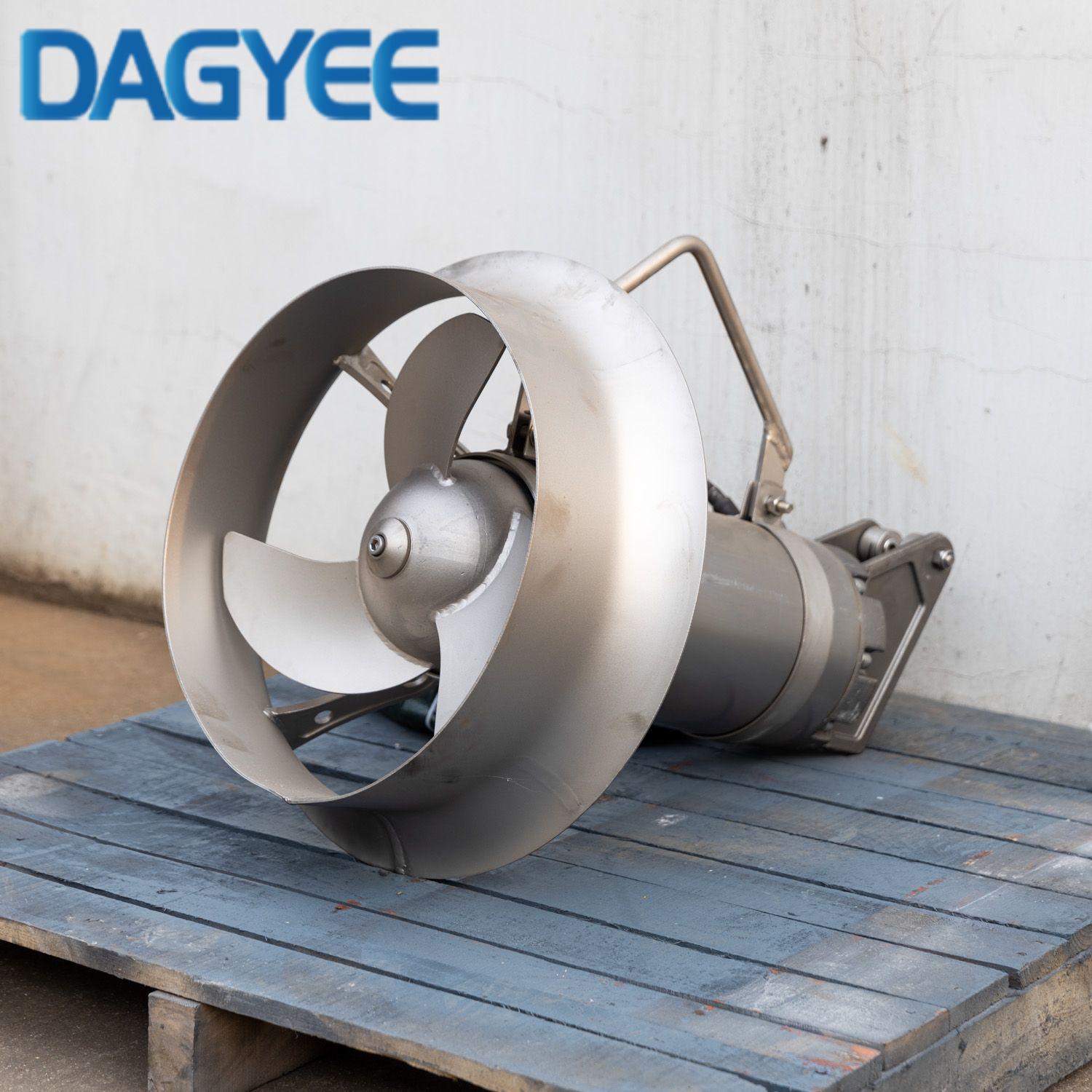
| 260 | Impeller diameter (mm) | 260 = 260mm across |
| 3 | Number of blades | 3 = 3 blades on the impeller |
| 740 | Rated speed (r/min) | 740 = 740 revolutions per minute |
And if you see an extra letter at the end, like /C, /S, or /P, that tells you the material:
Suffix Material When to Use
C Cast Iron Standard municipal wastewater, neutral pH, no corrosion
S Stainless Steel (SUS304 or SUS316L) Chemical, chlorinated, or corrosive wastewater
P Polyurethane Large impellers for low-speed flow, good wear resistance
Material choice is where a lot of buyers trip up. I've seen people spec stainless steel for a standard municipal plant — wasted money. I've also seen cast iron used in a chemical plant — the mixer was gone in 18 months. Match the material to the job.
3. SMB Series Specs: Real Numbers, Real Choices
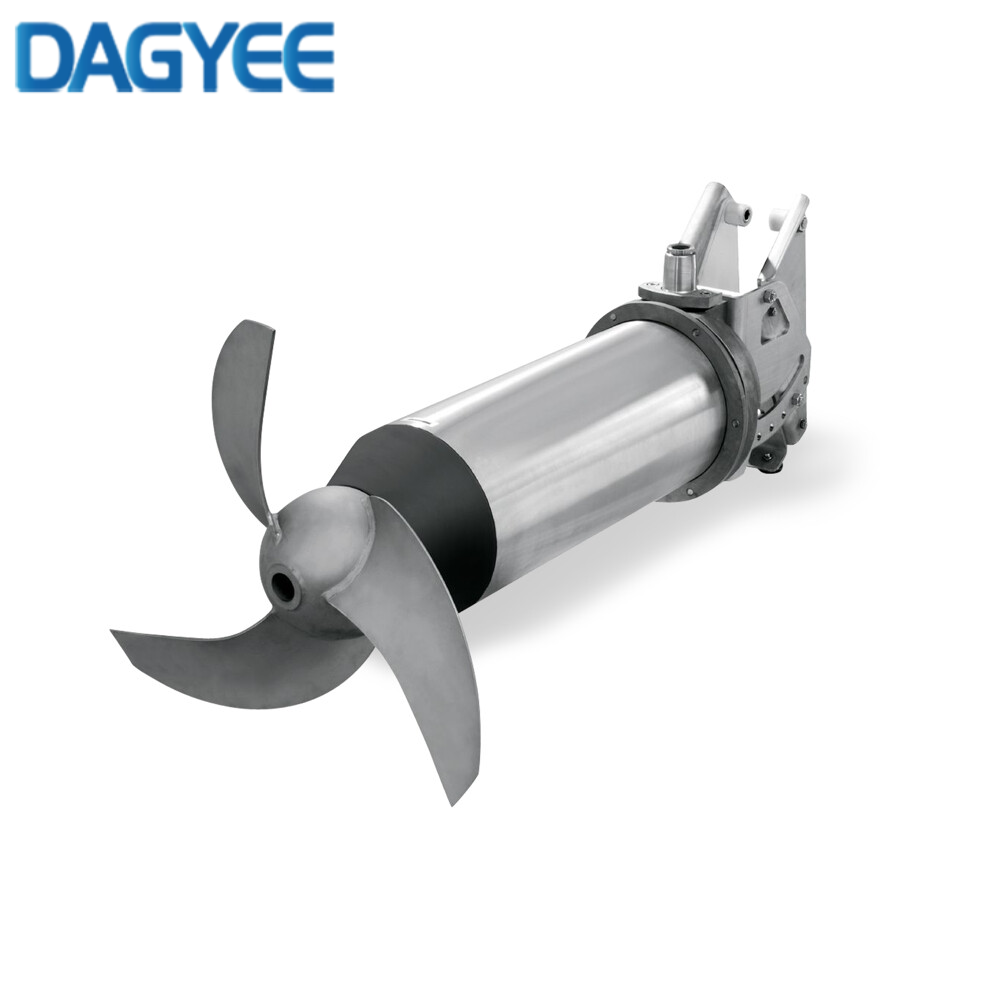
SMB Series · Technical Specifications
| Model | Power (kW) | Current (A) | Speed (rpm) | Impeller (mm) | Thrust (N) | Weight (kg) |
|---|---|---|---|---|---|---|
| SMB0.85/8-260/3-740/C/S | 0.85 | 3.4 | 740 | 260 | 163 | 55/58 |
| SMB1.5/6-260/3-980/C/S | 1.5 | 4.4 | 980 | 260 | 290 | 55/58 |
| SMB2.2/8-320/3-740/C/S | 2.2 | 5.9 | 740 | 320 | 582 | 74/77 |
| SMB4/6-320/3-980/C/S | 4 | 10.8 | 980 | 320 | 609 | 74/77 |
| SMB1.5/8-400/3-740/S | 1.5 | 5.6 | 740 | 400 | 382 | 76/80 |
| SMB2.5/8-400/3-740/S | 2.5 | 7.3 | 740 | 400 | 575 | 76/80 |
| SMB3/8-400/3-740/S | 3 | 8.6 | 740 | 400 | 642 | 78/82 |
| SMB4/6-400/3-980/S | 4 | 10.3 | 980 | 400 | 1010 | 80/84 |
| SMB4/12-620/3-480/S | 4 | 14 | 480 | 620 | 1230 | 240/245 |
| SMB5/12-620/3-480/S | 5 | 18.2 | 480 | 620 | 1420 | 240/245 |
| SMB7.5/12-620/3-480/S | 7.5 | 28 | 480 | 620 | 1963 | 255/270 |
| SMB10/12-620/3-480/S | 10 | 32 | 480 | 620 | 2361 | 255/270 |
I've handed this table to customers before, and they often stare at it like it's in a foreign language. So let me walk you through the takeaways — these are the things I wish someone had told me years ago.
Rule 1: Bigger impeller means more thrust (and it's not linear)
Look at SMB0.85/8-260 and SMB2.2/8-320. Both run at 740 rpm. Bumping the impeller from 260mm to 320mm jumps thrust from 163N to 582N — more than triple. If your media is thick or has high solids content, go for the bigger impeller. You'll get way more mixing power for a modest increase in horsepower.
Rule 2: Speed isn't everything
Compare SMB4/6-400 (980 rpm) and SMB4/12-620 (480 rpm). Both are 4kW.
The first one spins fast with a smaller impeller. That's for mixing — breaking up solids and keeping them suspended. The second spins slow with a big impeller. That's for pushing water across a whole tank. Same power, completely different jobs. Pick the wrong one and you'll either churn water uselessly or fail to keep solids from settling.
Rule 3: Same frame, different guts
SMB4/6-320 and SMB2.2/8-320 both use the 320mm impeller. But one runs 4kW, the other 2.2kW. This lets you dial in the power you actually need without paying for a whole different chassis.
Rule 4: Material choice affects weight (and price)
Cast iron vs stainless — the weight difference is small, but the cost difference isn't. Stainless costs more upfront. But if your media is corrosive, it'll outlast cast iron many times over. I've seen plants replace cast iron units every two years while stainless runs for a decade. Do the math on that one.
5. Power and Poles: What Really Matters
Pole count is where people get confused. More poles means slower speed and more torque. Here's the short version:
Motor Poles Selection Guide
| Poles | Speed | Best Use |
|---|---|---|
| 6-pole | ~980 rpm | Faster mixing, smaller tanks |
| 8-pole | ~740 rpm | Sweet spot — most common, balanced performance |
| 12-pole | ~480 rpm | Slow, high torque — great for pushing water across big tanks |
6. A Real Example: The Mexico Export Order
Here's what they needed:
• SUS316L stainless steel on every wetted part: shaft, impeller, fasteners, hub, guide cone. Not just the shell — everything.
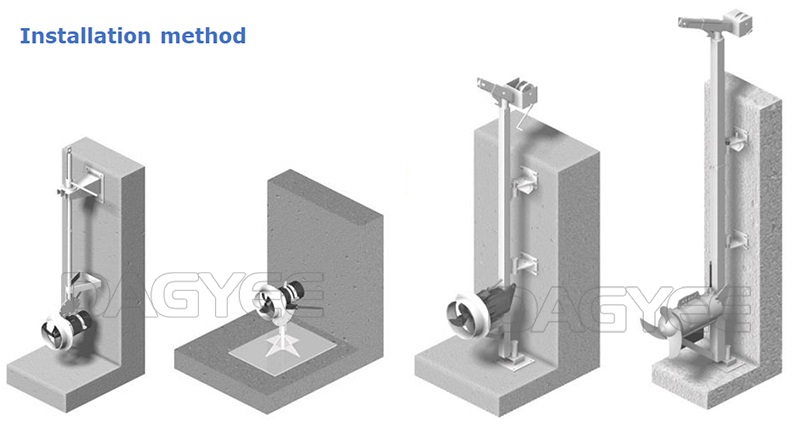
• Guide-rail lifting system for maintenance without entering the tank
• 480V / 60Hz / 3-phase power (Mexico standard)
Small order. One unit. But every detail mattered. That's what we mean when we say "customized to your application." It's not about being the cheapest on the list. It's about getting the right unit for the job.
7. The One Rule You Need to Remember: 0.15–0.3 m/s Flow Velocity
For effective mixing, you need flow velocity between 0.15 and 0.3 m/s in the tank.
Drop below 0.15 m/s and you'll get dead zones — solids will settle out, sludge will accumulate, and you'll be sending someone in with a hose to clean it out.
Push above 0.3 m/s and you're just wasting energy and potentially disrupting biological processes.
So when you're sizing a mixer, you're really trying to hit that velocity range for your specific tank volume and geometry.
1. What's the application? Mixing or flow generation? This decides the speed and impeller style.
2. What are the tank dimensions? Shape, width, length, water depth. Bigger tanks need more thrust.
3. What's in the water? Solids content, viscosity, temperature, pH. Standard units handle pH 5-9, temps up to 40°C. Go beyond that and you need custom materials.
Standard operating limits for QJB mixers:
• Temperature: ≤40°C
• pH range: 5–9
• Liquid density: ≤1150 kg/m³
• Max submergence depth: 20m
Outside these, talk to us before buying. We've built units for all kinds of non-standard conditions — high-temp, low-pH, abrasive slurries. It's not a problem. It just needs to be spec'd correctly from the start.
8. Three Mistakes I See All the Time
SMB4/12-620 (4kW) produces 1230N. SMB4/6-400 (4kW) produces 1010N. Same power, but one gives you 20% more thrust. So if you just compare kW, you might pick the wrong machine. Match the thrust to the job.
Mistake #2: "Stainless is always overkill"
It is for municipal wastewater. It's not for chemical, paint line, or chlorinated water. I've seen carbon steel units rot out in a year in the wrong environment. Pay a bit more upfront or pay a lot more later.
Mistake #3: "One mixer is enough"
For large tanks, one unit won't cut it. You need multiple mixers in the right positions. The placement matters as much as the model selection — angle, depth, spacing between units. We help customers with this all the time.
9. What DAGYEE Does Differently
Material choices that make sense — We offer standard cast iron and stainless. But we also do full SUS316L on every wetted part — not just the shaft, but impeller, fasteners, hub, guide cone — when the job calls for it. We don't try to upsell you. We recommend what fits.
Complete mounting systems — Guide rails, winches, stainless cables, lifting frames. We supply the whole package. Maintenance can be done from above — no one has to climb into the tank.
International voltage compliance — We build units for 480V/60Hz for North American projects. It's not an afterthought; it's designed in.
No guesswork in selection — We ask about your tank, your media, your process conditions. Then we run the numbers and recommend a specific model — not the one we happen to have in stock, but the one that actually works for your site.
Summary
QJB model codes follow a consistent pattern. Once you learn it, you can read any manufacturer's spec sheet:
And if you need something outside the standard box — different material, different voltage, different mounting — that's where we come in.
DAGYEE — Submersible Mixers Built for Your Application
Need a hand selecting the right model? Send us your tank dimensions, media type, and operating conditions. We'll run the numbers and recommend a specific unit — no obligation, just advice.