Screw Sludge Dewatering Machine Selection Guide: Models, Costs, and Performance Data
screw sludge dewatering machine: A Practical Guide to Low-Clog, Cost-Effective Sludge Treatment
Sludge disposal keeps getting more expensive. Whether you run a municipal wastewater plant, a food processing facility, a textile mill, or a livestock farm, getting rid of sludge eats up a growing chunk of your operating budget.
Traditional dewatering equipment all come with their own set of headaches. Belt filter presses clog constantly. Plate-and-frame units are labor-intensive and run in batches. Centrifuges chew through electricity and wear parts quickly. None of them make life easy for the people who have to keep them running.
Over the past ten years, screw sludge dewatering machines — particularly the stacked screw design — have gained serious traction. They've replaced older equipment in everything from small containerized treatment units to large industrial wastewater lines. Field tests and peer-reviewed studies show that properly configured screw presses can cut polymer use by 12–25%, slash daily maintenance time by over 70%, and produce stable cake solids between 17% and 21% even under 24/7 operation.
This guide pulls together data from MDPI environmental research, ETH Zurich design papers, and full-scale municipal plant case studies from Deswater. We'll walk through how these machines work, what the specs mean, how they compare to other options, and what actually happens when you install one in a real plant. If you're specifying equipment for a new project or trying to fix an existing dewatering line, this should give you a solid starting point.
How a Screw Sludge Dewatering Machine Actually Works
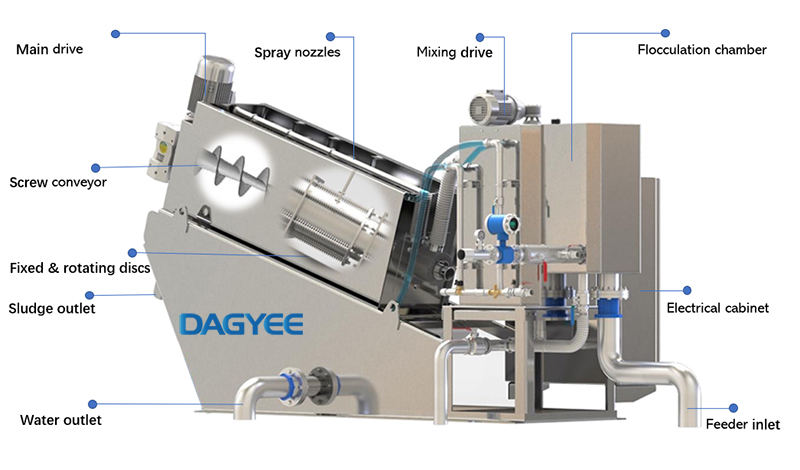
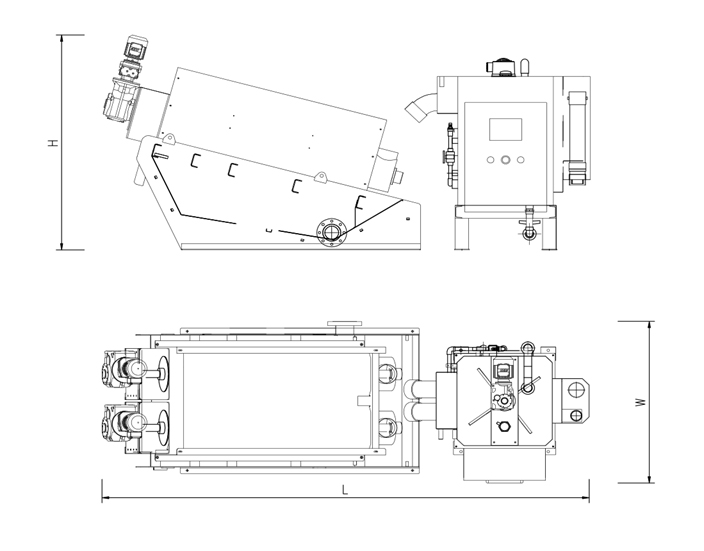
A stacked screw dewatering machine uses four main components to separate solids from liquids: a variable-pitch screw shaft, a set of stacked rings (both moving and stationary), an adjustable back-pressure plate, and a flocculation mixing tank. Unlike belt presses that rely on filter cloth, the stacked ring design uses small gaps between rings as the filtration medium. This eliminates the clogging problems that plague cloth-based systems, especially when dealing with fine organic sludges like activated sludge or food waste.
The screw shaft has a pitch that gradually decreases from the feed end to the discharge end. As flocculated sludge moves forward along the rotating screw, the available space shrinks, building up pressure that squeezes water out of the sludge flocs. The water passes through the gaps between the rings, while the solids continue forward toward the discharge port. The back-pressure plate at the outlet lets you control internal resistance — tightening it increases cake dryness, loosening it boosts throughput.
The Four-Stage Process
- Flocculation mixing: Polymer solution mixes with incoming sludge in the pre-mixing chamber. Good flocculation turns scattered particles into large, permeable flocs. Poor flocculation, on the other hand, sends turbidity through the roof and drops dewatering efficiency by about 30%.
- Gravity thickening: The flocculated sludge enters the front section of the screw chamber. A lot of free water drains off here before mechanical compression even starts, which reduces the load on the rest of the system.
- Screw compression: The decreasing pitch of the screw generates progressively higher pressure. Water drains through the ring gaps as the screw rotates.
- Cake discharge: The back-pressure plate sets the final compression level, squeezing out bound water and producing a dry cake ready for hauling, incineration, or land application.
Centrifuges shear sludge flocs with high-speed rotation, which actually increases chemical consumption. Plate-and-frame presses need constant cloth washing and can't run unattended. Belt presses are prone to blinding and require regular babysitting.
Screw presses run at low speed — typically 10–35 RPM — so they don't break up flocs. They clean themselves as they run, and they'll keep going around the clock without anyone standing over them.
Standard Technical Specifications
The table below covers standard DL series models — these are the ones you'll see in most municipal and industrial installations.
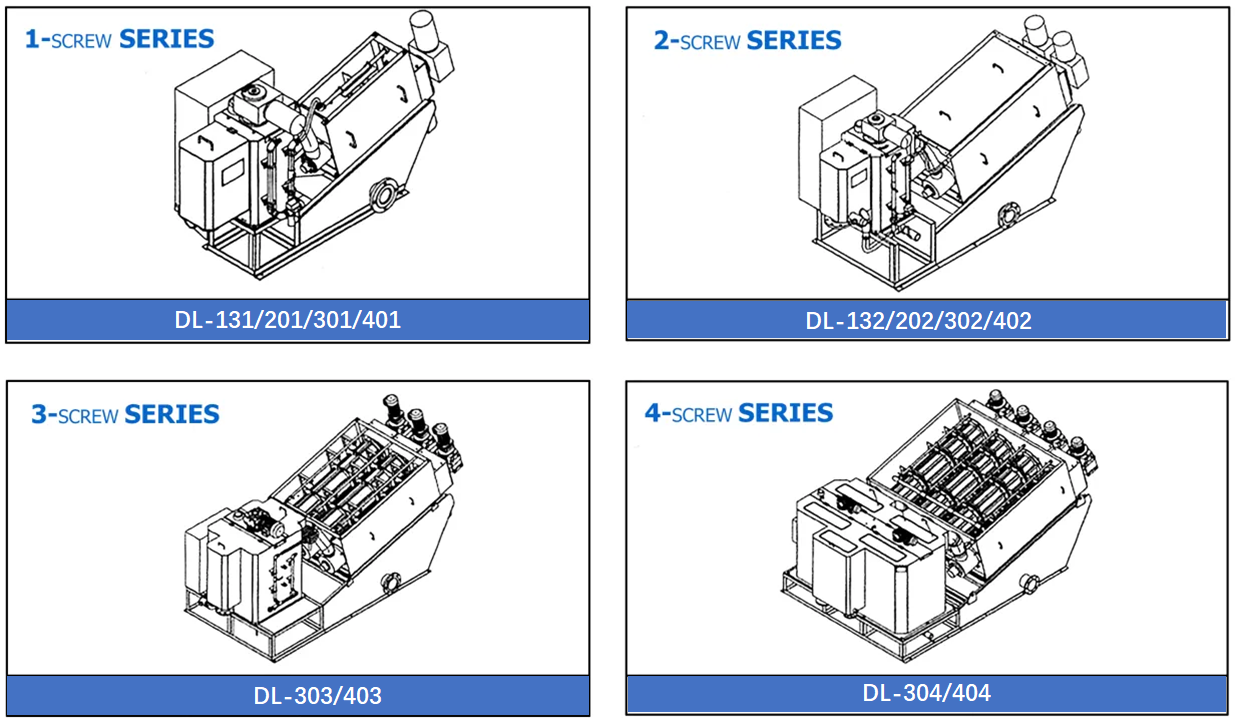
DL Series — Technical Specifications
Screw sludge dewatering machine — standard model parameters for reference
| Model | DS Capacity (kg/h) | Spiral Dia. (mm) | Discharge Dist. (mm) | Dimensions (mm) | Net Weight (kg) | Running Weight (kg) | Power (kW) | Wash Water (L/h) | |||
|---|---|---|---|---|---|---|---|---|---|---|---|
| Min | Max | L | W | H | |||||||
| DL202 | 18 | 30 | 200×2 | 350 | 2500 | 935 | 1270 | 470 | 730 | 1.11 | 64 |
| DL301 | 30 | 50 | 310×1 | 495 | 3255 | 985 | 1600 | 850 | 1320 | 0.74 | 40 |
| DL302 | 60 | 100 | 310×2 | 495 | 3455 | 1295 | 1600 | 1200 | 2230 | 1.11 | 80 |
| DL303 | 90 | 150 | 310×3 | 495 | 3605 | 1690 | 1600 | 1520 | 3080 | 1.86 | 120 |
| DL352 | 120 | 200 | 350×2 | 580 | 4240 | 1550 | 2190 | 1950 | 3400 | 3.75 | 144 |
| DL353 | 180 | 300 | 350×3 | 580 | 4460 | 2100 | 2190 | 2600 | 4850 | 6 | 216 |
| DL402 | 120 | 200 | 410×2 | 585 | 4140 | 1550 | 2250 | 2450 | 3400 | 3.75 | 144 |
| DL403 | 180 | 300 | 410×3 | 585 | 4420 | 2100 | 2250 | 3350 | 4850 | 6 | 216 |
Note: DS = Dry Solids. Specifications are for reference only — consult factory drawings for final dimensions. For custom models or special material requirements (316L stainless steel, higher capacity), contact DAGYEE sales team for a tailored quote.
- Polymer dosing numbers in the spec sheets assume medium organic activated sludge. Livestock manure will need 15–30% more polymer.
- If your feed sludge drops below 0.8% solids, put a gravity thickener upstream. Otherwise, dewatering performance will be uneven.
- Cake dryness depends on coordinating screw speed and back-pressure. Tuning just one parameter won't get you there.
How It Compares to Other Equipment
Equipment Performance & Operation Cost Comparison
Cross-category comparison of four dewatering technologies
| Metric | Stacked Screw Press | Decanter Centrifuge | Belt Filter Press | Plate-and-Frame Press |
|---|---|---|---|---|
| Operation mode | 24/7 unattended | 24/7, noisy | Semi-continuous | Batch only |
| Clogging risk | Very low (self-cleaning) | Medium (shear damage) | High (cloth blinding) | Very high (residue buildup) |
| Daily maintenance time | 0.3–0.8 hrs | 1.5–2.2 hrs | 2.5–4 hrs | 4–6 hrs |
| Power use per m³ (kWh) | 0.6–1.1 | 2.2–3.5 | 1.3–1.9 | 1.0–1.5 |
| Polymer use (relative) | 100% | ~122% | ~116% | ~108% |
| Floor space | Small | Medium | Large | Extra large |
| Upfront cost | Medium-low | High | Medium-high | Medium |
| Best for | Organics, manure, food waste | High-density inorganic sludge | Medium-concentration municipal | Industrial sludge, low organics |
| Long-term running cost | Lowest | Highest | Medium-high | Medium |
Source: Deswater 2026 full-scale municipal plant monitoring. Plants running screw presses reported annual savings between $7,200 and $24,500 depending on daily sludge
Which Model for Which Job?
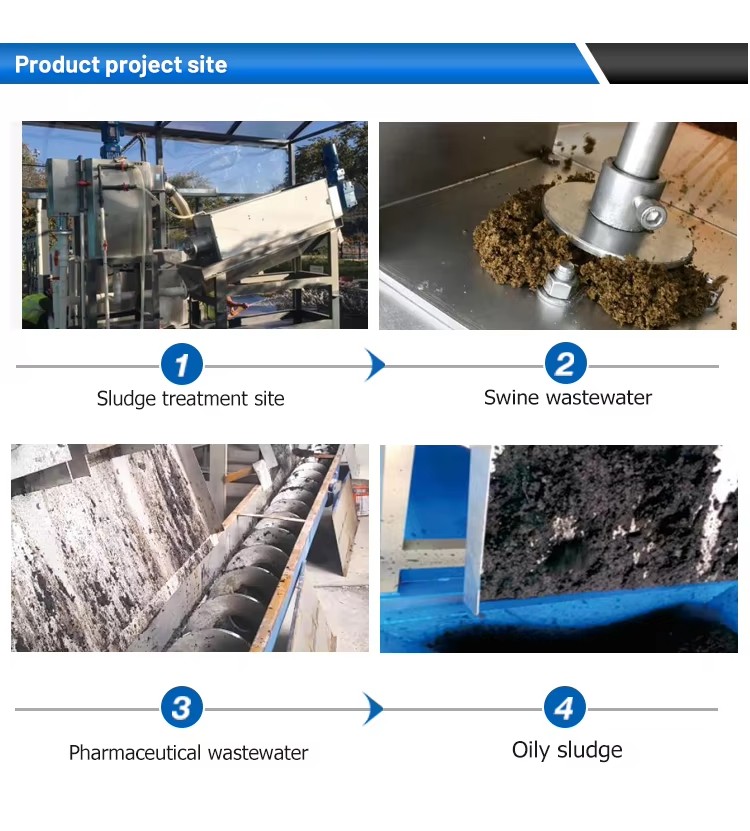
Industrial Application & Model Selection Guide
Match the right dewatering model to your industry and sludge type
| Application | Typical Feed Sludge | Recommended Model | Expected Cake Solids | Additional Equipment |
|---|---|---|---|---|
| Municipal WWTP | Activated sludge, 0.8–3.5% TS | DL301 / DL303 | 18–20% | Polymer dosing unit, sludge tank |
| Livestock farm | High-fiber organic, low solids | DL202 | 17–19% | Pre-screen for straw/debris |
| Food/beverage plant | High oil/protein, fragile flocs | DL303 / DL402 | 18.5–20.5% | Heated polymer tank |
| Textile mill | Fine dye particles, turbid filtrate | DL303 / DL402 | 19–21% | Two-stage flocculation |
| Containerized plant | Small volume, tight space | DL202 | 17.5–19.5% | All-in-one flocculation + dewatering |
| Chemical park | Mixed inorganic/organic, high volume | DL402 / DL403 | 19.5–21.5% | Thickener + homogenization tank |
Note: Expected cake solids are typical values based on municipal activated sludge. Actual results depend on feed concentration, polymer type, and screw speed/backpressure tuning. Contact DAGYEE for site-specific recommendations.
The Three Things That Actually Matter for Performance
Published data from 2023 MDPI studies shows that three variables drive most of the difference between good and bad dewatering results: screw speed, back-pressure setting, and flocculation quality. A lot of operators adjust only one thing and wonder why performance stays uneven.
Screw Speed
Running the screw at 10–20 RPM keeps sludge in the compression zone longer, which makes the cake drier. The trade-off is lower throughput. For fibrous sludges like livestock manure, stick to 12–18 RPM to prioritize dryness. For municipal plants that need to move volume, 25–32 RPM gives you more output — expect to lose about 1–1.5% solids content.
One thing to watch: CFD flow modeling shows that speeds above 35 RPM create turbulence between the rings, which breaks up flocs and increases solids loss in the filtrate by over 28%. Unless you have upstream thickening, don't run it that fast.
Back-Pressure
The back-pressure plate sets the internal chamber pressure. For typical municipal activated sludge, 5 kPa is a good starting point. Crank it up to 7–9 kPa and you'll gain 1–2% cake solids — but the motor will work harder and the rings will wear faster. For abrasive sludges that contain sand or metal particles, running high pressure for extended periods can shorten ring life by roughly 40%.
Feed Concentration and Flocculation
If your feed solids drop below 1%, the gravity zone won't remove enough free water. The compression section gets overloaded and you end up with wet, weak cake. If you can't fit a thickener on site, recirculating some sludge back to the mixing tank can help boost incoming concentration.
Polymer mixing matters too. Poor mixing means uneven floc sizes, which causes fluctuating filtrate quality. A continuous dilution and stirring system isn't optional — it's essential for stable long-term performance.
Real-World Example: A 22,000 m³/Day Municipal Plant
This case comes from Deswater's 2022 full-scale study of a mid-sized municipal plant handling about 22,000 m³ of domestic wastewater per day. Before the upgrade, the plant ran two belt filter presses. They needed two full-time maintenance staff just for cloth washing and daily checks. Power consumption was 1.7 kWh per cubic meter of sludge, and polymer use ran at 14.2 g per kg of dry solids. Cake solids hung around 14–16%, which meant extra drying before it could go to landfill.
After switching to a DL303 screw press with an automated polymer system, things changed within the first month:
- Maintenance went from two full-time people to a part-time daily inspection — about 30 minutes per shift.
- Power consumption dropped to 0.92 kWh/m³, saving roughly $1,180 per month in electricity.
- Polymer use fell to 10.4 g per kg of dry solids — a 27% reduction in chemical costs.
- Cake solids stabilized at 18.8–20.2%, which eliminated the need for secondary drying and cut hauling weight by nearly 22%.
- No clogging or emergency shutdowns over 12 months of continuous operation.
Simple Tuning Tips That Don't Cost Money
Based on pilot-scale work from ETH Zurich, here are a few adjustments you can make without buying new equipment:
- Match polymer type to the sludge. High-organic activated sludge does well with medium-anionic polymers. Fibrous livestock manure needs higher molecular weight flocculants to form flocs that can survive the screw chamber.
- Keep the feed rate steady. Sudden surges or drops break the flocculation balance. A buffer tank upstream smooths out the peaks and valleys.
- Run a light wash cycle once per shift. Five to ten minutes of clean water through the filtrate channel clears out fine particles that can gradually clog the ring gaps.
- Adjust for winter conditions. Cold water slows polymer dissolution and weakens flocs. Warm the polymer mixing tank by 8–12°C and slow the screw down slightly during cold months.
- Check ring wear every quarter. Uneven wear creates larger gaps that let fine solids escape into the filtrate. Replacing heavily worn rings restores original performance.
So, Is a Screw Press Right for You?
Screw sludge dewatering machines — especially the stacked ring configuration — fill a real need for plants that want low-maintenance, energy-efficient, continuous solids separation. Compared to belt presses, centrifuges, and plate-and-frame units, the screw press stands out for its anti-clog design, low labor demand, and consistent cake solids across most organic sludge types.
From small containerized units for remote sites to large municipal plants handling tens of thousands of cubic meters per day, there's a screw press model that fits the job. The tables and comparison charts in this guide give you a data-driven starting point for your equipment evaluation.
If you're dealing with frequent cloth blockages, high chemical costs, too much maintenance labor, or limited floor space, it's worth taking a look at a stacked screw dewatering machine. Our engineering team can run capacity calculations, match parameters to your specific sludge, and lay out a plan tailored to your target cake dryness. Reach out for a customized proposal with full cost projections for your facility.

Related News