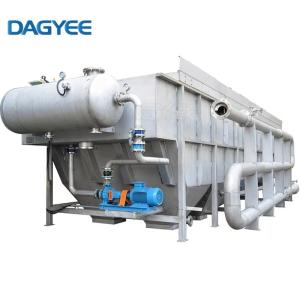
DAF Unit Troubleshooting: 9 Common Problems and Solutions for Cloudy Effluent and Poor Air Dissolution
DAF Unit Producing Cloudy Effluent? Poor Dissolved Air Performance? You Might Have These 9 Problems
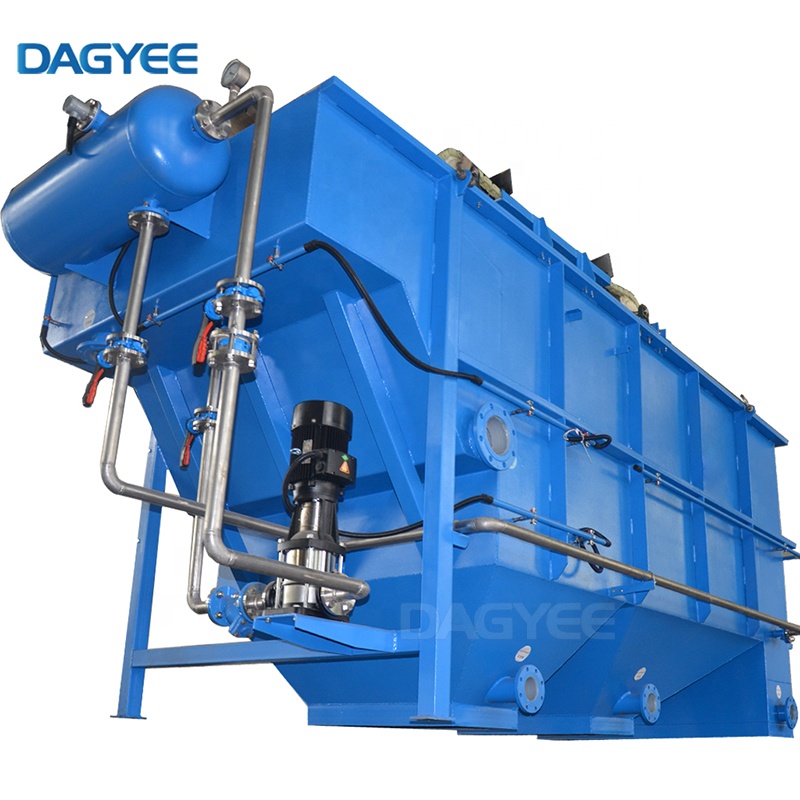
Introduction: Common Headaches with DAF Units
Cloudy effluent. Poor dissolved air performance. Uneven sludge blanket. Skimmer not working right.
These problems may seem minor, but if left unaddressed, they can lead to permit violations, fines, and even complete system shutdown.
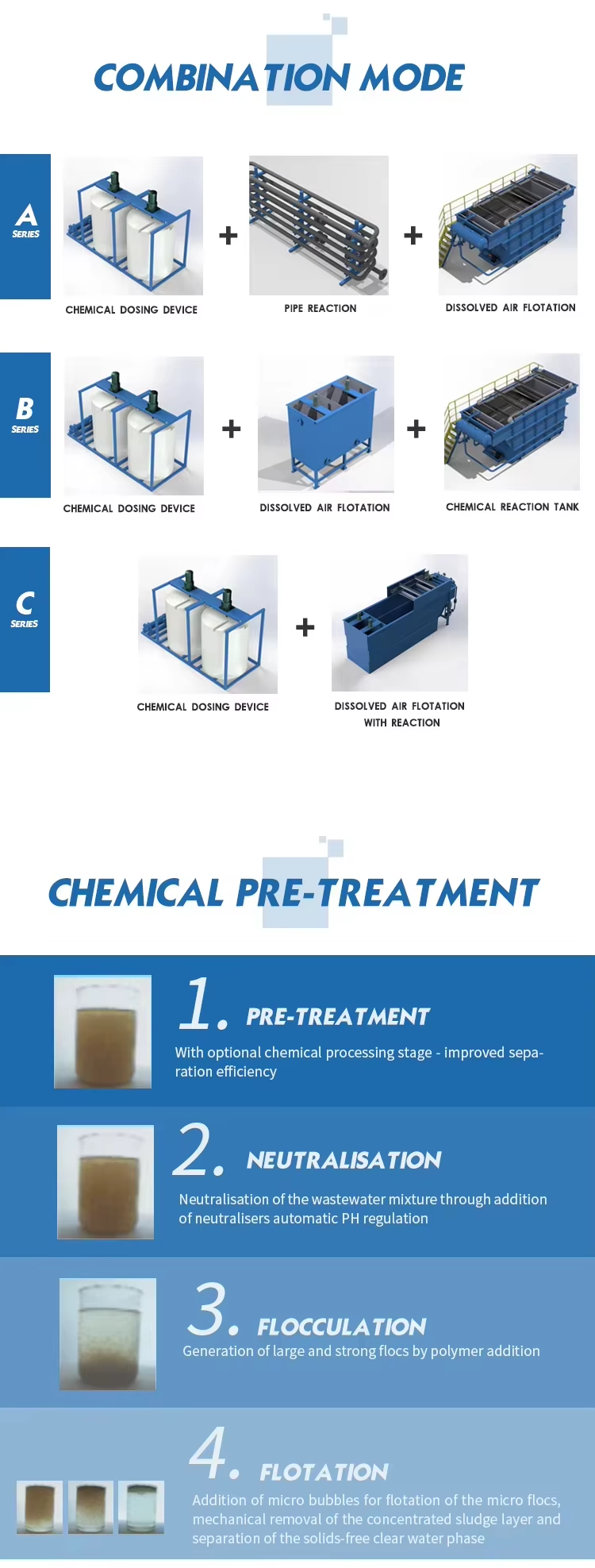
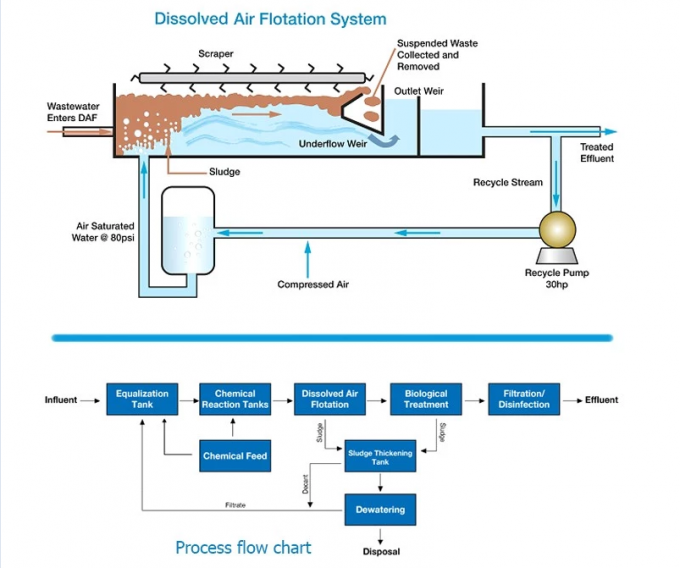
A DAF unit looks simple, but there are many factors that affect its performance — chemical dosing, dissolved air pressure, release valve condition, skimmer frequency, sludge discharge schedule. Any one of them out of adjustment can cause trouble.
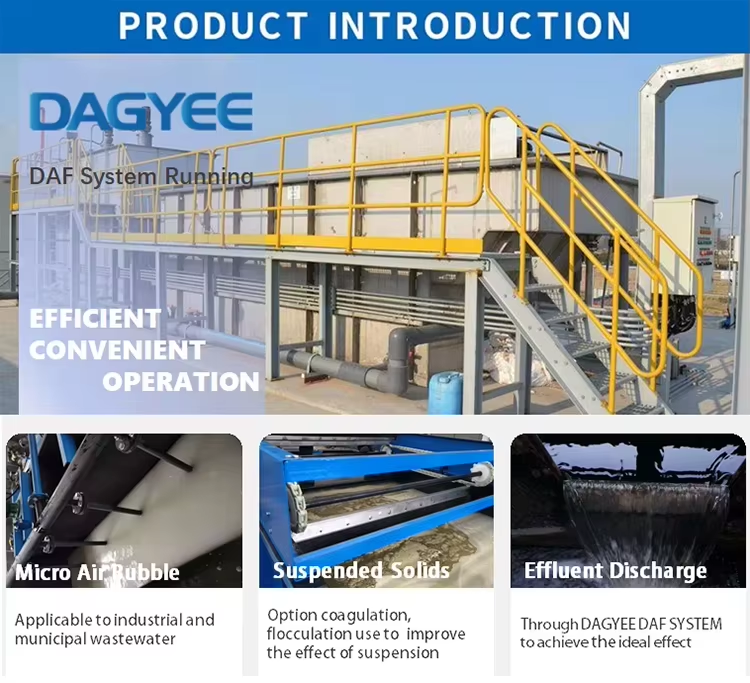
This article covers the nine most common DAF problems and how to fix them. There is also a DAGYEE DAF selection guide at the end to help you choose the right model for your application.
1. Cloudy Effluent / High Suspended Solids
This is the most common complaint and the one regulators look at first. Cloudy effluent can upset downstream biological treatment and cause permit violations.
Symptoms: Visible solids in effluent, loose flocs that do not hold together, bubbles not sticking to flocs.
Causes:
• Low dissolved air efficiency, poor bubble quality
• Wrong flocculant type or dosage
• pH out of optimal range
Solutions:
• Check dissolved air system, ensure efficiency ≥80%
• Run jar tests to find optimal PAC and PAM dosages (PAC typically 50-200mg/L)
• Adjust influent pH to 6.5-7.5
• Increase chemical dosage when water temperature drops below 10°C
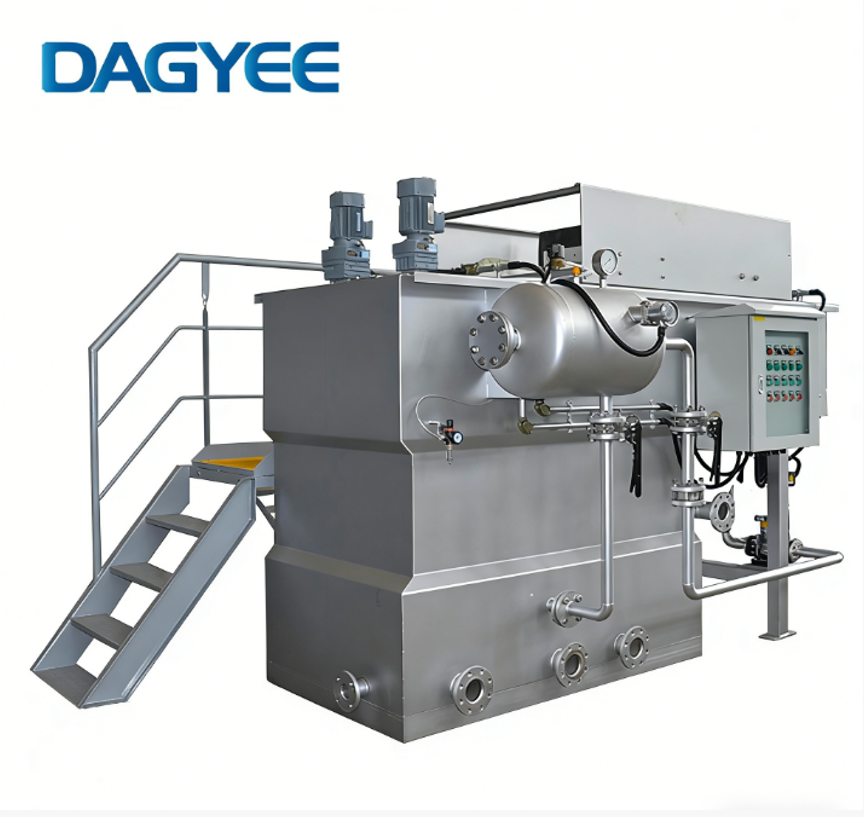
DAGYEE Suggestion: DAGYEE DAF units come with online pH monitoring and automatic chemical dosing systems that adjust dosage based on incoming water quality.
Symptoms: Flow rate exceeds design capacity, short retention time, flocs carried out before they can float.
Causes: Actual flow higher than design capacity, or large fluctuations in flow.
Solutions:
• Check if flow rate is within design range
• Add an equalization tank to smooth out peaks
• Adjust inlet and outlet valves
• Consider adding another unit in parallel
DAGYEE Suggestion: Always leave 20-30% margin when sizing. If your peak flow is 50 m³/h, choose a 60-70 m³/h model. DAGYEE offers free sizing calculations.
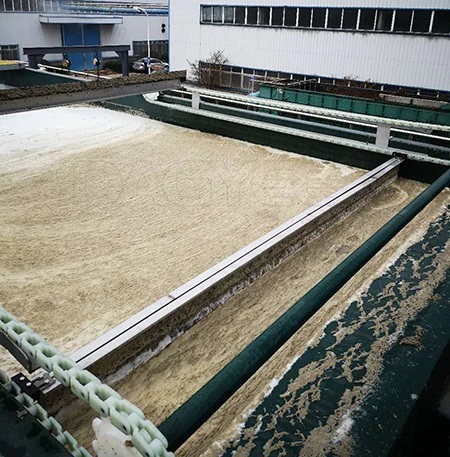
Symptoms: Sludge blanket too thick (>30cm), or sludge too wet (>97% moisture), sludge breaking up and sinking back down.
Causes: Skimmer running too infrequently, or skimmer blade set too deep.
Solutions:
• Skim when sludge blanket reaches 5-15cm thickness
• High-strength wastewater: skim 1-2 times per hour
• Normal wastewater: skim 3-4 times per hour
• Skimmer blade immersion depth ≤5cm
DAGYEE Suggestion: DAGYEE DAF units have variable frequency drive skimmers that automatically adjust speed and frequency based on sludge blanket thickness.
2. Poor Dissolved Air Performance / No Bubbles / Bubbles Too Large
The dissolved air system is the heart of any DAF unit. If it is not working right, nothing else matters.
Symptoms: Pressure gauge reads zero or fluctuates wildly, no dissolved air produced.
Causes:
• Air in the pressurization pump
• Clogged eductor or incorrect air adjustment
• Air compressor not working
Solutions:
• Stop pump and vent air. Open vent valve repeatedly until all air is out.
• Target pressure should be stable at 0.3-0.5 MPa (45-70 psi)
• Check eductor ball valve, clear any blockages
• Check air compressor power and pressure switch
DAGYEE Suggestion: DAGYEE DAF units have real-time pressure monitoring and automatic alarms. The system shuts down and alerts operators if pressure goes out of range.
Symptoms: No bubbles in some areas of the tank, or large bubbles rising in spots, uneven sludge blanket.
Causes: Release valves are the most trouble-prone part of any DAF system. Clogged or damaged valves prevent proper bubble release.
Solutions:
• Remove and inspect release valves, clean out debris
• Test monthly for flow resistance (pressure drop should be <0.02 MPa)
• Soak in 5% citric acid solution for cleaning
• Replace damaged valve components
• Replace critical membranes every quarter
DAGYEE Suggestion: DAGYEE release valves are designed to resist clogging with more release ports and better distribution. Maintenance intervals can be extended to 6 months.
Symptoms: Bubbles visibly too large (>100μm), looks like "water bubbles" instead of "milky white mist".
Causes:
• Clogged packing in the air dissolving vessel
• Incorrect recirculation ratio
• Poor quality water going to the air dissolving vessel
Solutions:
• Maintain water level at 1/2 to 2/3 of vessel height
• Adjust recirculation ratio to 20-30%
• Clean strainer on dissolved air water line (100 mesh)
• Bubble diameter should be controlled at 20-50μm
DAGYEE Suggestion: DAGYEE dissolved air systems achieve efficiency over 95%, producing stable 20-50μm bubbles that look like "milky white mist".
3. Sludge Blanket Problems
The sludge blanket is a good indicator of DAF performance. Abnormal sludge blanket means something is wrong.
Symptoms: Sludge blanket not flat across the tank, large bubbles breaking through in some areas.
Causes: Clogged release valves in some areas, or poor flow distribution causing short-circuiting.
Solutions:
• Inspect and clean release valves
• Add a pre-screen to keep debris out
• Check effluent weir leveling (deviation ≤3mm)
• Maintain water level 5-10cm below the sludge trough
DAGYEE Suggestion: DAGYEE DAF units have uniform flow distribution design. The inlet system spreads flow evenly across the tank, preventing short-circuiting and dead zones.
Symptoms: Skimmed sludge looks like slurry, flows like liquid, hard to dewater further.
Causes:
• Sludge not allowed enough time to thicken on the surface
• Skimmer blade set too deep, scooping up water
• Poor flocculation, flocs themselves are loose
Solutions:
• Optimal sludge moisture content should be 94-97%
• Increase skimming interval to allow sludge to thicken
• Adjust skimmer blade depth
• Check chemical dosing system, optimize flocculation
• Adjust VFD skimmer speed to 3-5 m/min
DAGYEE Suggestion: DAGYEE variable frequency skimmers automatically adjust frequency based on sludge blanket thickness and moisture content, keeping sludge moisture stable at around 95%.
Problem 9: Sludge Turns Black and Smells Bad
Symptoms: Skimmed sludge is dark in color with foul odor.Causes: Sludge sitting too long in the DAF tank or sludge hopper, going anaerobic.
Solutions:
• Increase skimming frequency
• Empty sludge hopper promptly
• Flush tank thoroughly before shutdown
• Check for dead zones where sludge can accumulate
DAGYEE Suggestion: DAGYEE DAF tanks have no-dead-zone design and an automatic flush system. One button flushes the entire tank before shutdown, preventing sludge buildup.
4. Quick Troubleshooting Table
| Symptom | Likely Cause | Solution | DAGYEE Feature |
|---|---|---|---|
| Cloudy effluent, high SS | Poor bubble-floc attachment | Check air efficiency, optimize chemicals, adjust pH | Online pH monitor, auto dosing |
| Cloudy effluent, high SS | Hydraulic overload | Reduce flow, add equalization | 20-30% oversizing margin |
| Cloudy effluent, high SS | Skimming too slow | Adjust skimming frequency | VFD skimmer auto adjusts |
| No bubbles or too few | Abnormal vessel pressure | Check pump, vent air, clean eductor | Pressure monitor, auto alarm |
| No bubbles or too few | Clogged release valves | Remove, clean, soak in citric acid | Anti-clog design |
| Bubbles too large | Damaged release valves | Replace valve components | Premium membranes |
| Uneven sludge blanket | Partially clogged valves | Inspect and clean release valves | Uniform flow distribution |
| Sludge too wet | Skimming too fast | Increase skimming interval | VFD skimmer auto adjusts |
| Sludge black and smelly | Sludge sitting too long | Increase skimming, flush tank | No dead zones, auto flush |
5. DAGYEE DAF Product Line
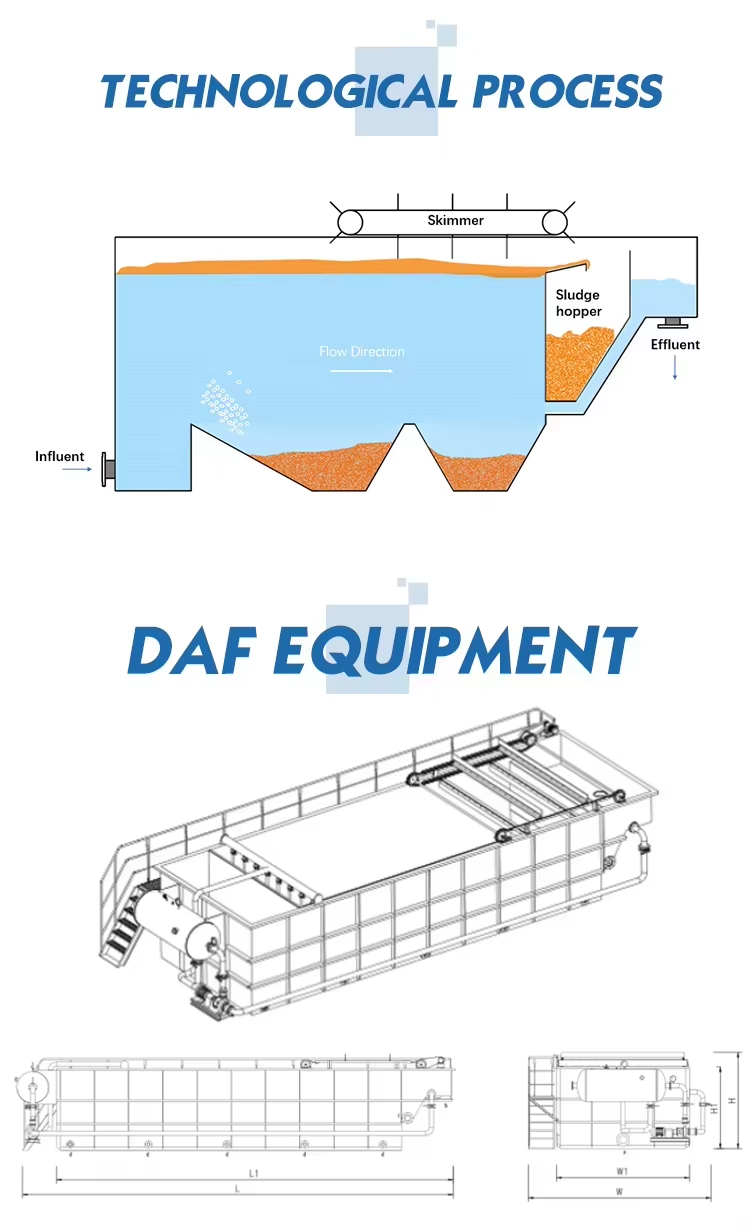
DAGYEE DAF Technical Specifications
| Model | Capacity (m³/h) | Dimensions L×W×H (m) | Total Power (kW) | Typical Applications |
|---|---|---|---|---|
| DAF-002 | 2 | 3.4×2.2×1.7 | 0.2 | Lab, pilot testing |
| DAF-003 | 3 | 3.7×2.4×1.7 | 0.2 | Small restaurant wastewater |
| DAF-005 | 5 | 4.0×2.4×1.7 | 0.2 | Small food plant |
| DAF-010 | 10 | 4.65×2.7×1.9 | 0.2 | Small slaughterhouse |
| DAF-015 | 15 | 5.6×2.9×2.0 | 0.2 | Small to medium food plant |
| DAF-020 | 20 | 5.9×3.2×2.0 | 0.2 | Medium slaughterhouse |
| DAF-030 | 30 | 6.8×3.2×2.2 | 0.4 | Medium food/chemical plant |
| DAF-040 | 40 | 8.0×3.6×2.2 | 0.4 | Paper mill, textile |
| DAF-050 | 50 | 8.4×3.6×2.2 | 0.4 | Large food/chemical plant |
| DAF-060 | 60 | 9.9×3.8×2.4 | 0.4 | Large slaughterhouse/paper |
| DAF-070 | 70 | 10.4×3.8×2.4 | 0.4 | Petrochemical, refinery |
| DAF-080 | 80 | 10.8×4.0×2.4 | 0.4 | Large industrial |
| DAF-100 | 100 | 12.1×4.2×2.4 | 0.4 | Municipal wastewater |
| DAF-120 | 120 | 12.5×4.4×2.4 | 0.4 | Municipal / large industrial |
Selection Guide by Wastewater Type
| Wastewater Type | Recommended Model | Notes |
|---|---|---|
| Oily (food, slaughterhouse) | DAF-030 or larger | Add efficient skimming system |
| Paper mill white water | DAF-040 or larger | Can add Lamella Plates for fiber recovery |
| Textile dyeing | DAF-040 or larger | Use with decolorizing chemicals |
| Petrochemical oily water | DAF-050 or larger | Recommend enclosed design |
| Municipal sewage | DAF-080 or larger / multiple units | Multiple units for redundancy |
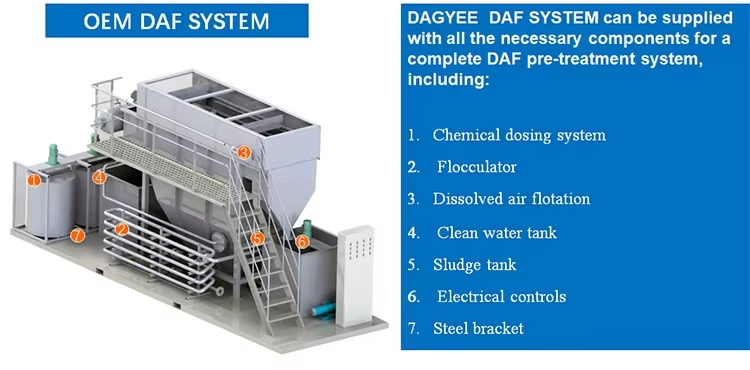
| Feature | Standard | Optional |
|---|---|---|
| Dissolved air system | High-efficiency air dissolving vessel | Nano bubble generator |
| Release valves | Anti-clog design | High-precision release valves |
| Skimmer | VFD controlled | Dual skimmer blades |
| Controls | PLC + HMI touchscreen | Remote monitoring module |
| Dosing system | Manual | Automatic with online sensors |
| Material | Carbon steel with epoxy coating | SS304 / SS316L |
6. Daily Maintenance Checklist
Good maintenance prevents 80% of DAF problems.
| Task | Frequency | Action |
|---|---|---|
| Check air dissolving vessel pressure | Daily | Ensure stable at 0.3-0.5 MPa |
| Observe bubble quality | Daily | Should look like "milky white mist" |
| Check sludge blanket thickness | Daily | Maintain at 5-15cm |
| Check dosing pumps | Daily | Confirm proper chemical feed |
| Clean release valves | Weekly | Remove, inspect, clean |
| Lubricate skimmer drive | Weekly | Apply lubricant |
| Calibrate online instruments | Monthly | pH meter, flow meter |
| Full dissolved air system inspection | Quarterly | Performance test, replace worn parts |
7. Final Advice
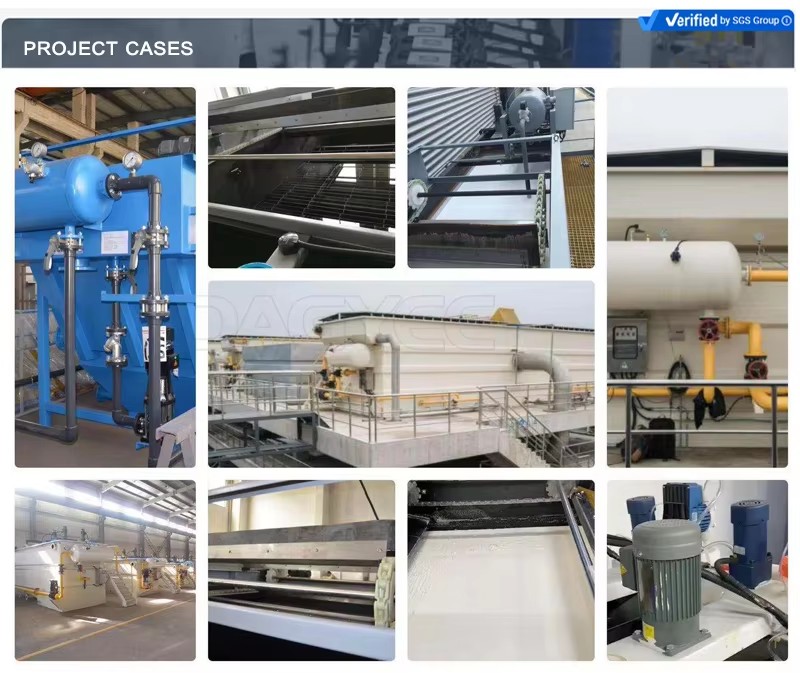
Based on DAGYEE's experience across hundreds of installations, here are a few recommendations:
First, keep an operating log. Record influent quality, chemical dosages, dissolved air pressure, effluent quality every day. Data is your best diagnostic tool.
Second, do preventive maintenance. Do not wait for something to break. Clean release valves regularly. Replace wear parts on schedule. Spending a little on maintenance saves a lot on repairs.
Third, train your operators. A DAF unit is not a "push start and forget" machine. Operators need to understand the principles, recognize symptoms, and handle common problems. A half hour of training can save thousands in repair costs.
Fourth, fix small problems early. DAF problems tend to get worse over time. A slightly larger bubble today. A slightly clogged release valve next week. A completely failed system next month. Catch it early.
DAGYEE offers free technical consultations and site inspections. Tell us your model, operating conditions, and symptoms. We will help you diagnose the problem and recommend solutions.