DAF System Troubleshooting: Common Problems and How to Fix Them
Dissolved air flotation: A Practical Guide for Plant OperatorsAsk any plant operator about DAF and you'll get one of two answers. Either it runs great and they don't worry about it. Or it's been a headache from day one.
The difference usually comes down to one thing. Knowing how the equipment actually works.
This guide covers the practical side of DAF. What you need to know to keep a system running right. Based on what I've seen work in real facilities.
What DAF Actually Does
DAF removes solids from water by attaching them to tiny bubbles. Those bubbles rise fast and carry the solids to the surface, where a scraper pushes the sludge off.
It works best on stuff that doesn't settle well. Fine particles. Oil droplets. Algae. Light flocs that take forever to sink in a clarifier.
The key is bubble size. Big bubbles don't attach well. Too small and they rise too slow to be useful. The sweet spot is around 30 to 80 microns.
What makes DAF different from aeration? In aeration, you're just blowing air through water. Big bubbles form and most just pop at the surface. In DAF, you dissolve air into water under pressure, then release it. The bubbles that form are tiny and uniform. That's why DAF works better for solids removal.
I've seen people try to replace DAF with simple aeration. It never works well. The bubble size is all wrong and the results are disappointing.
How It Works
Here's the sequence.
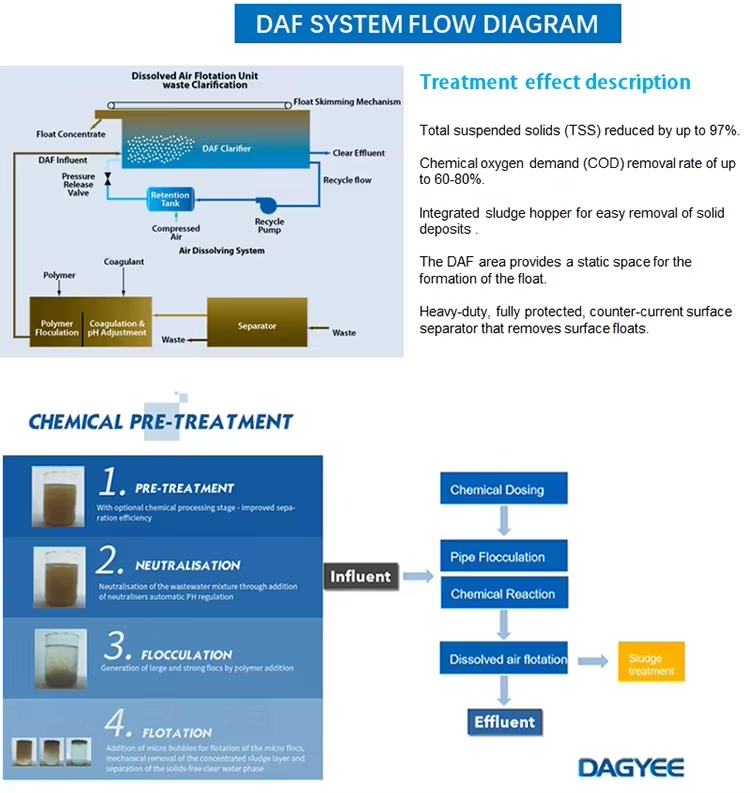
Water gets pressurized and mixed with air. Most systems run at 4 to 6 bar. At that pressure, water holds much more air than normal.
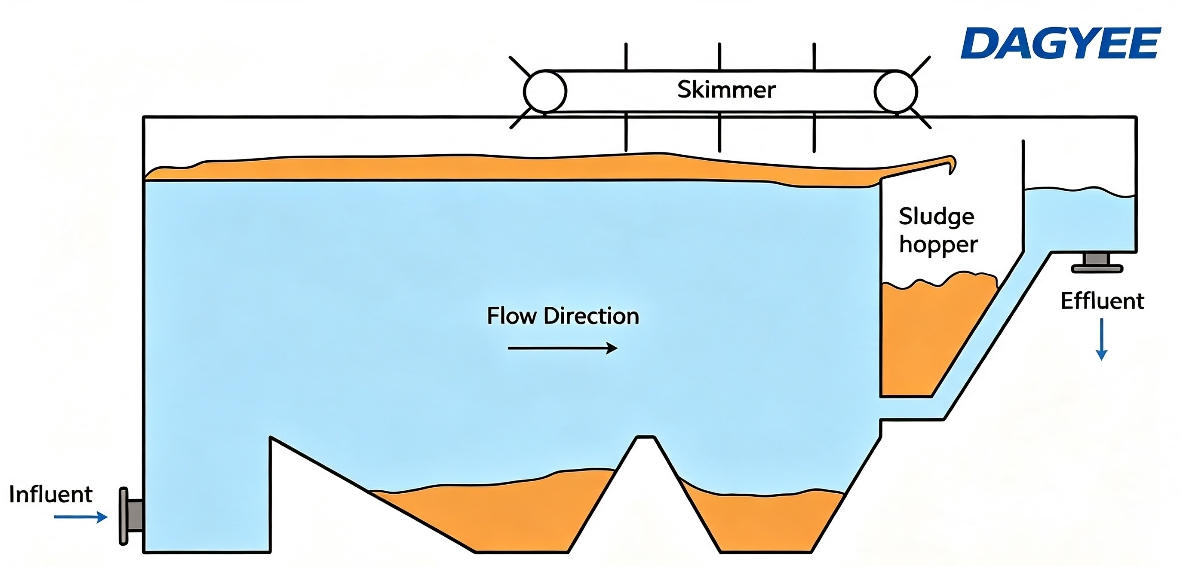
That pressurized water goes through a release valve and pressure drops suddenly. Air comes out of solution instantly. Forms bubbles. Very small ones.
Those bubbles rise through the tank. They hit particles. Particles stick to bubbles. Bubbles carry particles to the surface.
The surface builds up a sludge layer. A scraper pushes it into a trough. Clean water exits from the bottom.
Simple in theory. But lots can go wrong in practice.
What happens if the pressure is too low? You don't get enough dissolved air. The bubbles that form are bigger and fewer. Solids removal drops. What happens if the pressure is too high? Bubbles form but they're so small they rise too slowly. You waste energy and the bubbles don't carry solids efficiently.
The whole system is about balance. Pressure, flow, bubble size, contact time. Change one thing and everything else shifts.
The Four Main Components
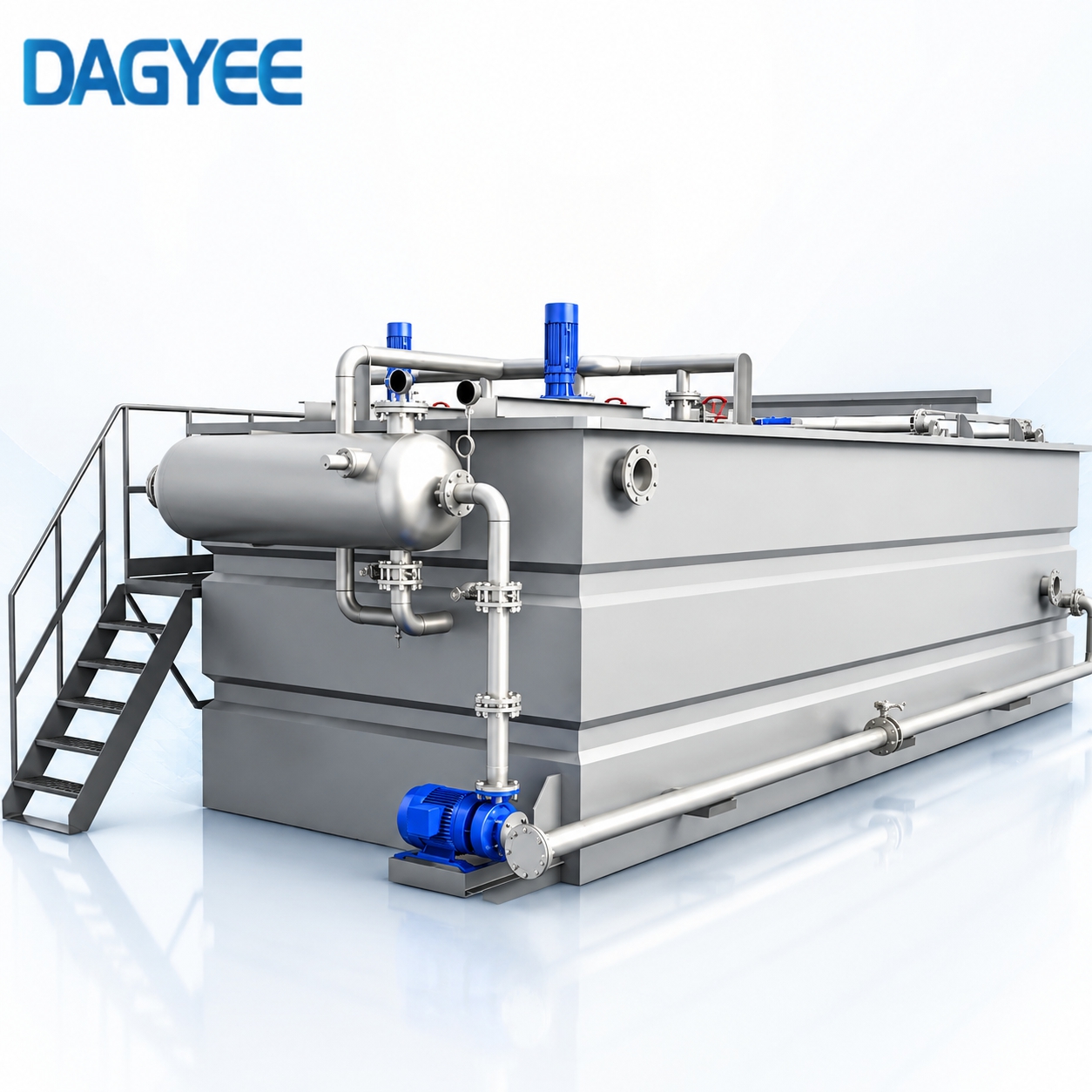
A DAF system has four parts that matter.
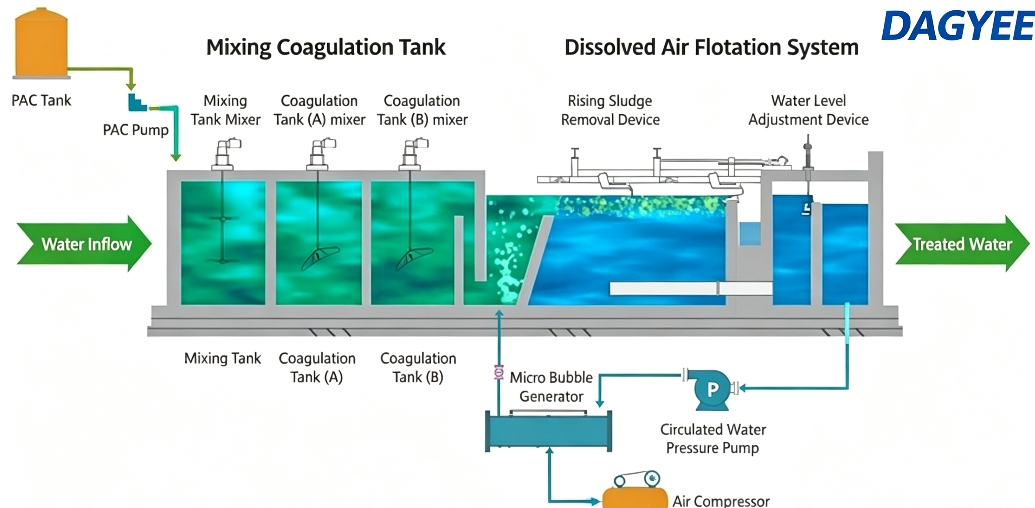
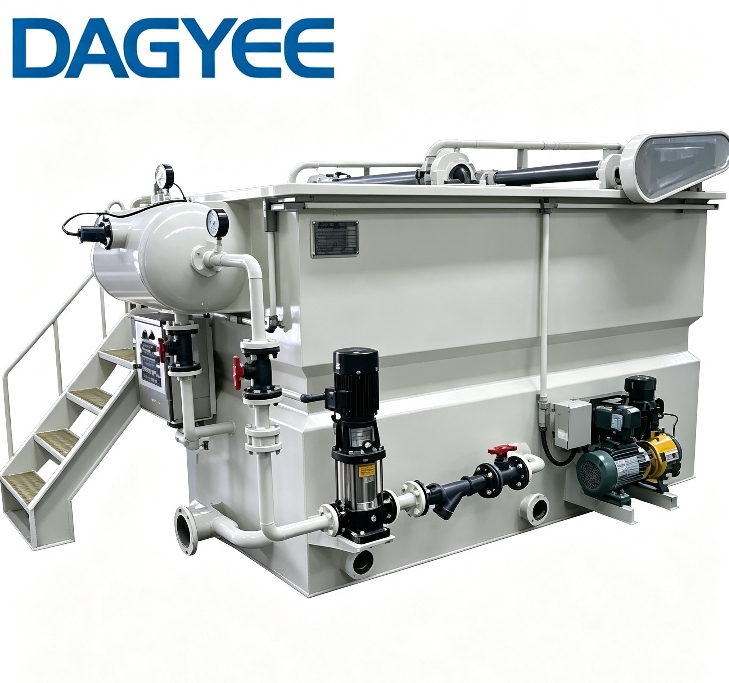
The dissolution system. This pressurizes water and mixes in air. Includes a tank, pump, and compressor. The tank needs enough volume for 2 to 5 minutes of residence time. The compressor should be oil-free. Oil in the water ruins bubble formation and fouls the release device.
The release device. This makes the bubbles. The design determines how small they get. Jet-type works best for most wastewater. It produces smaller bubbles, distributes them evenly, and clogs less. When the release device clogs, bubble size increases and performance drops. Check it first when things go wrong.
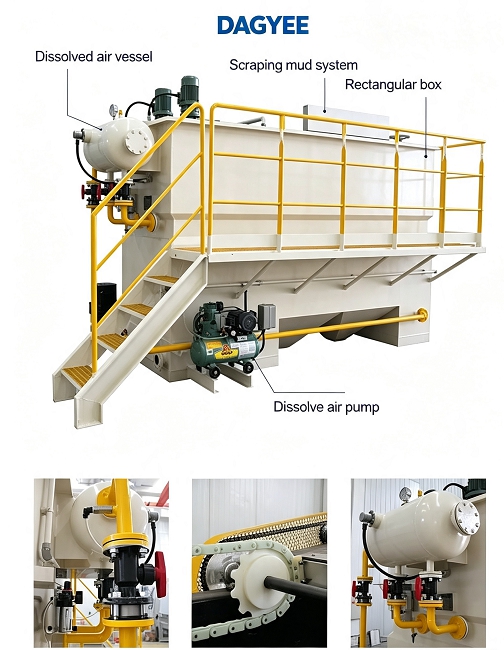
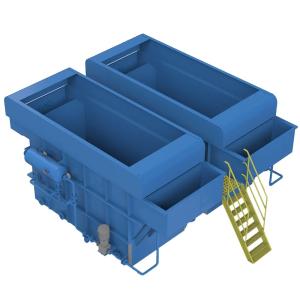
The flotation tank. Where separation happens. If water flows too fast, bubbles don't have time to rise. Too slow and you waste tank volume. Inlet baffles distribute flow evenly. Without them, water short-circuits through part of the tank and the rest is wasted. The tank depth also matters. Deeper tanks give bubbles more time to rise, but they cost more to build and take up more space.
The auxiliary systems. Chemical dosing, sludge removal, and controls all matter. Dosing is where many mistakes happen. Too little coagulant and particles don't stick. Too much and you waste chemical and generate extra sludge. Sludge removal timing matters. Scrape too fast and sludge breaks up. Too slow and it accumulates and sinks. Good controls make a huge difference. A DAF with decent controls runs with minimal attention. Poor controls need constant adjustment.
DAF Series Specifications
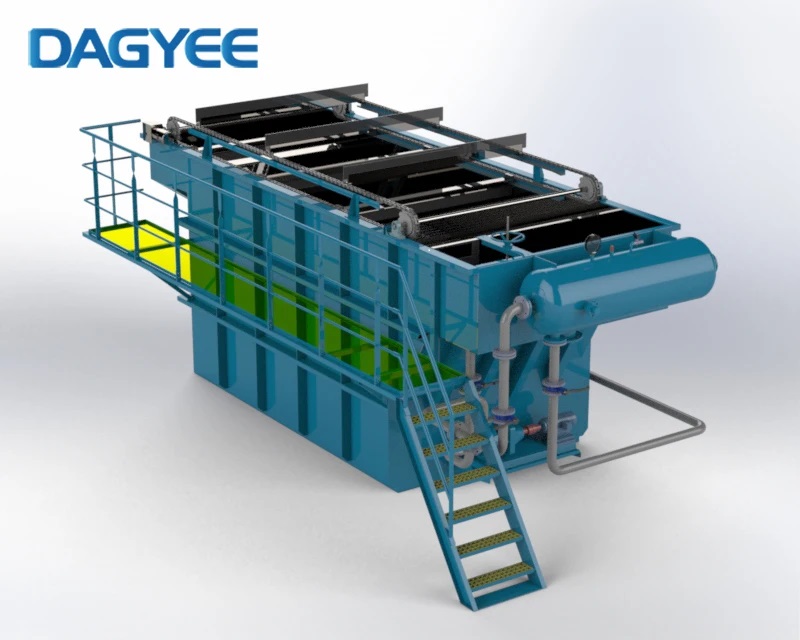
Dissolved air flotation equipment standard models
| Model | Qmax (m³/h) | Piping Connections (DN) | Physical Dimensions (m) | ||||||||
|---|---|---|---|---|---|---|---|---|---|---|---|
| Inlet | Outlet | Sludge | Vent | L | L1 | W | W1 | H | H1 | ||
| DAF-002 | 2 | 50 | 50 | 100 | 100 | 3.4 | 2.5 | 3.4 | 1.2 | 2.2 | 1.7 |
| DAF-003 | 3 | 50 | 50 | 100 | 100 | 3.7 | 2.8 | 2.4 | 1.2 | 2.2 | 1.7 |
| DAF-005 | 5 | 80 | 80 | 100 | 100 | 4.0 | 3.0 | 2.4 | 1.2 | 2.2 | 1.7 |
| DAF-010 | 10 | 100 | 100 | 100 | 100 | 4.6 | 3.8 | 2.7 | 1.4 | 2.4 | 1.9 |
| DAF-015 | 15 | 125 | 100 | 150 | 100 | 5.6 | 4.5 | 2.9 | 1.7 | 2.5 | 2.0 |
| DAF-020 | 20 | 150 | 150 | 150 | 100 | 5.9 | 4.8 | 3.2 | 2.0 | 2.5 | 2.0 |
| DAF-030 | 30 | 150 | 150 | 150 | 100 | 6.8 | 5.5 | 3.2 | 2.2 | 2.7 | 2.2 |
| DAF-040 | 40 | 200 | 150 | 150 | 100 | 8.0 | 6.7 | 3.6 | 2.6 | 2.7 | 2.2 |
| DAF-050 | 50 | 200 | 150 | 150 | 100 | 8.4 | 7.0 | 3.6 | 2.6 | 2.7 | 2.2 |
| DAF-060 | 60 | 250 | 200 | 150 | 100 | 9.9 | 8.4 | 3.8 | 2.8 | 2.9 | 2.4 |
| DAF-070 | 70 | 250 | 200 | 150 | 100 | 10.5 | 9.0 | 3.8 | 2.8 | 2.9 | 2.4 |
| DAF-080 | 80 | 250 | 250 | 150 | 100 | 12.0 | 10.5 | 4.0 | 3.0 | 2.9 | 2.4 |
| DAF-100 | 100 | 300 | 250 | 150 | 100 | 12.0 | 10.5 | 4.2 | 3.2 | 2.9 | 2.4 |
| DAF-120 | 120 | 300 | 250 | 150 | 100 | 12.5 | 11.4 | 4.4 | 3.4 | 2.9 | 2.4 |
Selection Tip: Choose the model based on your peak flow rate. Allow 10-20% margin for fluctuations. Confirm physical dimensions against your installation space. Contact DAGYEE for custom configurations.
Common Mistakes
I see these mistakes repeatedly.Skipping chemicals. Some think DAF is purely physical. For most wastewater, that's wrong. Fine particles won't stick to bubbles without help. PAC and PAM are usually needed. Adding the right chemicals can double your removal efficiency.
Setting parameters once and walking away. Wastewater changes. Temperature changes. Flow changes. Last month's settings might not work this month. Regular jar tests are cheap insurance. I've seen plants run for months with the wrong settings, wondering why performance keeps dropping.
Buying too big. Bigger isn't better. Oversized units waste energy, cost more, and often perform worse. Size for your actual flow plus some margin. But not too much. A DAF that's too big operates inefficiently at low flow. The bubbles don't mix properly. The sludge doesn't consolidate well.
Ignoring the release device. This is the most overlooked cause of poor performance. When it starts to clog, bubble size increases. Operators often don't notice until effluent quality drops. Regular inspection is essential. Some plants schedule cleaning every month. Others wait until they see problems. The proactive approach works better.
Ignoring pH. DAF performance depends on pH, especially with metal coagulants. If pH drifts out of range, removal efficiency suffers. A simple pH meter and a little attention can prevent a lot of problems.
Not checking pressure. Dissolution pressure directly affects bubble size. Pressure drops mean bigger, less effective bubbles. Spikes mean bubbles get too small and rise too slow. Good pressure gauges and regular readings prevent surprises.
Using the wrong chemical. Not all coagulants and flocculants work the same. The polymer that works for one wastewater may not work for another. Testing is part of the job. I've seen plants spend too much on the wrong polymer, getting worse results for more money.
Underestimating maintenance. DAF equipment needs regular attention. Pumps need checking. Compressors need oil changes. Release devices need cleaning. Scrapers need adjustments. Plan for it or the equipment will plan downtime for you.
Performance and Application Guidelines
What results can you realistically get? The numbers depend on your wastewater and chemical program.
Expected removal efficiency based on chemical program
| Parameter | Without Chemicals | With Coagulant | With Coagulant + Flocculant |
|---|---|---|---|
| Oil & Grease Removal | 30-50% | 60-75% | 80-95% |
| Suspended Solids Removal | 50-70% | 70-85% | 85-95% |
| COD Removal | 20-35% | 40-60% | 50-75% |
Note: Chemical addition significantly improves removal efficiency. PAC at 50-200 mg/L and PAM at 1-5 mg/L are typical starting points. Jar tests are recommended to find the optimal dose for your wastewater.
Also remember that removal efficiency isn't the only metric. Operating cost matters too. Chemical consumption, energy use, maintenance labor all add up. A system removing 95% but costing a fortune isn't necessarily better than one removing 90% at half the cost.
Application Selection Guide
Recommended models and key considerations by application
| Application | Typical Flow Range | Recommended Model | Key Consideration |
|---|---|---|---|
| Small industrial pretreatment | 2-10 m³/h | DAF-002 to DAF-010 | Compact footprint, simple operation |
| Food processing wastewater | 10-30 m³/h | DAF-015 to DAF-030 | High oil/grease removal required |
| Municipal wastewater | 30-60 m³/h | DAF-030 to DAF-060 | Consistent performance at variable flow |
| Large industrial facilities | 60-120 m³/h | DAF-060 to DAF-120 | Heavy-duty construction, corrosion resistance |
Selection Tip: Match your average and peak flow rates to the model range. Consider future expansion when selecting capacity. Contact DAGYEE for application-specific sizing.
When to Use DAF
DAF isn't right for every situation.DAF makes sense when: your wastewater has fine particles that won't settle, the solids are lighter than water, you need to remove emulsions, you have limited space, or flow rates vary.
DAF may not be the best choice when: your wastewater has mostly heavy settleable solids, the solids concentration is extremely high, or power costs are very high where you are.
Many assume DAF is always right when solids are "hard to settle." That's not true either. If solids are heavy but fine, a high-rate clarifier with plate settlers might work. If solids are oily, DAF is usually better.
Match the equipment to the problem. A plate clarifier might be cheaper, but if it can't meet discharge requirements, the upfront savings don't matter. If a clarifier can meet requirements, why pay for a DAF?
Consider the whole picture. Capital cost. Operating cost. Maintenance requirements. Space availability. Effluent quality targets. All of these matter. The cheapest option upfront might be the most expensive over time.
Troubleshooting Common Issues
Common problems, causes, and quick fixes
| Problem | Likely Cause | What to Check | Fix |
|---|---|---|---|
| Poor solids removal | Bubble size too large | Release device, pressure | Clean release device, adjust pressure |
| Cloudy effluent | Insufficient coagulant | Jar test results | Increase dose or switch chemical |
| No sludge layer | Not enough dissolved air | Pressure, air supply | Increase pressure, check compressor |
| Scum layer too watery | Scraper speed too fast | Scraper drive speed | Reduce scraper speed |
| High energy use | Excessive recycle ratio | Actual recycle flow | Reduce pump speed or trim impeller |
| Frequent clogs | Insufficient upstream screening | Inlet screens | Install or upgrade screening |
| Inconsistent performance | Pressure fluctuations | Control system, regulators | Calibrate or replace components |
Tip: When troubleshooting, check one thing at a time. Start with pressure, then the release device, then chemical dosing. Most problems trace back to one of these three.
A Few More Thoughts
The release device deserves special attention. It's small, simple, and easy to ignore. But it's the heart of the DAF system. When it clogs, bubble size increases and performance drops. When it works right, everything else falls into place.Some operators treat the release device like it's maintenance-free. It's not. It needs regular inspection and cleaning. Schedule it monthly at minimum. If you're treating wastewater with a lot of solids, schedule it weekly.
The coagulant dosing system is another area that gets neglected. Pumps wear out. Calibration drifts. Lines clog. When dosing is off, floc formation suffers and removal efficiency drops. Check dosing pumps regularly. Calibrate them weekly. Clean lines monthly.
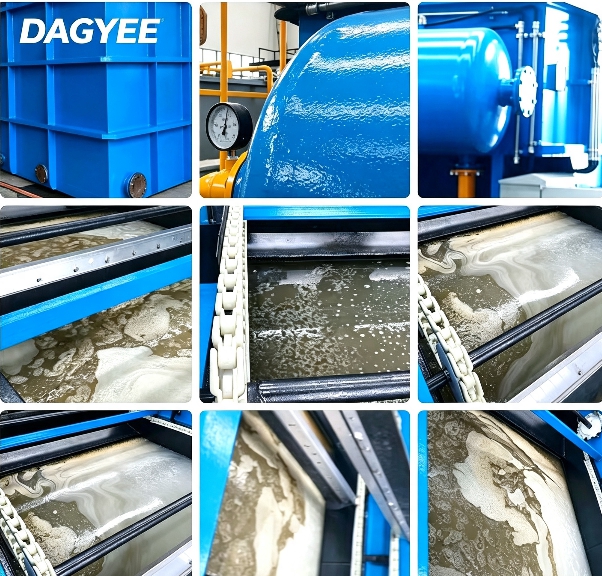
The scraper system seems simple. It's just a chain and some paddles. But if the speed is wrong, the sludge doesn't get removed properly. Too fast and the sludge breaks up. Too slow and it accumulates. Set the speed based on sludge consistency, not on a fixed schedule.
Finally, the control system. It's easy to ignore if it's working. But when it fails, nothing works right. Keep the control panel clean. Check sensors and probes regularly. Calibrate pressure gauges and flow meters. A small investment in control system maintenance prevents major failures.
Final Thoughts
DAF is a proven technology when set up right. But it's not plug-and-play. Success takes understanding your wastewater, setting up equipment properly, and doing regular maintenance.
Once a DAF is running right, it tends to stay that way. Problems usually show as gradual performance drifts, giving you time to correct them.
Catch the drift early. Regular jar tests, routine inspections, and monitoring influent and effluent quality are your best tools.
When problems do occur, don't change everything at once. Check one thing at a time. Pressure first. Then the release device. Then chemical dosing. Most problems trace back to one of those three.
DAGYEE — DAF Systems for Water Treatment