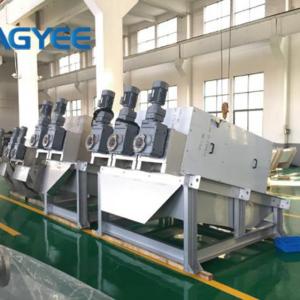

Screw Press Sludge Dewatering: Complete Guide for Plant Operators & Engineers
Screw Press Sludge Dewatering: Complete Guide to
Working Principle, Technical Specs, Applications & Benefits
In municipal and industrial
wastewater treatment, sludge dewatering is the key step that makes reduction,
safe disposal, and resource recovery possible. Traditional dewatering equipment
often struggles with high energy consumption, frequent clogging, complicated
operation, and inconsistent results. The screw press (volute) dewatering
machine offers a different approach — low energy use, reliable anti-clogging
performance, fully automatic operation, and broad adaptability across sludge
types.
This guide covers how it works,
what's inside, real-world performance data, selection parameters, maintenance
know-how, and how it stacks up against conventional options. Whether you're an
operator, engineer, or plant manager, this is a practical reference to help you
get the most out of your dewatering process.
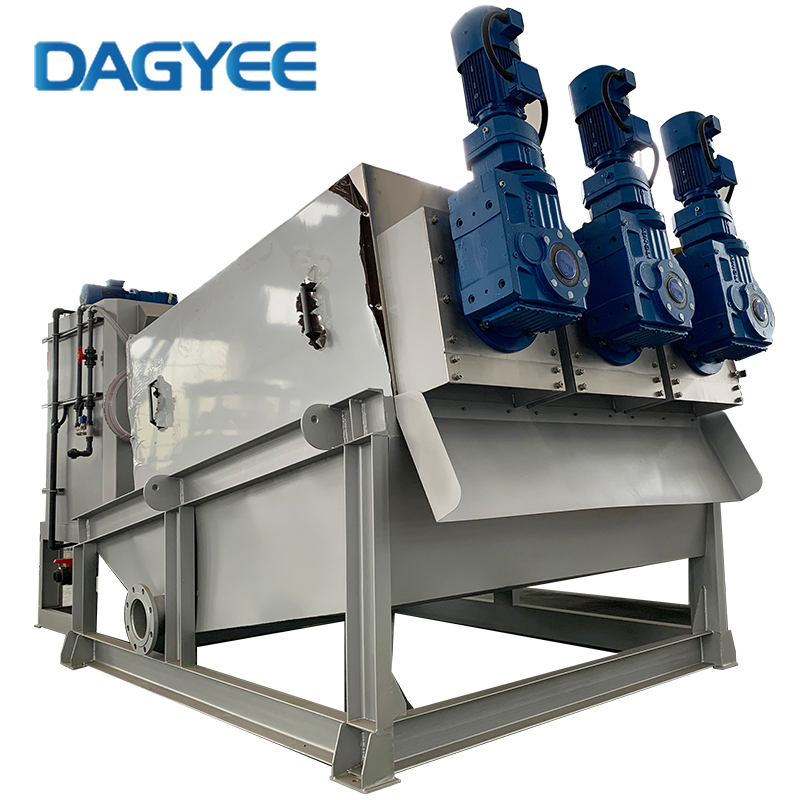
1. How It Works: Core Principles
and Structural Design
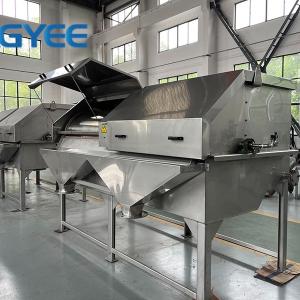
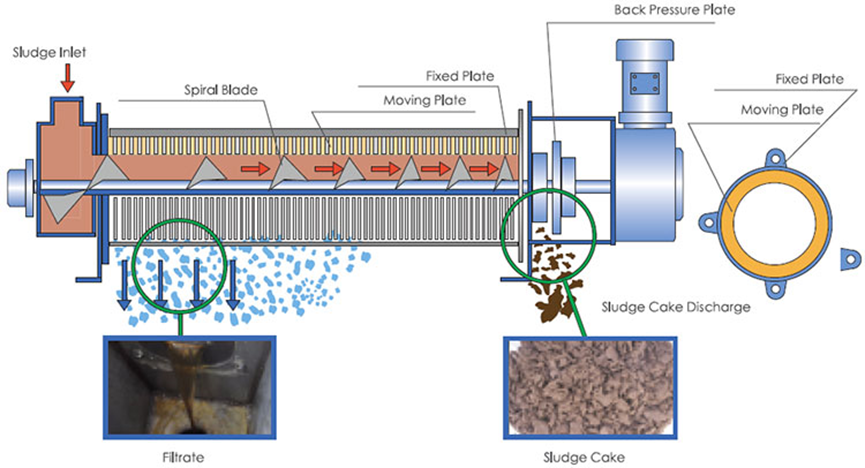
The screw press dewatering machine
(also called volute or double-screw dewatering press) is a solid-liquid
separation device built around spiral compression. Its key innovation lies in
its structure — no filter cloth, no conventional screens, so it doesn't clog
the way traditional equipment does. It handles both thickening and dewatering
in a single pass.
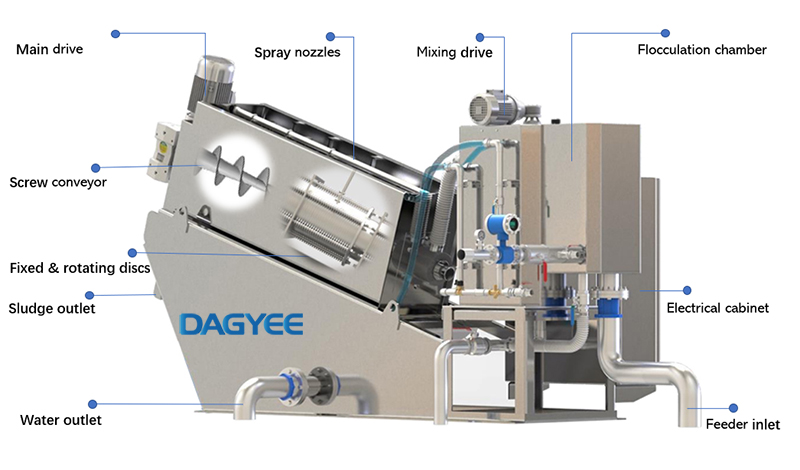
1.1 Major Components
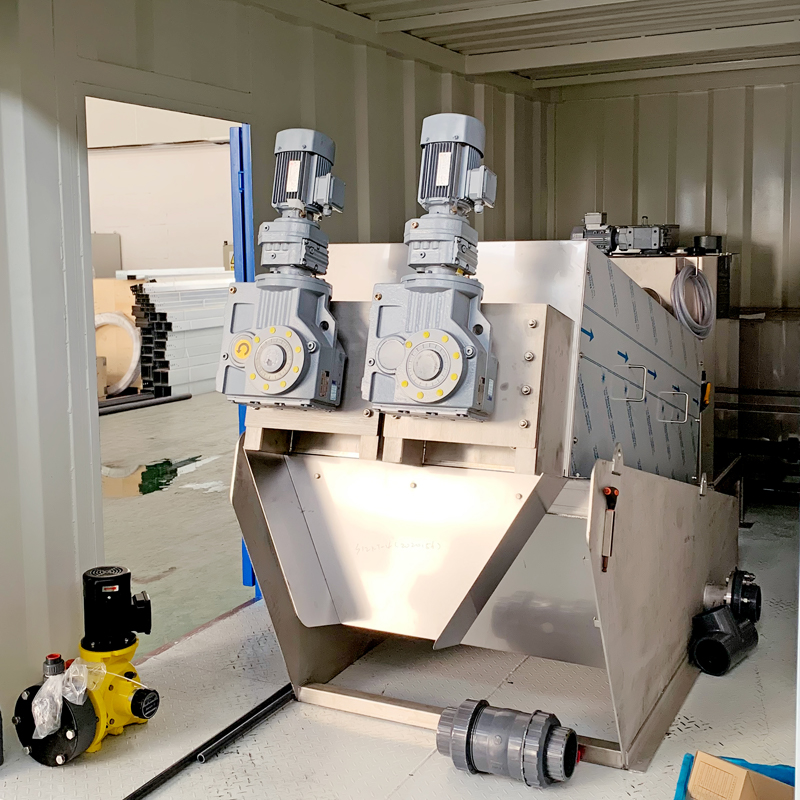
The machine has a compact,
integrated design. Four main assemblies do the heavy lifting:
Screw Shaft —
The driving force. Its diameter increases and pitch decreases from feed end to
discharge end, gradually building pressure as sludge moves forward. The shaft
surface is hardened and corrosion-protected for long service life.
Stacked Plate Assembly (Dynamic +
Static Rings) — Alternating
fixed and moving rings form tiny gaps (0.5–1.0 mm) that act as filtration
channels. The moving rings rotate with the shaft, creating a continuous
self-cleaning action — no separate rinsing system required.
Drive System —
Motor, reducer, and bearings running at low speed (typically 0.25–1 rpm). This
keeps energy consumption and noise down, and avoids shearing sludge particles.
Back Pressure Plate —
Located at the discharge end, it creates resistance to control cake dryness.
Adjustable pressure means you can fine-tune final moisture content.
1.2 The Three-Stage Process
Concentration —
Sludge enters the feed zone. Free water drains through the ring gaps by
gravity. No polymer needed at this stage — just simple, low-cost volume
reduction.
Dewatering —
Concentrated sludge moves into the compression zone. As the shaft pitch
decreases and diameter increases, pressure builds. Water is squeezed out
through the ring gaps, and a firm cake forms at the discharge end.
Self-Cleaning —
As the shaft rotates, the moving rings rub against the fixed rings, scraping
away any trapped solids. This continuous cleaning action keeps the gaps open —
no clogging, no downtime for manual cleaning, minimal wash water usage.
2. DAGYEE DL Series — Technical
Specifications at a Glance
Choosing the right model starts
with understanding your sludge concentration and required throughput. The table
below summarizes DAGYEE's standard DL Series parameters for quick reference.
DAGYEE DL Series · Technical Specifications
Screw press sludge dewatering equipment — model selection and parameter reference
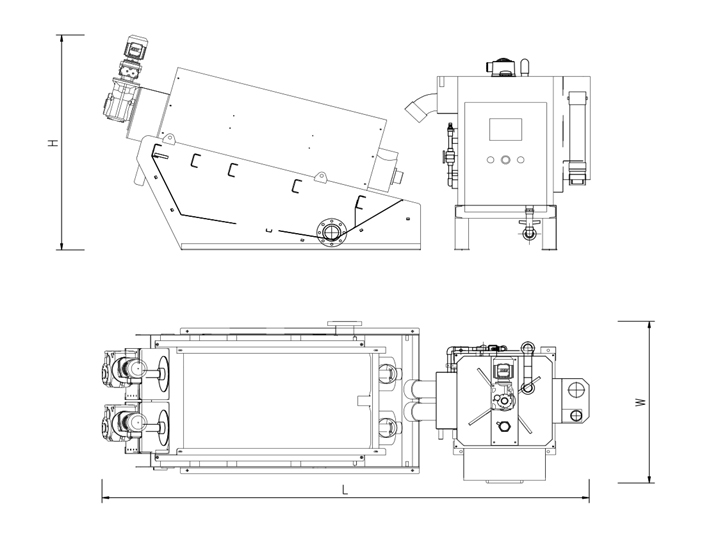
| Model | DS Capacity (kg/h) | Hydraulic Capacity (m³/h) at Different Feed Concentrations | Dimensions L×W×H (mm) | Power (kW) | ||||||
|---|---|---|---|---|---|---|---|---|---|---|
| Min | Max | 2 g/L | 5 g/L | 10 g/L | 20 g/L | 25 g/L | 50 g/L | |||
| DL101 | 3 | 5 | 1.5 | 0.6 | 0.5 | 0.25 | 0.2 | 0.1 | 1816×756×1040 | 0.2 |
| DL131 | 6 | 10 | 3 | 1.2 | 1 | 0.5 | 0.4 | 0.2 | 1969×756×1040 | 0.36 |
| DL132 | 12 | 20 | 6 | 2.4 | 2 | 1 | 0.8 | 0.4 | 2069×910×1040 | 0.62 |
| DL202 | 18 | 30 | 9 | 3.6 | 3 | 1.5 | 1.2 | 0.6 | 2500×935×1270 | 1.11 |
| DL301 | 30 | 50 | 15 | 6 | 5 | 2.5 | 2 | 1 | 3255×985×1600 | 0.74 |
| DL302 | 60 | 100 | 30 | 12 | 10 | 5 | 4 | 2 | 3455×1295×1600 | 1.11 |
| DL303 | 90 | 150 | 45 | 18 | 15 | 7.5 | 6 | 3 | 3605×1690×1600 | 1.86 |
| DL352 | 120 | 200 | 60 | 24 | 20 | 10 | 8 | 4 | 4240×1550×2190 | 3.75 |
| DL353 | 180 | 300 | 90 | 36 | 30 | 15 | 12 | 6 | 4460×2100×2190 | 6 |
| DL402 | 120 | 200 | 60 | 24 | 20 | 10 | 8 | 4 | 4140×1550×2250 | 3.75 |
| DL403 | 180 | 300 | 90 | 36 | 30 | 15 | 12 | 6 | 4420×2100×2250 | 6 |
3. Where DAGYEE Engineering Makes
the Difference
Not all screw presses are built the same. Here's a closer look at five critical components — and why DAGYEE's approach delivers longer life and fewer headaches.
DAGYEE Screw Press · Key Components
Five critical components — engineered for reliability and long service life
| Component | Function | Typical Failure Mode | DAGYEE Advantage |
|---|---|---|---|
| Screw Shaft | Generates pressure, conveys sludge | Abrasion from grit; corrosion from chemicals | 316L stainless steel + optional tungsten carbide hard facing for severe abrasive duty |
| Stacked Rings | Filter channels for liquid-solid separation | Blinding from solids buildup; mechanical wear | Precision-ground rings with self-wiping action; extended service intervals |
| Gearbox | Drives shaft rotation | Oil starvation or seal failure leading to breakdown | Planetary design with sight glass for quick oil checks; reliable and easy to monitor |
| Spray System | Keeps rings clean | Nozzle blockages or pipe leaks | Self-cleaning nozzles on an automatic timer — uses less water |
| Seals | Prevents leakage at shaft ends | Aging leads to leaks and internal corrosion | Double mechanical seals with replaceable cartridges — fast, tool-free service |
4. Maintenance That Actually Works
Good maintenance doesn't have to be
complicated. Here's a straightforward routine that keeps the machine running
smoothly with minimal fuss.
Daily (5 minutes)
-
Check
bolts, oil level, and spray nozzles before start
-
Monitor
feed stability, filtrate clarity, and cake quality during operation
-
Run
spray cycle and log data after shutdown
Weekly (1-2 hours)
-
Retorque
bolts and clean spray nozzles
-
Check
gearbox oil and inspect ring stack for wear
Monthly (half day)
-
Examine
screw flights for wear; replace shaft seals proactively
-
Change
gearbox oil and calibrate sensors
Yearly (1-2 days)
-
Full
teardown inspection of all components
-
Replace
all high-wear items at once
- Re-align shaft and run load test
5. Real-World Results: Two Case
Studies
Case 1: Municipal WWTP — 30-Day
Trial
A municipal plant treating domestic
sewage needed a better solution for digested sludge (97.9% moisture) and
waste-activated sludge (99.7% moisture). Their belt press consumed too much
power, clogged constantly, and produced wet cake.
Test setup: DL-202
screw press (2.2 kW, 0.3–0.75 rpm). Optimized polymer dosage and speed via
orthogonal testing.
Outcome:
Municipal WWTP Trial Results
30-day test run — digested sludge and waste-activated sludge
| Sludge Type | Feed Moisture | Cake Moisture | Key Result |
|---|---|---|---|
| Digested | 97.9% | 70.3% | Met disposal standards |
| Waste-Activated | 99.7% | 82.5% | Met disposal standards |
Key Takeaways:
• Energy use dropped to roughly half of the belt press.
• No clogging occurred during the entire trial.
• The machine ran 24/7 with minimal attention — a clear win on both operating cost and labor.
Case 2: Large Water Plant — Sandy
Sludge Challenge
A Shanghai water plant (200,000
m³/day capacity) generated sludge water at 97.5% moisture. The existing belt
presses wore out quickly due to high sand content, required constant operator
attention, and had high running costs.
Upgrade: Four
DL-301 units (10 m³/h each) in a high-efficiency thickening + screw press
configuration.
Large Water Plant · Results
Shanghai water plant — screw press upgrade performance
| Metric | Value |
|---|---|
| Cake Moisture | ≤75% |
| Volume Reduction | ≥90% |
| Operating Cost | 0.17 RMB/m³ |
| Annual Savings | ~120,000 RMB vs. belt presses |
Key Takeaways:
• Took up one-third the floor space of the old system
• Ran automatically without dedicated operators
• Handled abrasive sandy sludge with only annual ring replacement
• Stable performance, lower cost, less hassle
6. Screw Press vs. Traditional Equipment: Side-by-Side Comparison
Screw Press vs. Traditional Dewatering Equipment
Side-by-side comparison of key performance metrics
| Equipment Type | Cake Moisture | Energy Use (kWh/m³) | Clogging Issue | Automation | Space | Best Fit |
|---|---|---|---|---|---|---|
| Screw Press | 65–82% | 0.4–0.6 | None (self-cleaning) | Fully automatic | Very compact | WWTP, water plants, chemical, food, oily/sticky/sandy sludge |
| Belt filter press | 75–85% | 0.8–1.2 | Frequent | Semi-auto | Large | Clean, high-solid sludge |
| Plate & Frame Press | 60–75% | 1.0–1.5 | Frequent | Manual | Medium-Large | High-viscosity, batch jobs |
| Centrifuge | 70–80% | 1.2–1.8 | Frequent | Fully auto | Medium-Large | High-volume municipal sludge |
7. Why DAGYEE?
Engineered for reliability — backed by service
| Feature | What DAGYEE Delivers |
|---|---|
| Materials | Full 316L stainless on all wetted parts — shaft, rings, and housings |
| Wear Protection | Tungsten carbide surfacing option for severe abrasive service |
| Quality | CE certified, 100% factory-tested |
| Spare Parts | Ready stock of genuine components — fast shipping |
| Support | Remote diagnostics plus on-site service; multilingual team |
| Customization | Built to your sludge profile, not a generic spec |
8.
Final Thoughts
The
screw press dewatering machine has changed how many facilities approach sludge
treatment. Its self-cleaning design, low energy draw, automatic operation, and
wide material compatibility solve the problems that make traditional equipment
frustrating and expensive to run.
Whether
you're upgrading an old system, expanding capacity, or building a new plant,
DAGYEE screw presses offer a reliable, cost-effective path to better dewatering
— with less maintenance, less downtime, and fewer surprises.
Need
a solution tailored to your sludge?
Contact DAGYEE for engineering support, custom sizing, and performance data specific to your application.
DAGYEE
— Sludge Dewatering. Simplified.
Related News